HACCP & ISO 22000 Certified Saffron Manufacturer: Food Safety Standards at Golpeech
Introduction
In today’s global food industry, buyers expect more than a premium product—they expect confidence in every stage of production. For saffron importers, wholesalers, retailers, and private label brands, choosing a supplier is no longer based solely on color, aroma, or price. Increasingly, purchasing decisions are influenced by how well a manufacturer manages food safety, quality assurance, and operational consistency.
International food supply chains involve multiple handling, processing, and transportation stages. Without a structured food safety management system, the risk of contamination, improper handling, or inconsistent production increases. As regulatory requirements continue to evolve across many markets, certified food safety systems have become an important benchmark for evaluating suppliers.
Two of the most widely recognized food safety frameworks in the food industry are HACCP (Hazard Analysis and Critical Control Points) and ISO 22000:2018. Although these certifications do not measure saffron quality characteristics such as coloring strength or aroma, they demonstrate that a manufacturer has implemented systematic controls to identify, monitor, and reduce food safety risks throughout the production process.
For international buyers, these certifications provide additional assurance that production follows documented procedures, traceability is maintained, and preventive measures are integrated into daily operations. This can contribute to greater confidence when establishing long-term supply partnerships.
This guide explains what HACCP and ISO 22000 are, how they differ, why they matter in saffron manufacturing, and how they help importers assess the reliability of a food producer.
Why Food Safety Matters in the Global Saffron Trade
Saffron is among the world’s most valuable agricultural products. Because of its high value and relatively low production volume, buyers often place significant emphasis on supplier reliability alongside product quality. A visually appealing saffron sample alone cannot demonstrate how safely it was processed, packaged, or managed before export.
Modern international food trade places increasing importance on documented food safety practices. Importers, distributors, supermarkets, and food manufacturers frequently require suppliers to operate under recognized food safety management systems that help reduce operational risks and improve consistency across production batches.
Unlike quality evaluation standards—which assess characteristics such as color intensity, aroma, and flavor—food safety management focuses on controlling potential biological, chemical, and physical hazards that could arise during processing, packaging, storage, and distribution.
For saffron manufacturers, implementing internationally recognized food safety systems offers several advantages:
- Establishes standardized production procedures across different production stages.
- Supports traceability from raw material reception to finished product.
- Reduces the likelihood of food safety incidents through preventive controls.
- Demonstrates a structured commitment to continuous improvement.
- Increases confidence among international buyers, retailers, and regulatory authorities.
As global food regulations become more demanding, many professional buyers consider food safety certifications an important factor when selecting long-term suppliers. These certifications complement product quality standards by demonstrating that a manufacturer follows internationally recognized management practices throughout the production process.
Key Takeaway
Food safety certifications do not determine how good saffron is—they demonstrate how safely and consistently it is produced. Product quality and food safety are complementary aspects of supplier evaluation, each serving a different purpose in international trade.
What Is HACCP?
HACCP (Hazard Analysis and Critical Control Points) is an internationally recognized preventive food safety system designed to identify, evaluate, and control potential hazards throughout food production. Rather than relying solely on final product inspections, HACCP emphasizes preventing problems before they occur.
Originally developed for high-risk food applications, HACCP has become a widely accepted foundation for food safety management across the global food industry. Today, it is used by manufacturers, processors, and exporters in sectors ranging from dairy and seafood to spices and dried agricultural products.
For saffron manufacturers, HACCP provides a structured framework for managing food safety risks during receiving, handling, processing, packaging, storage, and shipment. Every step is assessed to determine where hazards could arise and what preventive controls are necessary to minimize those risks.
This preventive approach helps manufacturers maintain consistent food safety practices while providing buyers with greater confidence in the production process.
How HACCP Works
Instead of inspecting only the finished product, HACCP evaluates the entire production process.
The system begins by identifying potential hazards that could affect food safety. These hazards are then analyzed to determine where they can be effectively controlled. For each critical point, specific limits, monitoring procedures, corrective actions, and verification activities are established to ensure that food safety remains under control.
Because HACCP focuses on prevention rather than correction, it helps manufacturers detect issues before they affect finished products, reducing both operational risks and unnecessary waste.
The Seven Principles of HACCP
HACCP is built on seven internationally recognized principles that form the basis of an effective food safety management system.
Conduct a Hazard Analysis
Identify potential biological, chemical, and physical hazards associated with each stage of production.
Determine Critical Control Points (CCPs)
Identify the processing steps where hazards can be prevented, eliminated, or reduced to acceptable levels.
Establish Critical Limits
Define measurable criteria that indicate whether each critical control point remains under control.
Establish Monitoring Procedures
Continuously monitor critical control points to verify that established limits are consistently maintained.
Establish Corrective Actions
Define the actions required whenever monitoring indicates that a critical limit has not been met.
Establish Verification Procedures
Confirm that the HACCP system functions effectively through inspections, reviews, testing, and audits.
Maintain Documentation and Records
Keep comprehensive records that demonstrate compliance, support traceability, and facilitate continuous improvement.
Design Suggestion
Instead of presenting these principles in a traditional table, display them as seven numbered cards connected by a horizontal workflow or circular process diagram. This approach improves readability on mobile devices and aligns with the established content standards for the Golpeech Knowledge Center.
Why HACCP Matters for International Saffron Buyers
Although HACCP is implemented by manufacturers, its benefits extend directly to importers and distributors.
For buyers, a supplier operating under HACCP principles demonstrates a structured commitment to identifying risks before they become problems. This systematic approach can improve production consistency, strengthen traceability, support regulatory compliance, and reduce uncertainties within the supply chain.
For companies sourcing saffron for retail, food manufacturing, or private label programs, working with suppliers that follow internationally recognized food safety practices can simplify supplier qualification and contribute to more reliable long-term partnerships.
Key Takeaway
HACCP is not a product quality grading system. Instead, it is a preventive food safety framework that helps manufacturers manage production risks systematically. For international buyers, it provides greater transparency and confidence in how saffron is processed before it reaches the market.
What Is ISO 22000:2018?
While HACCP provides the methodology for identifying and controlling food safety hazards, ISO 22000:2018 is a comprehensive Food Safety Management System (FSMS) that integrates HACCP principles into a broader management framework.
Developed by the International Organization for Standardization (ISO), ISO 22000 enables food businesses to establish, implement, maintain, and continually improve a structured system for managing food safety throughout the supply chain.
Unlike HACCP alone, ISO 22000 combines preventive hazard control with organizational processes such as risk-based thinking, leadership commitment, communication, documented information, performance evaluation, and continual improvement. This integrated approach helps organizations maintain consistent food safety practices while adapting to changing operational and regulatory requirements.
For saffron manufacturers, ISO 22000 provides a systematic framework that supports safe production, hygienic processing, effective documentation, and traceability from raw material intake to finished product dispatch.
Key Components of ISO 22000
ISO 22000 is built around several interconnected elements that work together to strengthen food safety management.
Interactive Communication
Food safety depends on effective communication across the entire supply chain. Internal coordination between departments and external communication with suppliers, customers, and regulatory authorities help ensure that relevant food safety information is shared accurately and promptly.
Prerequisite Programs (PRPs)
Prerequisite Programs establish the basic environmental and operational conditions required for hygienic food production. These include facility sanitation, personnel hygiene, equipment maintenance, pest control, cleaning procedures, and other essential operational practices.
HACCP-Based Hazard Control
ISO 22000 incorporates HACCP principles to identify potential hazards, establish control measures, monitor critical activities, and verify that food safety objectives are consistently achieved.
Management System Approach
In addition to operational controls, ISO 22000 requires organizations to define responsibilities, establish documented procedures, evaluate performance, conduct internal audits, and implement continual improvement initiatives. This management perspective distinguishes ISO 22000 from HACCP as a standalone methodology.
Benefits of ISO 22000 for International Saffron Buyers
For importers and distributors, food safety is not only about regulatory compliance—it is also about reducing business risk and building a dependable supply chain.
Choosing a manufacturer certified to ISO 22000 can provide several practical advantages:
- Greater confidence that food safety is managed through documented and standardized processes.
- Improved traceability across production and packaging operations.
- Consistent implementation of hygiene and operational controls.
- Stronger documentation to support audits, customer requirements, and regulatory expectations.
- A management system focused on continual improvement rather than one-time compliance.
These benefits are particularly valuable for companies supplying supermarkets, food service businesses, industrial food manufacturers, or private label brands, where supplier qualification often includes evaluating food safety management systems alongside product specifications.
Key Takeaway
ISO 22000 does not replace HACCP—it builds upon it. While HACCP focuses on identifying and controlling food safety hazards, ISO 22000 provides the organizational framework needed to manage those controls consistently, document them effectively, and improve them over time.
HACCP vs ISO 22000: What’s the Difference?
Although HACCP and ISO 22000 are closely related, they are not interchangeable. Understanding the distinction helps buyers evaluate suppliers more accurately and recognize the level of food safety management implemented within a manufacturing facility.
In simple terms, HACCP is a preventive methodology, while ISO 22000 is a complete management system that incorporates HACCP along with additional organizational requirements.
Rather than competing standards, they complement one another. HACCP provides the technical foundation for hazard control, whereas ISO 22000 ensures that these controls are consistently managed, documented, reviewed, and continually improved across the organization.
HACCP
Primary Purpose
Prevent food safety hazards before they affect the final product.
Main Focus
Identifying hazards, establishing Critical Control Points (CCPs), monitoring operations, and implementing corrective actions.
Scope
Concentrates primarily on operational food safety controls during production and processing.
Management Requirements
Limited. HACCP focuses mainly on hazard analysis and operational control procedures.
Best Answer to the Question
“How does the manufacturer control food safety hazards during production?”
ISO 22000:2018
Primary Purpose
Establish and continually improve a comprehensive Food Safety Management System.
Main Focus
Integrating HACCP with leadership, communication, documentation, internal audits, risk-based thinking, and continual improvement.
Scope
Covers the entire organization, including management responsibilities, operational controls, supplier communication, traceability, and system performance.
Management Requirements
Extensive. ISO 22000 follows the ISO High-Level Structure and requires documented management processes across the business.
Best Answer to the Question
“How does the company manage food safety across its entire operation?”
Which One Is More Important?
For international buyers, the question is usually not whether a supplier follows HACCP or ISO 22000—it is whether the manufacturer has implemented a robust food safety system capable of consistently producing safe products.
Because ISO 22000 incorporates HACCP principles, organizations certified to ISO 22000 are expected to apply systematic hazard analysis while also maintaining the broader management processes required by the standard.
For this reason, many professional buyers consider the combination of HACCP implementation and ISO 22000 certification to be a strong indicator of a mature food safety management system.
However, food safety certifications represent only one aspect of supplier evaluation. Buyers should also consider product quality, laboratory testing, traceability, production capacity, packaging capabilities, export experience, and long-term supply reliability before selecting a manufacturing partner.
Key Takeaway
HACCP explains how food safety hazards are controlled. ISO 22000 explains how the entire organization manages those controls over time. Together, they provide a structured approach to producing safe food and maintaining consistent operational standards.
Why Food Safety Certifications Matter for Saffron Buyers
For international saffron buyers, selecting a supplier involves more than evaluating the appearance or sensory characteristics of the product. A reliable partnership depends on confidence in the entire supply chain—from raw material handling and processing to packaging, documentation, and export procedures.
Food safety certifications provide buyers with a structured way to assess whether a manufacturer has established recognized systems for managing production risks. They demonstrate that food safety is not handled through informal practices alone, but through documented procedures, preventive controls, monitoring activities, and continuous improvement processes.
For importers, wholesalers, and private label companies, working with suppliers that follow recognized food safety systems can create several important advantages.
1. Reduced Supply Chain Risk
International food trade involves multiple stages between production and the final customer. Any weakness in handling, storage, documentation, or processing can affect product reliability and create challenges for buyers.
Food safety management systems help manufacturers identify potential risks before they occur and establish preventive measures throughout the production process.
For buyers, this means greater confidence that the supplier has a systematic approach to managing possible food safety concerns rather than relying only on final product inspection.
2. Improved Traceability and Documentation
Traceability is a key requirement in modern food supply chains. Professional buyers need to understand where products come from, how they were processed, and how production information is recorded.
Food safety systems such as HACCP and ISO 22000 encourage manufacturers to maintain documented procedures and records that support:
- Production monitoring
- Batch identification
- Process verification
- Supplier management
- Internal review and improvement
For importers and distributors, stronger traceability supports better inventory management, regulatory compliance, and customer confidence.
3. Greater Confidence in Supplier Selection
Choosing a saffron supplier is a long-term business decision. Buyers are not only purchasing a product—they are establishing a relationship with a manufacturer whose processes must remain reliable over time.
A supplier with recognized food safety systems demonstrates a commitment to:
- Consistent production practices
- Preventive risk management
- Organized quality procedures
- Professional operational standards
This is particularly important for companies supplying retail chains, food manufacturers, restaurants, and private label brands where supplier reliability directly affects their own reputation.
4. Supporting International Market Requirements
Different markets may have specific expectations regarding food safety documentation, supplier approval procedures, and compliance requirements.
Although certification requirements can vary depending on the destination market and customer needs, internationally recognized food safety systems can help manufacturers align their operations with global expectations and facilitate communication with international buyers.
For exporters, these systems are not only about meeting current requirements—they are also about building a foundation for sustainable international partnerships.
Key Takeaway
For saffron buyers, HACCP and ISO 22000 represent more than certificates on paper. They indicate that a supplier has invested in structured food safety management, preventive controls, documentation, and operational discipline.
Food Safety Practices at Golpeech
For international saffron buyers, choosing a supplier means choosing a production partner. Beyond the quality of the final product, buyers need confidence that the manufacturer follows reliable processes to maintain safety, consistency, and traceability throughout the supply chain.
At Golpeech, food safety is supported through structured management systems designed to control risks, improve operational consistency, and meet the expectations of international markets. As an Iranian saffron manufacturer and exporter with decades of experience in global trade, Golpeech applies recognized food safety principles as part of its production and quality management approach.
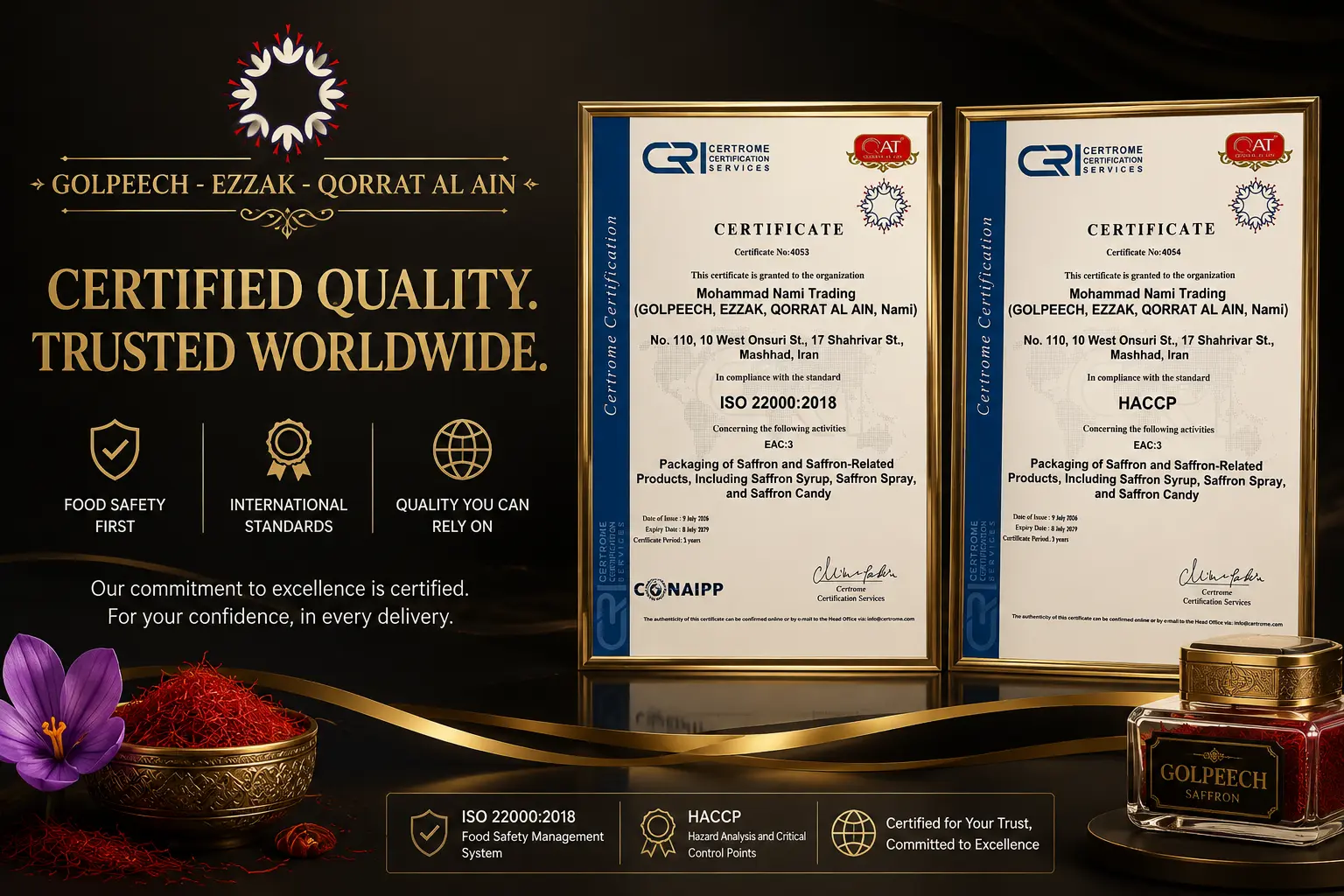
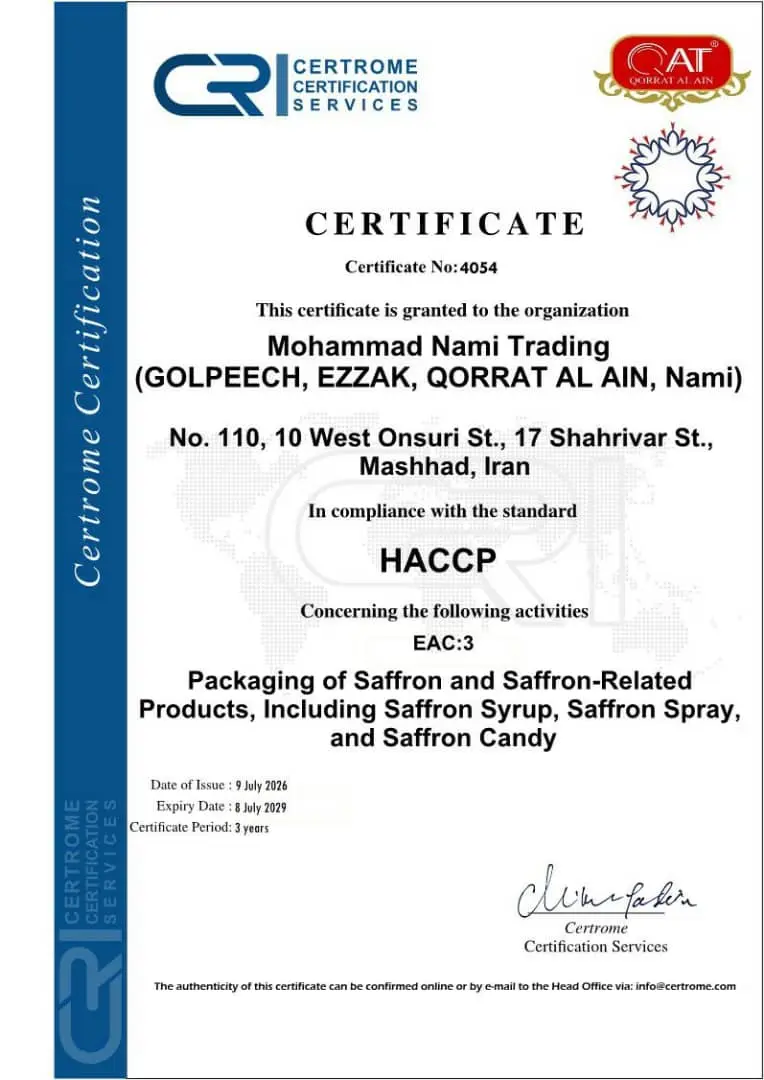
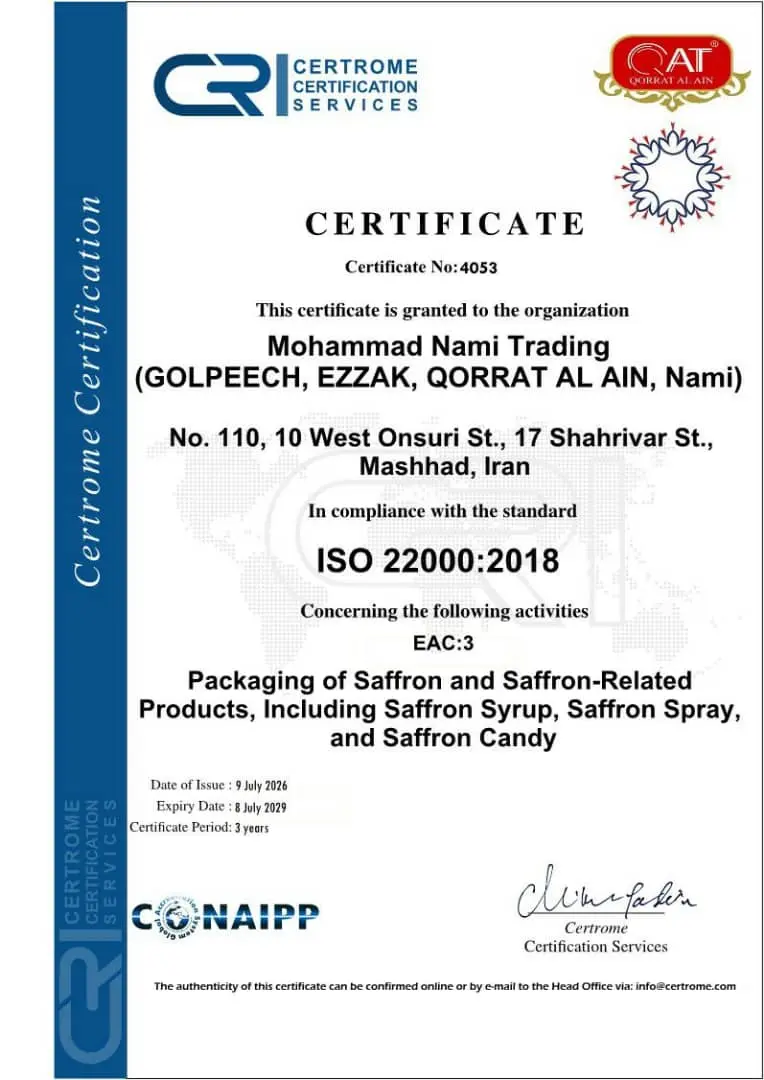
The company has obtained internationally recognized food safety certifications, including HACCP and ISO 22000:2018, demonstrating its commitment to implementing systematic food safety practices within its operations.
A Systematic Approach to Food Safety
Food safety is not limited to a single inspection at the end of production. It requires continuous attention throughout different stages, from receiving raw materials to final packaging and shipment.
Golpeech’s food safety approach is based on structured processes that support:
Controlled Production Procedures
Documented procedures help ensure that production activities are performed consistently according to established food safety requirements.
Preventive Risk Management
Following HACCP principles allows potential hazards to be identified and controlled before they can affect the finished product.
Traceability and Documentation
Maintaining production records and documented processes supports transparency, batch management, and effective communication with international buyers.
Hygienic Handling and Packaging
Appropriate hygiene practices during processing and packaging help protect product integrity throughout storage and transportation.
Supporting Reliable International Partnerships
For importers, wholesalers, and private label brands, supplier selection is not only about receiving a high-quality product—it is about building confidence in a long-term business relationship.
Food safety management systems provide buyers with additional assurance that production is organized, monitored, and continuously improved.
By combining traditional saffron expertise with structured food safety practices, Golpeech aims to provide international partners with a reliable sourcing experience based on transparency, consistency, and professional standards.
Golpeech Food Safety Commitment
HACCP Certified
A preventive approach for identifying and controlling food safety hazards.
ISO 22000:2018 Certified
A comprehensive food safety management system integrating hazard control with organizational processes.
Food Safety Certifications vs Saffron Quality Standards
When evaluating a saffron supplier, international buyers often consider two important but different aspects: food safety management and product quality evaluation.
Although these concepts are closely related, they serve different purposes. Understanding the difference helps importers make more informed decisions when selecting a saffron manufacturing partner.
Food safety certifications such as HACCP and ISO 22000:2018 focus on the systems and processes used to produce, handle, and manage food safely. They address questions such as:
- Are potential safety risks identified and controlled?
- Are production procedures documented and monitored?
- Is traceability maintained throughout the process?
- Does the manufacturer follow a structured food safety management system?
On the other hand, saffron quality standards focus on the characteristics and performance of the saffron itself. These standards evaluate product-related factors such as chemical composition, strength indicators, and specific quality parameters.
Two Different Perspectives in Supplier Evaluation
Food Safety Perspective
Main Question:
“How safely is the product produced and managed?”
Food safety systems evaluate:
- Production controls
- Hygiene practices
- Risk prevention
- Documentation
- Traceability
- Management procedures
Examples:
Product Quality Perspective
Main Question:
“What are the measurable characteristics and quality level of the saffron?”
Quality evaluation focuses on:
- Saffron characteristics
- Laboratory analysis
- Quality parameters
- Product specifications
Example:
- ISO 3632 saffron quality standard
Why Both Matter for Professional Buyers
A reliable saffron supplier should be evaluated from multiple perspectives.
A strong food safety system helps ensure that the product is produced under controlled conditions, while quality standards help buyers understand the characteristics and specifications of the saffron being purchased.
For international importers, wholesalers, and private label companies, combining these two perspectives provides a more complete picture of supplier capability.
Food safety answers how the product is produced safely.
Quality standards help evaluate the characteristics of the product itself.
Together, they support a more transparent and informed sourcing decision.
Key Takeaway
HACCP and ISO 22000:2018 demonstrate a manufacturer’s commitment to managing food safety risks. ISO 3632 and laboratory quality evaluations address saffron quality characteristics. These systems complement each other and provide different layers of confidence for international buyers.
Frequently Asked Questions About HACCP and ISO 22000 in Saffron Manufacturing
What is HACCP in saffron production?
HACCP is a preventive food safety system that helps saffron manufacturers identify, evaluate, and control potential hazards during production. Instead of relying only on final product inspection, HACCP focuses on preventing food safety issues through structured monitoring and control procedures.
Is HACCP the same as ISO 22000:2018?
No. HACCP and ISO 22000:2018 are related but different systems. HACCP focuses specifically on identifying and controlling food safety hazards, while ISO 22000:2018 provides a broader Food Safety Management System that incorporates HACCP principles along with documentation, communication, auditing, and continual improvement requirements.
Why are food safety certifications important for saffron importers?
Food safety certifications help importers evaluate whether a supplier follows structured and documented processes for managing production risks. They provide additional confidence in areas such as traceability, hygiene practices, operational consistency, and supplier reliability.
Do HACCP and ISO 22000 guarantee saffron quality?
No. HACCP and ISO 22000 focus on food safety management, not on measuring saffron quality characteristics. Product quality evaluation involves separate standards and laboratory analysis that assess saffron-specific parameters.
What is the difference between food safety standards and saffron quality standards?
Food safety standards focus on how a product is produced, handled, and managed safely. Saffron quality standards focus on the characteristics and measurable properties of the saffron itself. Both are important but evaluate different aspects of supplier performance.
Why should international buyers work with certified saffron suppliers?
Certified suppliers demonstrate that they have implemented recognized systems for managing food safety risks. For importers, this can support more reliable sourcing decisions, improve supply chain confidence, and simplify supplier evaluation processes.
Is ISO 22000:2018 important for food exporters?
Yes. ISO 22000:2018 is widely recognized as a comprehensive food safety management framework. For exporters, it demonstrates that food safety is integrated into their operational processes through systematic controls, documentation, and continuous improvement.
How do HACCP and ISO 22000 support traceability?
These systems encourage manufacturers to maintain documented procedures and records throughout production. This helps businesses track processes, manage batches, review operations, and provide clearer information to customers and partners.
Does Golpeech have HACCP and ISO 22000:2018 certification?
Yes. Golpeech has obtained HACCP and ISO 22000:2018 certifications as part of its commitment to implementing structured food safety management practices for international saffron supply.
Are food safety certifications enough when choosing a saffron supplier?
Food safety certifications are an important part of supplier evaluation, but professional buyers should also consider factors such as product specifications, laboratory testing, packaging capabilities, export experience, production capacity, and long-term supply reliability.
FAQ Summary
HACCP and ISO 22000:2018 help demonstrate that a saffron manufacturer follows structured food safety practices. However, they complement—not replace—product quality evaluation and laboratory standards.
Conclusion: Building Confidence Through Certified Food Safety Systems
In the global saffron market, trust is one of the most important factors in building successful long-term partnerships. For importers, wholesalers, and private label brands, selecting a supplier means evaluating not only the product itself but also the systems and processes behind its production.
HACCP and ISO 22000:2018 provide internationally recognized frameworks that help food manufacturers identify risks, establish preventive controls, maintain documentation, and continuously improve their food safety practices.
While these certifications do not determine the grade or quality characteristics of saffron, they demonstrate a manufacturer’s commitment to producing and managing food products through structured and controlled processes.
At Golpeech, food safety management is an essential part of our approach to serving international markets. By implementing HACCP principles and maintaining an ISO 22000:2018 certified food safety management system, Golpeech supports reliable saffron sourcing through documented procedures, traceability, and professional production practices.
For businesses looking for a dependable saffron partner, evaluating both food safety systems and product quality standards provides a more complete understanding of supplier capability.
Safe production, consistent processes, and transparent partnerships are the foundation of sustainable international saffron trade.