

Sales director
Saffron is one of the world’s most valuable spices, but its quality is not determined by cultivation and harvesting alone. The way saffron is handled, separated, dried, tested, graded, packaged, and stored plays a decisive role in preserving its color, aroma, flavor, and commercial value.
From freshly harvested Crocus sativus flowers to export-ready saffron, every processing stage requires careful attention. Delays in handling, unsuitable drying conditions, inadequate cleaning, or improper storage can affect the final product and reduce its stability.
For importers, wholesalers, distributors, and food manufacturers, understanding saffron processing is essential when evaluating product quality and choosing a reliable supplier. A high-quality saffron shipment should not only look attractive but also meet appropriate quality specifications, demonstrate consistency, and be supported by relevant quality documentation.
This guide explores the complete saffron processing journey, explains the science behind drying and quality preservation, introduces international quality standards, and highlights what professional buyers should consider when sourcing Iranian saffron.
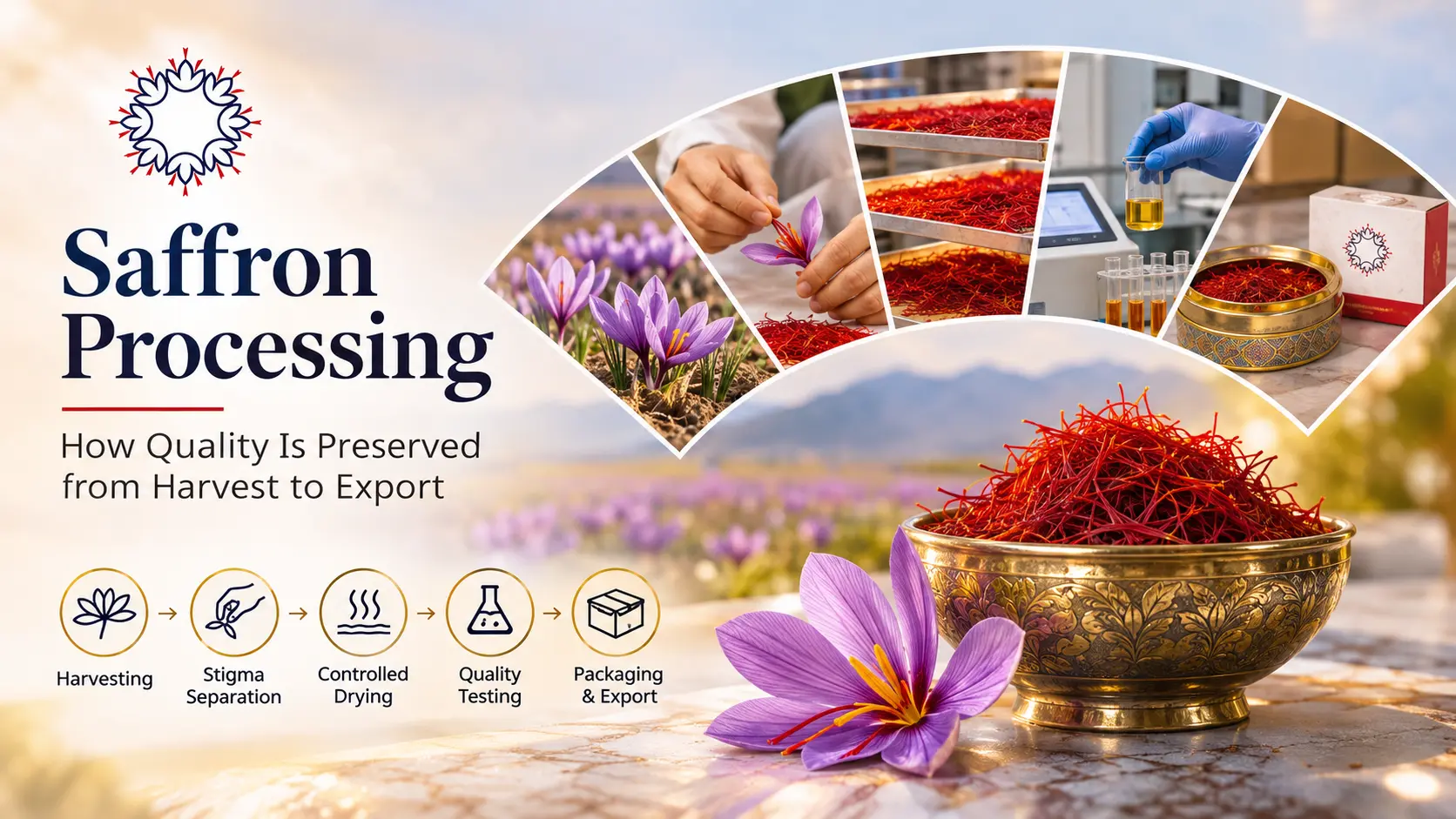
Professional saffron processing involves a sequence of carefully managed operations. Although specific methods may vary according to production facilities, equipment, and local practices, the overall objective remains the same: preserving the natural characteristics of saffron while producing a clean, stable, and market-ready product.
The main stages include:
Receiving and handling freshly harvested saffron flowers
Manual separation of the red stigmas
Cleaning and initial inspection
Controlled drying
Grading and sorting
Laboratory quality evaluation
Hygienic packaging
Proper storage and preparation for export
Each stage contributes to the final quality of saffron. Processing should therefore be understood as an integrated quality management process rather than a collection of independent production activities.
Saffron harvesting takes place during a relatively short flowering season. Fresh flowers are delicate and should be handled carefully from the moment they are collected.
After harvesting, flowers are transported to the processing area for stigma separation. Delays and unsuitable handling conditions can negatively affect their freshness and increase the risk of deterioration.
Good post-harvest handling practices include:
Transferring harvested flowers to the processing area promptly.
Avoiding unnecessary compression and physical damage.
Protecting flowers from direct sunlight and excessive heat.
Maintaining clean transportation and handling conditions.
Processing flowers as soon as reasonably possible after harvesting.
The timing of these operations is particularly important during peak harvest periods, when large quantities of flowers must be handled within a limited timeframe.
For professional producers, efficient post-harvest handling is the first step toward achieving consistent saffron quality.
Each saffron flower contains three red stigmas, which are the valuable parts used to produce saffron.
The separation of these stigmas is traditionally performed by hand. This process requires attention and experience because the stigmas are delicate and can be damaged through careless handling.
During separation, the red stigmas are removed from the flower. Depending on the desired commercial grade, different portions of the attached yellow style may also be retained or removed.
After separation, saffron stigmas are inspected and cleaned to remove unwanted floral material and other foreign substances.
Important considerations during this stage include:
Preserving the integrity of the red stigmas.
Removing unwanted floral parts.
Minimizing contamination from foreign materials.
Maintaining clean working surfaces and equipment.
Separating materials according to the intended product grade.
The quality of separation influences the appearance, purity, and commercial classification of the final saffron.
The proportion of red stigma and the presence of yellow style are important factors in distinguishing commercial saffron grades.
For example, Super Negin, Negin, and Sargol are commonly associated with different characteristics of stigma appearance and separation. Pushal contains a portion of the yellow style attached to the red stigma.
However, visual appearance alone cannot establish the complete quality of saffron. Laboratory evaluation is also necessary when objective quality specifications are required.
Drying is one of the most important stages in transforming fresh saffron stigmas into the finished spice.
Freshly separated stigmas contain considerable moisture. This moisture must be reduced to produce a stable product suitable for storage, packaging, and distribution.
However, saffron drying is not simply a matter of removing water. It also involves physical, chemical, and biochemical changes that influence the spice’s characteristic color, aroma, and flavor.
The main objective is to achieve appropriate moisture reduction while preserving the valuable compounds responsible for saffron quality.
Traditional drying methods have been used for generations in saffron-producing regions.
Depending on the local practice, drying may involve controlled exposure to heat or natural airflow. These methods can produce high-quality saffron when properly managed.
However, traditional techniques may be more sensitive to environmental conditions, including:
Ambient temperature
Relative humidity
Air circulation
Drying duration
Exposure to light
Thickness and distribution of the saffron layer
Variations in these conditions can lead to differences in moisture content and product characteristics between batches.
Modern processing facilities may use specialized drying equipment to regulate important processing variables.
These systems can provide greater control over temperature, airflow, and drying duration.
Potential advantages include:
More consistent drying conditions.
Better control over moisture reduction.
Improved batch-to-batch uniformity.
Reduced dependence on changing environmental conditions.
More predictable processing operations.
However, mechanical drying is not automatically superior in every situation. The performance of a drying system depends on its design, operating conditions, and suitability for the product.
The objective should always be to achieve consistent, measurable quality rather than simply using more advanced equipment.
The distinctive characteristics of saffron are closely associated with three important natural compounds.
| Compound | Main contribution to saffron quality |
|---|---|
| Crocins | Responsible for saffron’s characteristic coloring strength |
| Safranal | A major contributor to saffron’s distinctive aroma |
| Picrocrocin | Responsible for much of saffron’s characteristic bitter taste and a precursor involved in aroma development |
These compounds are influenced by the conditions under which saffron is dried and subsequently stored.
Crocin and coloring strength
Crocins are water-soluble carotenoid compounds responsible for saffron’s strong coloring ability. Their concentration and stability influence the intensity of the golden-yellow color produced when saffron is used in food and other applications.
Safranal and aroma
Safranal is an important volatile compound associated with saffron’s characteristic aroma. Its formation and retention are influenced by post-harvest processing, drying conditions, and storage.
Picrocrocin and flavor
Picrocrocin contributes to saffron’s characteristic bitter taste. During processing and storage, chemical and enzymatic transformations can influence the balance of compounds associated with saffron’s sensory characteristics.
Research has demonstrated that different drying methods and temperature-time combinations can produce different concentrations of these compounds. Therefore, there is no single temperature or drying duration that should be considered universally optimal for every saffron variety, processing system, and batch.
Drying conditions should be selected according to the equipment, moisture level of the raw material, airflow, and desired product characteristics.
Both insufficient and unsuitable drying can create problems.
Insufficient drying may result in:
Excess residual moisture.
Reduced storage stability.
Increased susceptibility to deterioration.
Greater risk of microbial growth under unsuitable storage conditions.
Inappropriate drying conditions may result in:
Changes in aroma composition.
Unwanted variations in coloring performance.
Differences in product characteristics between batches.
Reduced overall quality stability.
It is therefore important to monitor the drying process and verify the characteristics of the finished product rather than relying exclusively on a predetermined processing time.
Moisture content is an important parameter in determining the stability of processed saffron.
Appropriate moisture control helps protect the product during storage and transportation, particularly when saffron is shipped to international markets.
For exporters and bulk suppliers, maintaining consistent moisture characteristics across production batches is important because buyers expect products that meet agreed specifications.
Moisture assessment should therefore form part of the overall quality evaluation process.
After drying, saffron can be sorted and classified according to its physical characteristics and commercial specifications.
Grading is an important stage because different saffron grades serve different market requirements and price segments.
Common Iranian saffron grades include:
| Saffron grade | General characteristics |
|---|---|
| Super Negin | Long, predominantly red, carefully separated stigma threads |
| Negin | Red saffron threads with characteristics determined by separation and sorting |
| Sargol | Primarily red stigma portions with minimal yellow style |
| Pushal | Red stigmas with a portion of the attached yellow style |
| Bunch | Stigmas presented together with their attached style portions |
The exact appearance and characteristics may vary according to production and grading practices.
For importers and wholesalers, grading is not simply about appearance. It helps establish the product specification and supports purchasing decisions.
Important considerations include:
Proportion of red stigma and yellow style.
Thread length and appearance.
Presence of broken stigmas.
Foreign matter and cleanliness.
Uniformity within the batch.
Laboratory quality results.
It is important to distinguish between commercial grade and laboratory quality classification. A product’s commercial name does not, by itself, establish its coloring strength, aroma profile, or complete compliance with a quality standard.
Professional buyers should evaluate both physical characteristics and laboratory documentation.
Visual inspection is useful, but it cannot provide a complete assessment of saffron quality.
Two samples may appear similar while showing different laboratory results. For this reason, laboratory testing is an important component of quality assurance in international saffron trade.
Depending on the testing requirements and applicable specifications, saffron evaluation may include:
Coloring strength.
Aroma-related characteristics.
Flavor-related characteristics.
Moisture and volatile matter.
Foreign matter.
Purity and physical characteristics.
Microbiological safety, where required.
Laboratory analysis provides objective information that can support product classification, purchasing decisions, and quality verification.
ISO 3632 is an internationally recognized standard for evaluating saffron.
The current first part, ISO 3632-1:2025, specifies requirements for dried saffron obtained from the pistils of Crocus sativus L. It applies to saffron in filament, cut-filament, and powder forms.
The 2025 edition replaced the previous 2011 edition.
The ISO 3632 framework provides a common basis for assessing saffron characteristics and product specifications in international trade.
For buyers, the importance of this standard lies in its ability to support more objective comparisons between saffron samples and suppliers.
Saffron quality evaluation under the ISO 3632 framework involves measurable characteristics associated with its coloring, aroma, and flavor.
These characteristics are assessed through standardized analytical procedures.
In particular:
Coloring strength
Coloring strength is associated with the crocin compounds responsible for saffron’s coloring ability. It is an important consideration for food manufacturers and buyers who use saffron as a natural coloring ingredient.
Aroma-related characteristics
The assessment of aroma-related characteristics helps provide information about the compounds associated with saffron’s distinctive fragrance.
Flavor-related characteristics
Flavor evaluation helps assess characteristics associated with the natural taste of saffron.
Laboratory results should always be interpreted according to the applicable edition of the standard and the relevant testing method.
A laboratory report provides supporting evidence about the characteristics of a specific saffron sample or batch.
When evaluating a supplier, professional buyers should consider requesting:
A laboratory report identifying the tested product.
Relevant test results and analytical parameters.
Sample or batch identification.
Testing date and laboratory information.
The applicable standard or analytical method.
A laboratory report should correspond to the product or batch being evaluated. General quality claims without supporting documentation are not a substitute for product-specific verification.
Saffron is used in food products, beverages, and food manufacturing applications. Maintaining hygienic processing conditions is therefore essential.
Good hygiene practices help reduce contamination risks and protect product integrity throughout processing.
Important food safety considerations include:
Clean processing environments.
Regular cleaning and sanitation of equipment.
Food-grade materials and processing tools.
Appropriate employee hygiene practices.
Protection against dust and foreign materials.
Controlled handling and packaging conditions.
Appropriate pest prevention measures.
These practices should form part of a documented food safety management system.
Traceability is another important element of professional saffron production and international trade.
A traceability system helps identify the origin and processing history of a product through relevant production and distribution records.
Depending on the supplier’s system, records may include:
Raw material identification.
Harvest or sourcing information.
Processing and production records.
Batch or lot identification.
Quality inspection results.
Packaging records.
Shipment documentation.
For international buyers, traceability improves transparency and makes it easier to investigate quality concerns or identify specific batches.
A reliable supplier should be able to explain how product identification and relevant records are maintained throughout the supply chain.
Even carefully processed saffron can deteriorate if it is packaged or stored under unsuitable conditions.
Saffron is sensitive to several environmental factors, particularly light, moisture, oxygen, heat, and strong external odors.
Protective packaging is therefore essential for preserving the quality achieved during harvesting and processing.
Suitable saffron packaging should help protect the product from:
Direct light exposure.
Moisture penetration.
Excessive air and oxygen exposure.
Physical damage.
External odors and contamination.
The choice of packaging material depends on the product format, intended market, quantity, and storage requirements.
For bulk saffron, packaging should also support safe handling and transportation while maintaining product integrity.
For retail saffron, packaging may additionally need to meet market-specific labeling, presentation, and regulatory requirements.
After packaging, saffron should be stored in a cool, dry, clean environment away from direct sunlight and strong odors.
Proper storage practices include:
Using suitable sealed packaging.
Avoiding excessive temperature fluctuations.
Preventing exposure to moisture.
Protecting the product from light.
Keeping saffron away from strong-smelling materials.
Maintaining appropriate inventory management procedures.
Storage conditions influence the stability of saffron’s aroma, color, and other quality characteristics over time.
For exporters, these considerations remain important throughout warehousing, order preparation, and international transportation.
Exporting saffron requires more than producing a visually attractive product. The finished product must meet the agreed specifications, packaging requirements, and applicable import-market regulations.
For international trade, processing quality and documentation work together to support a reliable supply relationship.
Before shipment, buyers and suppliers should establish clear specifications covering:
Product identity and grade
The commercial grade and physical characteristics of saffron should be clearly identified.
Quality specifications
Relevant laboratory parameters, moisture requirements, and purity expectations should be agreed upon.
Packaging requirements
Packaging material, product weight, labeling, and bulk or retail presentation should be confirmed before production and shipment.
Documentation
Depending on the destination market and transaction, relevant documentation may include commercial invoices, packing lists, certificates of origin, laboratory reports, and applicable food safety or health documentation.
Batch consistency
For recurring orders, buyers should pay attention to the consistency of product characteristics across different shipments.
These factors help reduce misunderstandings and support smoother international purchasing relationships.
Importers and food manufacturers often purchase saffron repeatedly throughout the year.
A supplier’s ability to maintain agreed product specifications across multiple shipments can be as important as the quality of an individual sample.
Consistency helps buyers manage their own production processes, maintain product standards, and build confidence in their supply chain.
For this reason, professional sourcing decisions should consider not only the first sample but also the supplier’s quality management practices and ability to support long-term purchasing requirements.
Choosing a saffron supplier requires more than comparing prices or examining photographs.
Professional buyers should evaluate several factors before entering into a bulk purchasing agreement.
Here is a practical checklist:
| Evaluation factor | What buyers should check |
|---|---|
| Product grade | Clear identification of the saffron grade and physical characteristics |
| Laboratory analysis | Relevant test results and applicable ISO 3632 specifications |
| Moisture | Compliance with agreed product requirements |
| Purity | Cleanliness and absence of unacceptable foreign materials |
| Batch consistency | Similar quality across samples and shipments |
| Traceability | Product and batch identification records |
| Packaging | Protection suitable for the intended market and transportation |
| Documentation | Relevant export and product quality documents |
| Supply capability | Ability to meet agreed quantities and delivery schedules |
| Communication | Clear technical and commercial communication |
Before placing a bulk order, buyers may also want to ask:
Which saffron grades are available?
Can you provide product specifications and laboratory reports?
Which ISO 3632 edition or analytical method is used for quality evaluation?
How is product moisture assessed?
What packaging options are available for bulk and retail orders?
Can you provide batch identification and traceability information?
What quantities can you supply?
Can product specifications be maintained for recurring orders?
Clear answers to these questions help buyers make more informed purchasing decisions and establish realistic expectations before shipment.
Several mistakes during post-harvest handling and processing can compromise the quality of saffron.
Understanding these risks helps producers improve processing practices and helps buyers recognize potential quality concerns.
Delayed flower processing
Leaving harvested flowers unprocessed for extended periods may accelerate deterioration and reduce the freshness of the raw material.
Careless stigma separation
Rough handling can damage delicate stigma threads and increase the presence of unwanted floral material.
Inappropriate drying conditions
Unsuitable temperature, airflow, or drying duration may affect moisture reduction and the balance of saffron’s quality-related compounds.
Insufficient drying
Excess residual moisture can reduce storage stability and increase the risk of deterioration.
Poor hygiene
Contaminated equipment, unsuitable working conditions, and inadequate handling practices may compromise food safety.
Inconsistent grading
Insufficient sorting and classification can create variations in appearance and product composition.
Improper packaging and storage
Exposure to light, moisture, heat, oxygen, and external odors may gradually affect saffron quality even after successful processing.
Preventing these problems requires attention at every stage, from the initial handling of fresh flowers to final packaging and distribution.
Professional saffron processing is fundamental to delivering a product that meets the expectations of international buyers.
For importers, wholesalers, distributors, and food manufacturers, the value of saffron is determined by a combination of physical appearance, coloring strength, aroma, flavor, purity, safety, and consistency.
A well-managed processing and quality assurance approach supports:
More consistent product characteristics.
Better control over moisture and storage stability.
Reliable grading and product identification.
More objective laboratory evaluation.
Improved traceability.
Greater confidence in supplier performance.
Better preparation for international distribution.
At Golpeech Saffron, we recognize that international trade requires more than supplying a premium agricultural product. Clear product specifications, reliable communication, appropriate quality documentation, and an understanding of buyers’ requirements are essential elements of a successful business relationship.
As an Iranian saffron exporter, Golpeech focuses on connecting the quality heritage of Iranian saffron with the requirements of international markets.
For professional buyers, understanding the processing journey is an important starting point for evaluating product quality and identifying the right supply partner.
The quality of saffron is the result of a carefully managed journey that begins in the field and continues through processing, laboratory evaluation, packaging, and storage.
From the manual separation of delicate red stigmas to controlled drying, grading, and quality verification, every stage contributes to preserving the natural characteristics that make saffron one of the world’s most valuable spices.
Crocin, safranal, and picrocrocin play important roles in saffron’s color, aroma, and flavor. Protecting these characteristics requires appropriate processing conditions, careful handling, and effective quality control.
For international buyers, the most reliable approach is to evaluate saffron through a combination of physical inspection, laboratory results, product specifications, traceability, and supplier reliability.
At Golpeech Saffron, we believe that understanding quality is the foundation of successful saffron sourcing.
Looking for a reliable source of Iranian saffron?
Contact the Golpeech team to discuss saffron grades, product specifications, bulk supply requirements, and export opportunities.
The main steps include receiving fresh saffron flowers, separating the red stigmas, cleaning, drying, grading, laboratory evaluation, packaging, and proper storage. Each stage contributes to the quality and stability of the finished product.
Drying reduces the natural moisture content of fresh saffron stigmas and helps develop the characteristics of the finished spice. It also influences the balance and stability of compounds responsible for color, aroma, and flavor.
Drying temperature and duration influence moisture removal and the chemical transformations associated with saffron’s quality characteristics. The optimal conditions depend on the equipment, airflow, raw material, and processing method. No single temperature should be considered universally suitable for every drying system.
Crocin compounds are primarily responsible for saffron’s coloring strength, safranal contributes significantly to its distinctive aroma, and picrocrocin is associated with its characteristic bitter taste and aroma development.
The ISO 3632 framework provides standardized specifications and analytical approaches for evaluating dried saffron. Relevant quality characteristics include coloring strength, aroma-related properties, and flavor-related properties. The current first part of the standard is ISO 3632-1:2025.
Grading generally describes the physical and commercial characteristics of saffron, such as stigma appearance, separation, and the proportion of yellow style. Laboratory testing evaluates measurable quality characteristics and provides objective results that cannot be determined through visual inspection alone.
Saffron should be packed in suitable protective packaging and stored in a cool, dry environment away from direct sunlight, moisture, heat, and strong odors. Proper packaging and storage help maintain its aroma, color, and overall quality.
Importers should evaluate product grade, laboratory reports, moisture characteristics, purity, traceability, packaging, export documentation, supply capacity, and the supplier’s ability to maintain consistent quality across multiple shipments.