

Saffron Quality Testing
logo golpeech Golpeech Saffron
Golpeech Saffron

Table of Contents

Barzgar Golpeech Golpeech Saffron super vizer

Saffron Quality Testing: Purity Guaranteed Under the Shield of Science

An Interview with the Technical Manager of the Golpeech Saffron Specialized Laboratory

Understanding Saffron Quality Testing: From Authenticity to Laboratory Analysis

Saffron quality testing is essential for verifying the authenticity, purity and consistency of one of the world’s most valuable spices. For international buyers, importers and food manufacturers, evaluating saffron quality goes far beyond its appearance, aroma or color. Reliable assessment requires scientific analysis of its key chemical properties, microbiological safety and compliance with recognized quality parameters.

In premium Iranian saffron production, laboratory testing plays a crucial role in maintaining consistent quality across different batches and ensuring that products meet the expectations of international markets. Parameters such as Crocin, Picrocrocin and Safranal, together with the quality criteria defined in ISO 3632, provide important insights into saffron’s coloring strength, taste and aroma.

At Golpeech, laboratory-based quality control is an integral part of the saffron evaluation process. In this interview, the Technical Manager of the Golpeech Saffron Specialized Laboratory explains how scientific testing, authenticity verification and quality assessment contribute to the evaluation of premium saffron, from raw materials to finished products.

Introduction: Where Heritage Meets Laboratory Precision

In the saffron industry, quality is not a mere claim; it is a precise figure on an analysis sheet. While the 50-year legacy of the Nami family forms the foundation of trust for the Golpeech brand, the group’s specialized laboratory serves as the vigilant guardian of this quality. To understand how the health and authenticity of our products are monitored, we sat down with Ms. Barzegar, the Technical Manager and Head of the Golpeech Laboratory. As a specialist with rigorous standards, she ensures that no product leaves the facility without comprehensive scientific certification.

Interview Questions and Answers

 Ms. Barzegar, what is the role of the laboratory in a company with a 50-year history like Golpeech? Can modern science truly replace traditional expertise?

  • Answer : In Golpeech, the laboratory complements experience rather than replacing it. While Mr. Nami can identify the authenticity of saffron simply by sight and touch, our duty in the lab is to translate this authenticity into the language of mathematics and international standards, such as ISO 3632. This ensures the product is verifiable for international traders anywhere in the world.

 International buyers, especially in Europe, are highly sensitive to the chemical indicators of saffron. Which parameters do you measure?

  • Answer : We measure three vital indicators with high precision:

    • Crocin: Responsible for coloring strength.

    • Picrocrocin: The source of saffron’s specific bitter taste.

    • Safranal: The source of the unique aroma

  • Additionally, we meticulously conduct moisture tests and check for foreign matter to ensure the product meets the highest export grades.

 The biggest concern for traders is “adulteration” in saffron. How does the Golpeech laboratory reduce this risk to zero for the customer?

  • Answer : Unfortunately, fraud involving synthetic dyes or similar plants exists in the market. At the Golpeech laboratory, we guarantee 100% purity through synthetic color detection tests and microscopic examinations of the stigmas. Every shipment is coded, and the packaging process does not begin until the laboratory approval certificate is issued.

 How do you evaluate Khorasan saffron in terms of laboratory analysis compared to other regions of the world?

  • Answer : The climate of Khorasan results in a very high percentage of active compounds in the saffron. In the lab, we observe that the saffron supplied by Golpeech records coloring strength figures significantly higher than international standards. This means the buyer achieves a better result using a smaller quantity of saffron.

 Golpeech also offers products like Saffron Tea and Saffron Spray. How is technical supervision handled for these processed products?

  • Answer : Our challenge here is maintaining the health and natural integrity of the product. In our Saffron Spray, we use no chemical additives or harmful gases. Our supervision includes rigorous microbiological testing to ensure these products are not only flavorful but also entirely health-oriented.

  •  What is the importance of microbial analysis in export saffron, and how does Golpeech guarantee biological safety?

    • Answer : Saffron is a sensitive product directly linked to consumer health. At the Golpeech laboratory, we go beyond chemical tests to examine shipments for microbial load, including yeasts and bacteria. Our laboratory environment and packaging processes are strictly sterile to ensure that the product reaches the buyer in compliance with the most stringent international hygiene standards.

     Wholesale buyers are often concerned about quality consistency in large orders. How does the lab ensure the saffron quality doesn’t vary between different parts of a single order?

    • Answer : This is a core responsibility of the technical department. Through precise random sampling from all sections of a large shipment, we ensure every package shares the same analysis. Essentially, the Golpeech laboratory acts as a continuous Quality Control (QC) unit, so the wholesaler doesn’t have to worry about inconsistencies; the entire order is delivered with a uniform grade.

     On what basis is the grading of products like Negin and Super Negin confirmed in the laboratory?

    • Answer : Beyond physical characteristics like the thickness of the stigmas, the laboratory defines the boundaries between grades by precisely measuring coloring strength. For example, Golpeech Super Negin must reach a specific Crocin level to be authorized for export under that title.

     As the Technical Manager, what advice do you have for wholesale buyers when reviewing analysis sheets?

    • Answer : I recommend they pay close attention to the analysis date and the correlation between the batch code and the test report. At Golpeech, we have made it possible for customers to verify the authenticity of their analysis sheets by contacting our laboratory directly.

     What is your final message as a technical expert to international buyers?

    • Answer : At Golpeech, science serves integrity. Our goal in the technical department is to provide customers with peace of mind, delivering a product that meets both the ethical commitment of management and the highest scientific and hygienic standards of the laboratory.

“At Golpeech, we put science to work so you can feel truly confident in the saffron’s authenticity; we are here to translate 50 years of heritage into the precise language of global standards.”

Key Parameters in Saffron Quality Testing

Golpeech Saffron Quality Testing Guide

Understanding saffron quality requires more than visual inspection. Laboratory analysis provides measurable indicators that help evaluate the spice’s chemical composition, authenticity and overall quality.

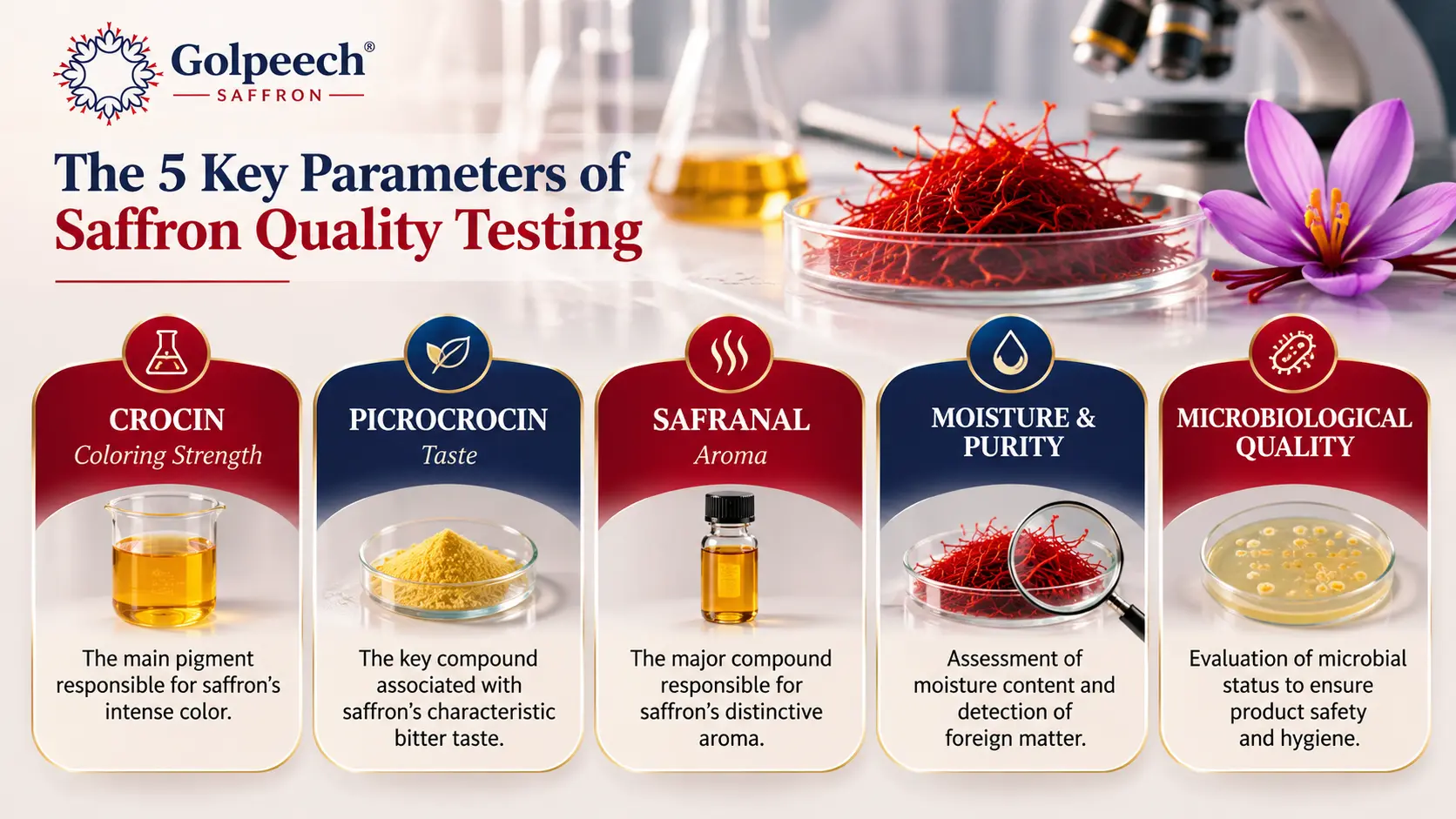
1. Crocin: Measuring Saffron’s Coloring Strength

Crocin is the primary pigment responsible for saffron’s distinctive red-orange coloring properties. Its concentration is one of the important parameters evaluated during saffron quality analysis.

2. Picrocrocin: The Compound Behind Saffron’s Taste

Picrocrocin is associated with saffron’s characteristic bitter taste. Measuring this compound helps provide a more complete understanding of saffron’s chemical quality.

3. Safranal: Evaluating Saffron’s Aroma

Safranal is one of the major compounds responsible for saffron’s characteristic aroma. Its measurement is an important part of understanding saffron’s aromatic profile.

4. Moisture, Purity and Microbiological Quality

Moisture content, foreign matter and microbiological parameters are also important considerations in saffron quality control. These assessments help evaluate product condition, cleanliness and suitability for different applications.

5. Batch Consistency and Laboratory Documentation

For bulk saffron buyers and international importers, consistency between batches is particularly important. Laboratory analysis and documented test results, including a Certificate of Analysis (COA), can help buyers make more informed purchasing decisions.
Why Saffron Quality Control Matters to International Buyers

Golpeech Saffron Quality Guide

For international saffron importers, wholesalers and food manufacturers, quality control is a critical part of supplier evaluation. A visually attractive saffron sample does not necessarily guarantee consistent quality across a commercial shipment.

Professional saffron quality control helps buyers assess several important factors:

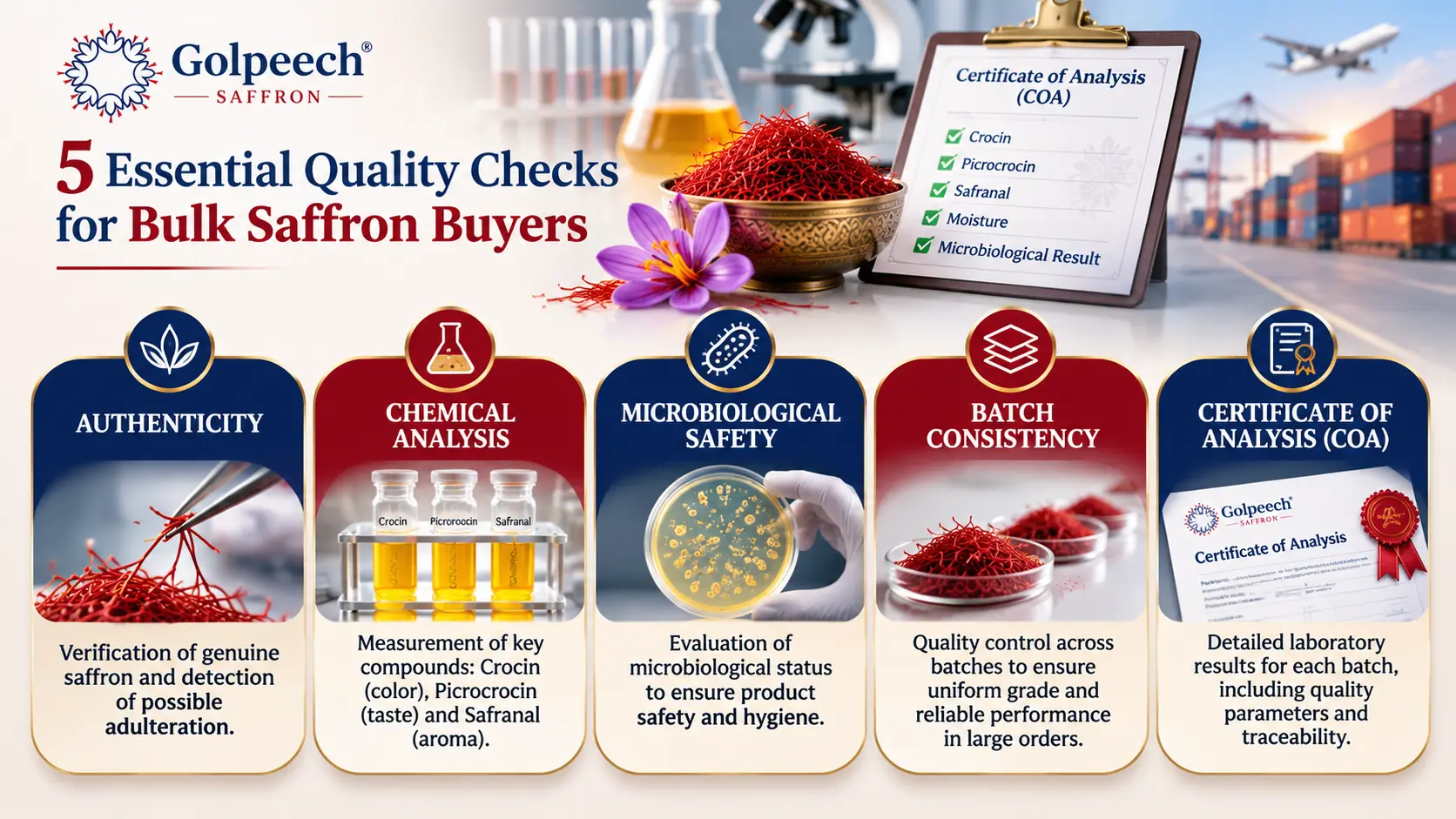
  • Product Authenticity: Laboratory analysis helps identify potential adulteration and verify product characteristics.

  • Chemical Quality: Testing Crocin, Picrocrocin and Safranal provides measurable information about saffron’s key quality attributes.

  • Microbiological Safety: Appropriate microbiological testing helps evaluate the product’s microbiological condition.

  • Batch Consistency: Comparing laboratory results across production batches supports more consistent purchasing decisions.

  • Documentation and Traceability: Clear laboratory records and batch-specific Certificates of Analysis help buyers review product specifications and supplier quality practices.

For companies sourcing Iranian saffron in bulk, these factors contribute to a more transparent procurement process and a stronger foundation for long-term supplier relationships.
Frequently Asked Questions About Saffron Quality Testing

Golpeech Saffron Quality FAQ

What Is Saffron Quality Testing?

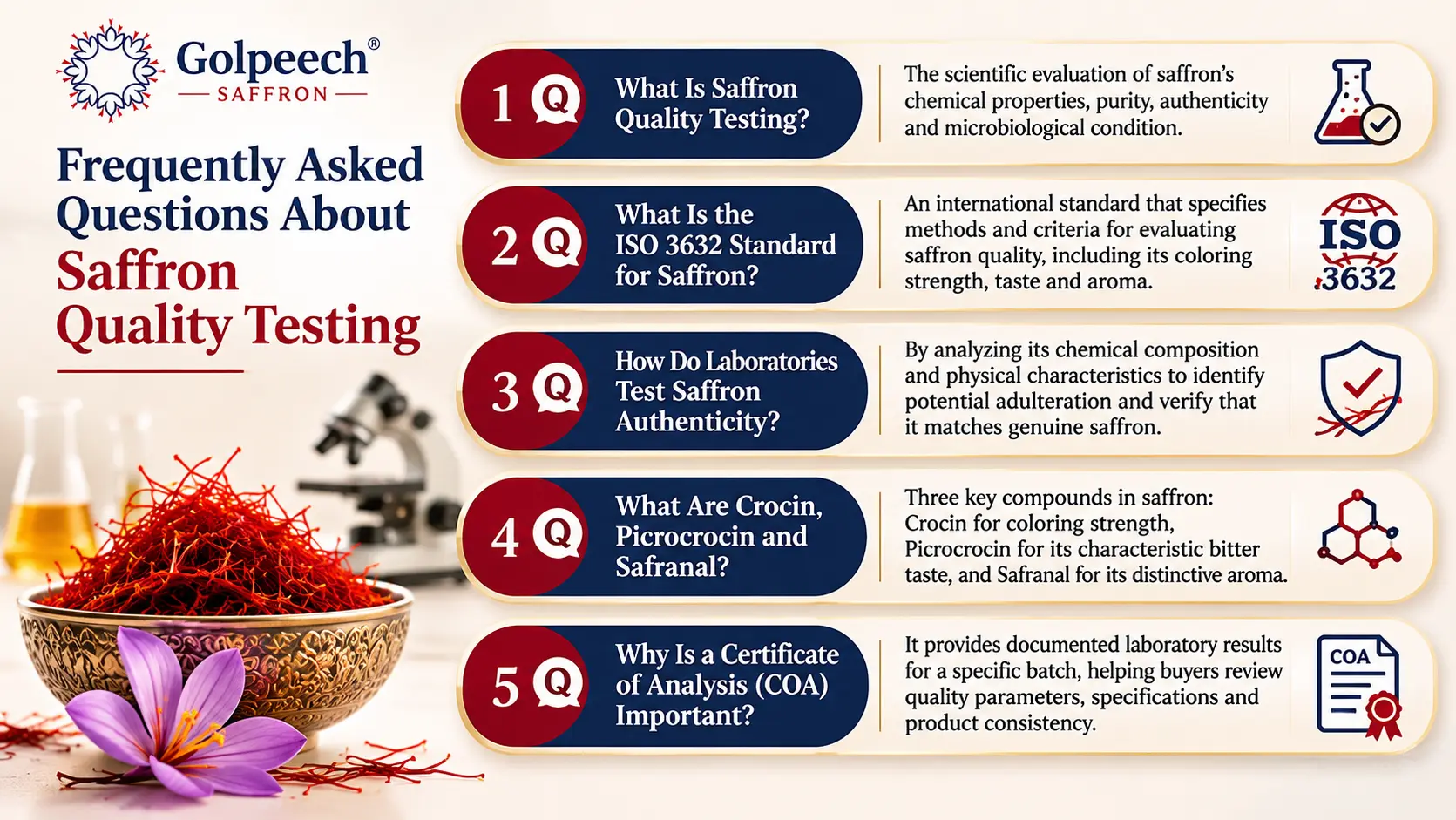
Saffron quality testing is the scientific evaluation of saffron’s chemical properties, purity, authenticity and microbiological condition. Laboratory analysis helps determine important quality indicators, including coloring strength, aroma and other characteristics that influence the overall quality of saffron.

What Is the ISO 3632 Standard for Saffron?

ISO 3632 is an international standard that specifies methods and criteria for evaluating saffron quality. It includes important parameters related to coloring strength, taste and aroma, helping buyers and producers assess saffron according to recognized quality specifications.

How Do Laboratories Test Saffron Authenticity?

Saffron authenticity testing involves laboratory methods that examine its chemical composition and physical characteristics. These analyses can help identify potential adulteration, detect foreign substances and assess whether a sample exhibits characteristics consistent with genuine saffron.

What Are Crocin, Picrocrocin and Safranal in Saffron?

Crocin, Picrocrocin and Safranal are three important compounds associated with saffron quality. Crocin contributes to its coloring strength, Picrocrocin is responsible for its characteristic bitter taste, and Safranal contributes significantly to its distinctive aroma.

Why Is a Certificate of Analysis Important When Buying Bulk Saffron?

A Certificate of Analysis (COA) provides documented laboratory test results for a specific saffron sample or batch. For importers and wholesale buyers, it offers valuable information about product specifications, quality parameters and microbiological results, supporting more informed purchasing decisions.

Scientific Quality Control: The Foundation of Reliable Saffron Supply

Saffron quality is built on more than appearance, color or aroma. Reliable laboratory analysis, recognized quality parameters and consistent quality control are essential for evaluating authenticity and maintaining product standards across commercial batches.

At Golpeech, scientific quality assessment is an important part of our commitment to supplying premium Iranian saffron to international markets. By combining industry experience with laboratory-based evaluation, we aim to support transparency, consistency and confidence throughout the sourcing process.

Looking for a reliable Iranian saffron supplier?

Contact Golpeech to learn more about our saffron collections, product specifications and bulk supply capabilities.

Website: https://golpeechsaffron.com/