Detecting Saffron Adulteration: A Complete Guide to Laboratory Testing and Authenticity Verification
Why Detecting Saffron Adulteration Matters More Than Ever
Saffron is the world’s most valuable spice, prized for its distinctive color, aroma, and flavor. Its high market value, however, also makes it one of the most frequently adulterated food products in international trade. From artificially colored plant materials to moisture manipulation and unauthorized additives, fraudulent practices continue to evolve as global demand increases.
For importers, wholesalers, food manufacturers, and private-label buyers, purchasing adulterated saffron is more than a quality issue. It can lead to financial losses, regulatory problems, damaged brand reputation, and reduced customer confidence. Even experienced buyers may find it difficult to distinguish genuine saffron from sophisticated imitations through visual inspection alone.
Modern saffron authentication therefore relies on scientific laboratory testing rather than appearance or aroma. Analytical methods allow buyers to verify purity, identify foreign materials, evaluate chemical composition, and confirm that saffron meets internationally recognized quality parameters before it reaches consumers.
This guide explains how saffron adulteration occurs, why conventional inspection methods are often insufficient, and which laboratory techniques are used to verify authenticity and protect commercial buyers from fraud.
What Is Saffron Adulteration?
Saffron adulteration refers to any intentional practice that changes the natural composition of saffron in order to increase profit or misrepresent quality. These practices may involve adding foreign plant materials, applying synthetic colorants, increasing moisture or weight, or mixing different quality grades without proper disclosure.
Unlike accidental contamination, adulteration is a deliberate act designed to deceive buyers. In international trade, even small amounts of adulterated material can affect product quality, laboratory test results, regulatory compliance, and customer trust.
Common objectives of saffron adulteration include:
Increasing shipment weight without adding genuine saffron.
Creating the appearance of stronger coloring power through artificial dyes.
Masking aged or lower-quality saffron to resemble premium grades.
Mixing inferior grades with higher-quality saffron while selling the product as a premium grade.
Replacing part of the saffron with inexpensive botanical materials that visually resemble saffron threads.
As adulteration techniques become more sophisticated, reliable detection increasingly depends on laboratory analysis rather than sensory evaluation alone.
Why Is Saffron Frequently Adulterated?
Several factors make saffron particularly vulnerable to fraud compared with many other spices.
Exceptional Market Value
Producing saffron requires harvesting and separating thousands of delicate stigmas by hand. The labor-intensive nature of production results in a high market price, creating strong financial incentives for dishonest suppliers to manipulate products.
Global Demand Continues to Grow
As saffron consumption expands across the food, pharmaceutical, cosmetic, and nutraceutical industries, international demand continues to increase. Growing demand can encourage fraudulent practices in highly competitive supply chains where buyers may prioritize low prices over verified quality.
Difficult Visual Identification
Unlike many agricultural products, saffron threads can be imitated using dyed botanical materials or modified through artificial treatments. Some adulterated products closely resemble genuine saffron, making visual inspection alone unreliable.
Complex International Supply Chains
Saffron often passes through multiple intermediaries before reaching importers or food manufacturers. Without traceability and laboratory verification, buyers may have limited visibility into product origin, handling conditions, or quality control procedures.
Increasing Sophistication of Fraud
Modern adulteration is no longer limited to obvious substitutions. Advances in food fraud techniques allow counterfeit products to imitate the appearance, aroma, and even some analytical characteristics of authentic saffron, making comprehensive laboratory testing increasingly important for quality assurance.
Key Takeaways
Saffron is one of the most frequently adulterated premium spices because of its exceptionally high value.
Visual inspection alone is no longer sufficient to verify authenticity.
Laboratory testing provides objective evidence of purity, quality, and compliance.
Understanding common adulteration methods helps buyers make informed purchasing decisions and reduce commercial risk.
Most Common Types of Saffron Adulteration
Food fraud in the saffron industry can take many forms, ranging from simple substitution with inexpensive plant materials to sophisticated chemical manipulation designed to imitate premium-quality saffron. Understanding these practices helps buyers recognize potential risks and appreciate the importance of laboratory verification.
Addition of Foreign Plant Materials
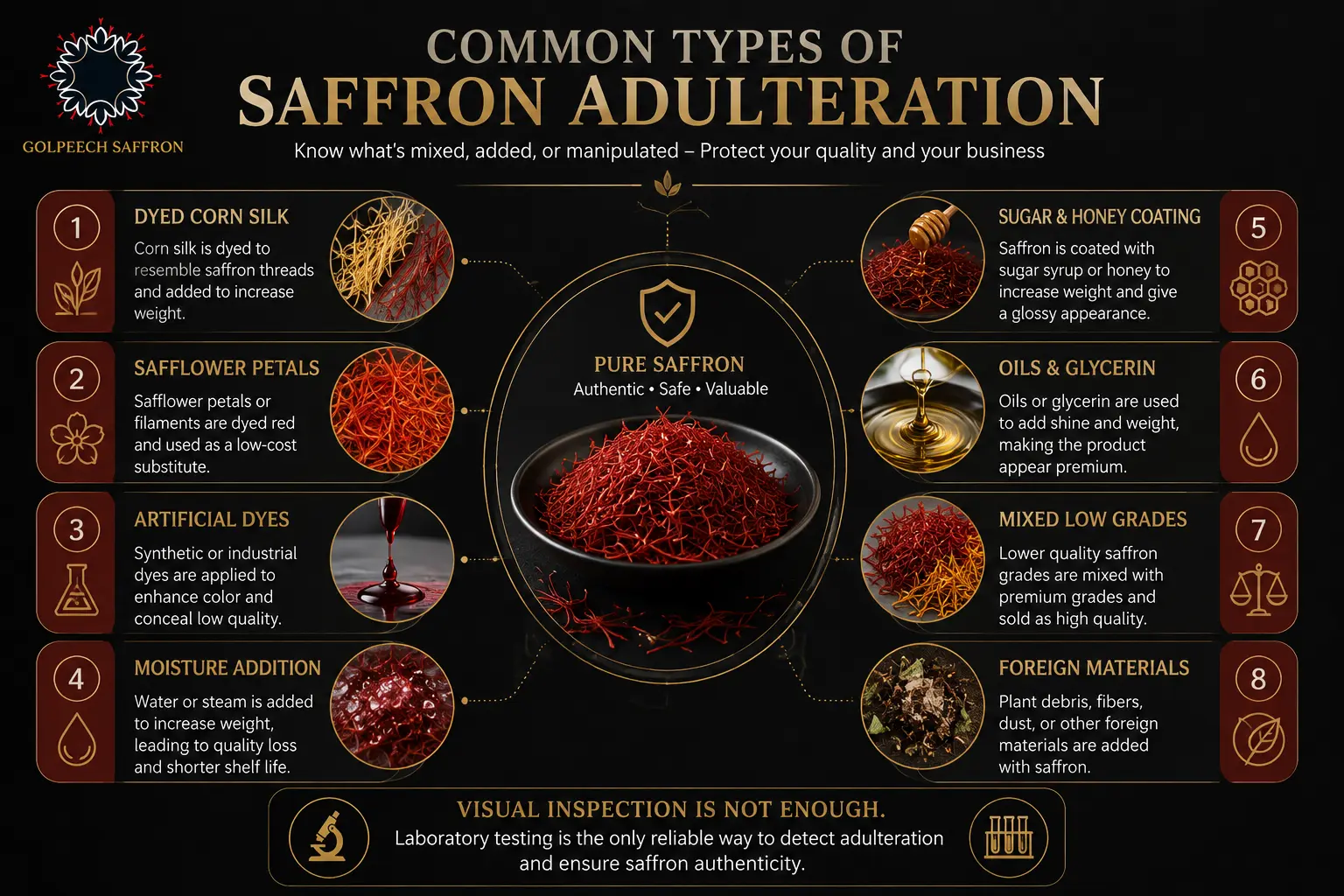
One of the oldest and most common forms of adulteration involves mixing saffron with plant materials that resemble saffron threads. These substitutes may be carefully dyed to imitate the deep red color of genuine saffron and can be difficult to identify without microscopic examination.
Materials sometimes encountered in fraudulent products include:
Corn silk
Safflower petals
Dyed grass or fibers
Wheat or barley awns
Other dried botanical materials with similar appearance
Although these materials may resemble saffron visually, they do not contain the natural compounds responsible for saffron’s characteristic color, aroma, or flavor.
Artificial Color Enhancement
Some suppliers apply synthetic or unauthorized food colorants to improve the visual appearance of low-quality or aged saffron.
Artificial dyes may:
Produce an unnaturally intense red appearance.
Create the impression of higher coloring strength.
Conceal quality deterioration.
Mask inferior raw materials.
Because visual appearance can be misleading, laboratory techniques such as chromatography and spectrophotometric analysis are often required to identify abnormal color profiles.
Moisture Manipulation
Increasing moisture content is a relatively simple way to raise shipment weight artificially.
Excess moisture may be introduced through:
Water spraying
Steam exposure
Humidity treatment
Besides increasing weight, elevated moisture can accelerate quality deterioration by promoting microbial activity, reducing shelf life, and affecting the stability of saffron’s natural compounds.
Addition of Sugar, Honey, Oils, or Other Coating Materials
Some fraudulent products are coated with substances that increase weight while giving saffron a glossy appearance.
Examples include:
Sugar solutions
Honey
Vegetable oils
Glycerin or similar coating agents
These treatments may also alter the product’s drying behavior, chemical composition, and analytical test results.
Mixing Different Quality Grades
Not all adulteration involves foreign materials.
In some cases, lower-quality saffron grades are intentionally blended with premium grades and marketed as a uniformly high-grade product. Buyers expecting premium characteristics may receive inconsistent quality that fails to match the declared specification.
Proper grading, traceability, and laboratory testing help identify such inconsistencies.
Addition of Excess Style Portions
Premium saffron consists primarily of the red stigmas of the Crocus sativus flower. Some products contain excessive amounts of the yellow or white style portion, which contributes significantly less coloring strength than the stigma.
While limited style content may be acceptable depending on the commercial grade, excessive inclusion can reduce product value and overall performance.
Microscopic examination allows laboratories to evaluate botanical composition and verify conformity with declared product specifications.
Visual Signs of Potentially Adulterated Saffron
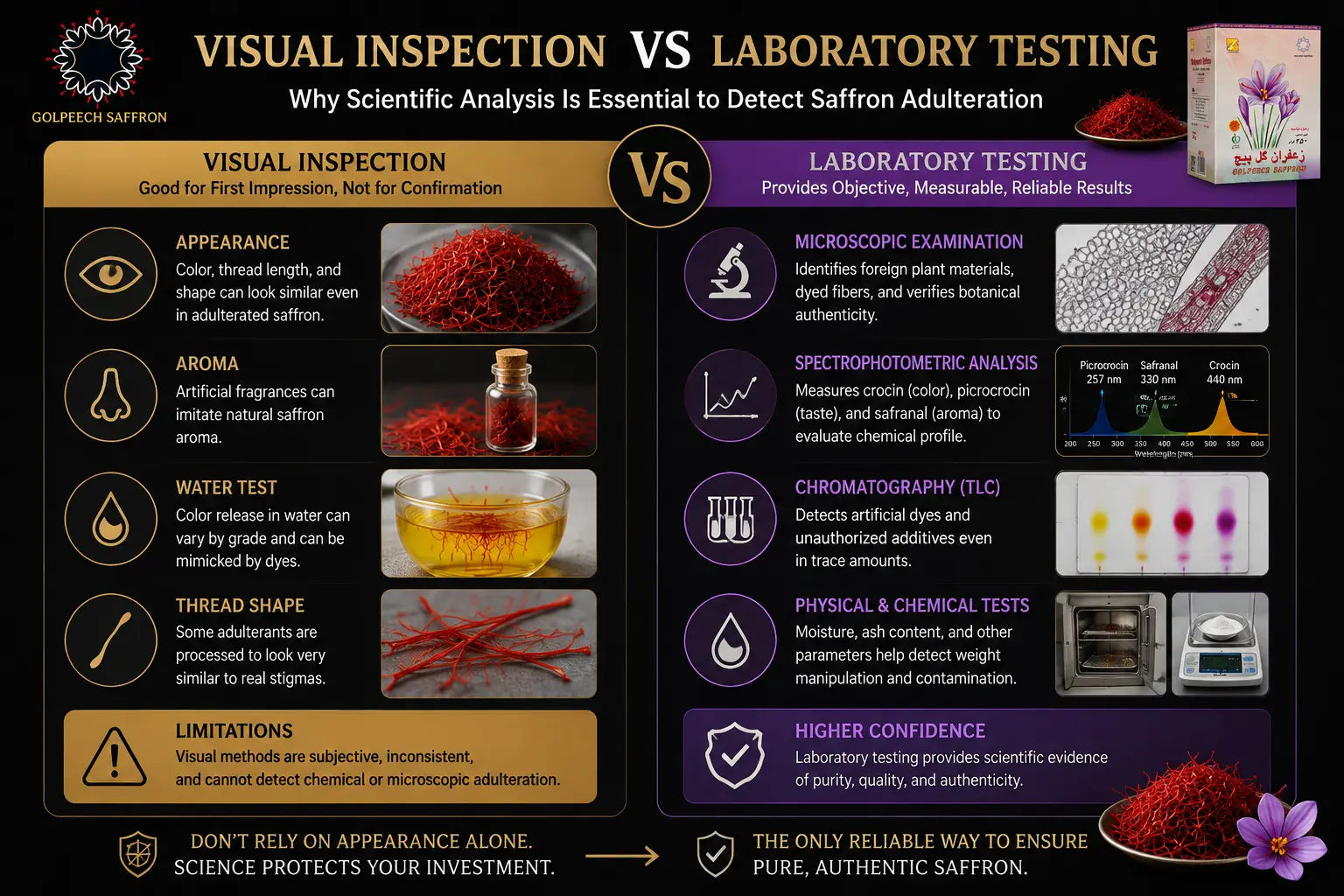
Visual inspection can provide useful preliminary observations, but it should never be considered definitive proof of authenticity.
Experienced buyers often evaluate several characteristics before sending samples for laboratory analysis.
Thread Shape
Authentic saffron stigmas typically display a natural trumpet-shaped structure that gradually widens toward the tip. Uniform or perfectly identical threads may warrant closer examination.
Color Distribution
Natural saffron usually exhibits subtle variations in color rather than perfectly uniform pigmentation. Threads that appear unnaturally bright or evenly colored throughout may require further investigation.
Aroma
Genuine saffron has a distinctive aroma resulting from naturally occurring volatile compounds.
An unusually strong perfume-like smell or chemical odor may indicate artificial flavoring or improper handling, although aroma alone cannot confirm adulteration.
Color Release in Water
Authentic saffron gradually releases its characteristic golden-yellow pigments into warm water while maintaining the integrity of the threads for a considerable period.
Samples that release intense red coloration almost immediately or rapidly lose their structure may deserve additional laboratory evaluation. However, this simple observation should not be treated as conclusive evidence because color release can vary depending on saffron grade, processing conditions, and moisture content.
Why Visual Inspection Is Not Enough
Although experienced traders can often recognize obvious quality problems, modern saffron fraud has become increasingly sophisticated.
Artificial dyes, carefully selected botanical substitutes, controlled moisture adjustment, and advanced processing techniques can produce products that closely resemble genuine saffron during routine visual inspection.
Moreover, important quality characteristics—including coloring strength, bitterness, aroma compounds, moisture level, mineral content, and the presence of unauthorized additives—cannot be evaluated accurately without scientific analysis.
For this reason, responsible importers and quality-focused suppliers increasingly rely on laboratory testing to verify authenticity, confirm compliance with quality specifications, and reduce commercial risk before products enter the supply chain.
The following section explains the analytical methods commonly used to detect saffron adulteration and evaluate product authenticity with greater precision.
Laboratory Methods Used to Detect Saffron Adulteration
Modern saffron authentication relies on a combination of complementary laboratory techniques rather than a single test. Each analytical method evaluates a different aspect of saffron quality, helping laboratories detect adulteration, verify authenticity, and assess compliance with established quality parameters.
By combining microscopic examination, chemical analysis, and physicochemical testing, laboratories can build a comprehensive quality profile for every batch of saffron.
Microscopic analysis is one of the first and most effective methods for detecting foreign botanical materials that may not be visible during routine inspection.
Under magnification, trained analysts can evaluate the physical structure of saffron threads and distinguish authentic stigmas from substituted or added plant materials.
Microscopic examination is commonly used to identify:
Dyed corn silk
Safflower petals
Grass fibers
Wheat or barley awns
Other foreign botanical materials
Authentic saffron stigmas have a characteristic trumpet-shaped structure with naturally irregular surfaces and a three-lobed tip. These botanical features are difficult to reproduce artificially and remain one of the most reliable indicators of authenticity.
Microscopy can also be used to estimate the proportion of stigma and style tissue, helping verify whether the supplied product matches its declared commercial grade.
Buyer Insight: Microscopy confirms what the product is physically made of, but it cannot determine the full chemical quality of saffron. Additional laboratory tests are required for complete authentication.
Spectrophotometric Analysis: Measuring Saffron’s Chemical Fingerprint
While microscopy evaluates physical structure, spectrophotometry measures the natural compounds responsible for saffron’s unique quality.
This analytical technique measures light absorption at specific wavelengths to determine the concentration of saffron’s three principal bioactive components.
Crocin – Coloring Strength (440 nm)
Crocin is responsible for saffron’s characteristic golden-yellow color and is one of the primary indicators of commercial quality.
Abnormally high or inconsistent absorption patterns may suggest artificial color enhancement or poor-quality raw material. Measuring crocin helps laboratories assess coloring strength objectively rather than relying on visual appearance.
Picrocrocin – Taste Profile (257 nm)
Picrocrocin contributes to saffron’s distinctive bitter taste and serves as another important authenticity marker.
Unexpected deviations may indicate excessive processing, aging, or certain forms of adulteration that alter saffron’s natural chemical balance.
Safranal – Aroma Profile (330 nm)
Safranal is the volatile compound primarily responsible for saffron’s characteristic aroma.
Both unusually low and excessively high concentrations may indicate improper drying, poor storage conditions, or artificial attempts to modify aromatic characteristics.
When evaluated together, crocin, picrocrocin, and safranal provide a comprehensive chemical fingerprint that helps laboratories distinguish authentic saffron from manipulated products.
Visual appearance alone cannot reliably reveal whether saffron has been treated with synthetic dyes.
Thin-Layer Chromatography (TLC) separates the chemical components present in a sample, allowing analysts to identify colorants that should not naturally occur in authentic saffron.
This method can assist laboratories in detecting:
Unauthorized synthetic dyes
Artificial color enhancement
Certain foreign chemical substances
Abnormal pigment patterns
Pure saffron produces a characteristic chromatographic profile, while adulterated samples often generate additional bands that indicate the presence of foreign compounds.
Because TLC provides direct chemical evidence, it is considered an important tool for investigating suspected adulteration.
Moisture content influences both saffron quality and commercial value.
Excessive moisture may increase shipment weight artificially while accelerating deterioration during storage and transportation.
Laboratories monitor moisture content to help ensure that saffron:
Maintains product stability
Resists microbial growth
Preserves coloring strength
Meets declared quality specifications
Has not been intentionally weighted through added water
Accurate moisture measurement protects both buyers and suppliers by supporting fair commercial transactions.
Total Ash Analysis: Identifying Abnormal Mineral Content
Total ash analysis measures the amount of inorganic residue remaining after controlled combustion of a saffron sample.
Although authentic saffron naturally contains minerals, unusually high ash values may indicate contamination or the addition of inorganic substances intended to increase product weight.
Ash determination therefore provides another important indicator when evaluating overall product authenticity and purity.
Foreign Matter Examination
In addition to specialized analytical tests, laboratories routinely inspect saffron for foreign matter that should not be present in a premium product.
Evaluation may include:
Plant debris
Dust
Soil particles
Packaging residues
Other visible contaminants
Removing foreign materials is essential for maintaining consistent product quality and meeting the expectations of international buyers.
Why Multiple Tests Are Necessary
No single laboratory method can identify every form of saffron adulteration.
For example:
Microscopy verifies botanical identity but does not measure chemical quality.
Spectrophotometry evaluates key quality compounds but cannot identify every foreign material.
Chromatography detects certain unauthorized additives but is not designed to assess physical purity.
Moisture and ash analyses help identify weight-related manipulation but do not evaluate aroma or coloring strength.
By combining several complementary analytical techniques, laboratories can achieve a much higher level of confidence when verifying saffron authenticity.
This multi-method approach significantly reduces the risk of undetected fraud and provides importers, distributors, and food manufacturers with objective evidence to support purchasing decisions.
Key Takeaways
Laboratory authentication relies on multiple complementary analytical methods rather than a single test.
Microscopy verifies botanical identity and detects foreign plant materials.
Spectrophotometric analysis measures crocin, picrocrocin, and safranal to evaluate saffron’s chemical profile.
TLC helps identify artificial colorants and unauthorized chemical additives.
Moisture and ash analyses support the detection of weight manipulation and quality inconsistencies.
Combining these techniques provides a far more reliable assessment than visual inspection alone.
Understanding Laboratory Standards for Saffron Testing
Reliable saffron testing is not based solely on sophisticated equipment—it also depends on standardized analytical procedures. Using recognized testing methodologies helps laboratories produce consistent, repeatable, and comparable results across different batches and markets.
One of the most widely referenced international standards for saffron quality evaluation is ISO 3632, which provides a framework for classifying saffron based on analytical measurements and physical characteristics.
What Does ISO 3632 Evaluate?
ISO 3632 focuses on several key quality parameters that influence saffron’s commercial value and authenticity, including:
Coloring strength
Aroma-related compounds
Bitterness-related compounds
Moisture content
Botanical purity
Physical characteristics
Rather than relying on appearance alone, these parameters provide measurable data that buyers can use when comparing products from different suppliers.
Important: ISO 3632 is a testing and classification standard. Compliance with its analytical methods or quality parameters should not be confused with holding an ISO certification.
Why Laboratory Reports Matter for International Buyers
For importers and food manufacturers, purchasing decisions often involve suppliers from different countries, production regions, and supply chains. Laboratory reports provide objective evidence that helps reduce uncertainty before products enter commercial distribution.
A comprehensive laboratory evaluation can help buyers:
Verify product authenticity.
Confirm consistency between shipments.
Assess compliance with agreed quality specifications.
Reduce the risk of purchasing adulterated products.
Support quality documentation for customers and regulatory requirements.
Instead of relying solely on supplier claims, buyers can use laboratory data to make evidence-based purchasing decisions.
How Importers Can Verify Saffron Authenticity Before Purchasing
Laboratory testing is most effective when combined with a structured supplier evaluation process. Buyers should consider authenticity verification as part of a broader quality assurance strategy rather than a single inspection step.
Review Available Laboratory Documentation
Ask whether the supplier can provide recent analytical reports that describe the product’s quality parameters. Reports should clearly identify the tested batch and the analytical methods used.
Confirm Product Traceability
Understanding where and how saffron was produced helps buyers assess supply chain transparency.
Useful information may include:
Country and region of origin
Harvest season
Batch identification
Processing facility
Packaging date
Good traceability supports both quality management and commercial confidence.
Evaluate Quality Control Procedures
Reliable suppliers generally maintain documented quality control systems throughout production, storage, and packaging.
Questions worth asking include:
How are incoming raw materials inspected?
Are multiple quality checkpoints used?
Is laboratory testing performed before shipment?
How are non-conforming batches handled?
These procedures demonstrate the supplier’s commitment to consistent product quality.
Compare More Than Price
Exceptionally low prices may indicate lower quality, inconsistent grading, or increased fraud risk.
When comparing suppliers, buyers should evaluate:
Product consistency
Laboratory documentation
Packaging quality
Traceability
Technical support
Long-term reliability
The total value of a supplier extends well beyond the purchase price.
Questions Buyers Should Ask Before Choosing a Saffron Supplier
Selecting a supplier involves more than evaluating samples. Asking the right questions can help identify suppliers with robust quality management practices.
Consider discussing the following topics:
How is saffron authenticity verified before shipment?
Which laboratory analyses are routinely performed?
Can laboratory reports be provided for commercial batches?
How is product traceability maintained?
What measures prevent contamination during processing?
How are different saffron grades separated and controlled?
What packaging methods are used to preserve quality?
How is moisture monitored during storage?
What procedures are followed if a batch does not meet quality specifications?
How is consistency maintained across repeat orders?
These questions encourage transparent communication and help establish long-term business relationships based on documented quality rather than assumptions.
How Golpeech Supports Product Authenticity
At Golpeech, product authenticity is supported through a combination of quality control procedures, laboratory evaluation, and careful production management.
Incoming raw materials are assessed before entering production, while finished products undergo quality verification according to internal quality control procedures. Laboratory evaluation focuses on confirming product consistency, identifying potential quality deviations, and supporting compliance with customer specifications.
In addition to laboratory analysis, emphasis is placed on:
Careful selection of raw materials.
Controlled processing and packaging.
Batch traceability.
Quality documentation.
Continuous monitoring throughout production.
This systematic approach helps reduce the risk of adulteration entering the supply chain and provides greater confidence for importers, distributors, and private-label partners seeking reliable saffron products.
Conclusion
As saffron fraud becomes increasingly sophisticated, traditional inspection methods are no longer sufficient to guarantee authenticity. Visual appearance, aroma, and simple household tests may provide useful initial observations, but they cannot reliably detect many modern forms of adulteration.
Scientific laboratory analysis offers a far more dependable approach by examining saffron’s botanical structure, chemical composition, moisture level, mineral content, and potential unauthorized additives. When these analytical methods are combined with robust quality management and transparent traceability, buyers gain a stronger foundation for informed purchasing decisions.
For importers, wholesalers, food manufacturers, and private-label brands, investing in verified authenticity is not simply a quality measure—it is a practical strategy for protecting product integrity, customer confidence, and long-term business success.
Ultimately, trust in the saffron trade should be built on objective evidence, consistent quality control, and transparent laboratory verification rather than appearance alone.
Frequently Asked Questions (FAQ)
What is saffron adulteration?
Saffron adulteration is the intentional alteration of genuine saffron by adding foreign materials, artificial colorants, excess moisture, or lower-quality components to increase profit or misrepresent product quality.
Why is saffron one of the most adulterated spices?
Because saffron is the world’s most expensive spice by weight, even small amounts of adulteration can generate significant financial gain. Its complex supply chain and premium market value make it particularly vulnerable to food fraud.
Can fake saffron look identical to genuine saffron?
Yes. Modern adulteration techniques can produce products that closely resemble authentic saffron in appearance. Dyed plant materials and artificial treatments may deceive even experienced buyers without laboratory analysis.
Is the water test enough to detect fake saffron?
No.
The water test can provide a preliminary indication, but it cannot reliably confirm authenticity. Some adulterated products can imitate the color-release behavior of genuine saffron, while authentic saffron from different grades may behave differently during immersion.
Which laboratory test is most reliable for detecting saffron adulteration?
There is no single test that detects every type of adulteration.
Reliable authentication usually combines several analytical techniques, including microscopic examination, spectrophotometric analysis, chromatography, moisture determination, and physical inspection.
What is the role of spectrophotometry in saffron testing?
Spectrophotometry measures the concentration of crocin, picrocrocin, and safranal—the natural compounds responsible for saffron’s color, taste, and aroma. These measurements help evaluate quality and identify abnormal chemical profiles.
How does microscopy help identify adulterated saffron?
Microscopic examination allows analysts to verify the botanical structure of saffron stigmas and detect foreign plant materials such as dyed corn silk, safflower petals, or other botanical substitutes.
Does ISO 3632 guarantee that saffron is authentic?
No.
ISO 3632 is an internationally recognized testing and classification standard. It provides analytical criteria for evaluating saffron quality but does not, by itself, guarantee authenticity or certify an individual product.
Why is moisture content important in saffron quality?
Excess moisture can artificially increase shipment weight, reduce shelf life, encourage microbial growth, and negatively affect saffron’s stability during storage and transportation.
What documents should importers request from a saffron supplier?
Importers commonly request laboratory reports, batch identification, traceability information, quality specifications, and documentation supporting the supplier’s quality management procedures.
Can laboratory testing detect artificial dyes?
Yes.
Analytical techniques such as Thin-Layer Chromatography (TLC) and other chemical methods can help identify unauthorized synthetic colorants that are not naturally present in authentic saffron.
Why is laboratory verification important for wholesale buyers?
Laboratory verification provides objective evidence of product quality and authenticity. It helps wholesalers, distributors, food manufacturers, and private-label brands reduce purchasing risk, maintain product consistency, and support customer confidence.
In today’s world, where global supply chains face constant disruptions, the idea of being self-sufficient Saffron is more valuable than ever. Saffron, one of the most precious and delicate spices in existence, demands exceptional care at every stage—from soil to shelf.
In the saffron industry, quality is not a mere claim; it is a precise figure on an analysis sheet. While the 50-year legacy of the Nami family forms the foundation of trust for the Golpeech brand, the group’s specialized laboratory serves as the vigilant guardian of this quality.
After the delicate dawn harvest, saffron’s transformation truly begins. In this stage—known as processing—the focus shifts from field to facility. The moment the crocus flowers arrive, the race against time resumes, and the stakes are high.