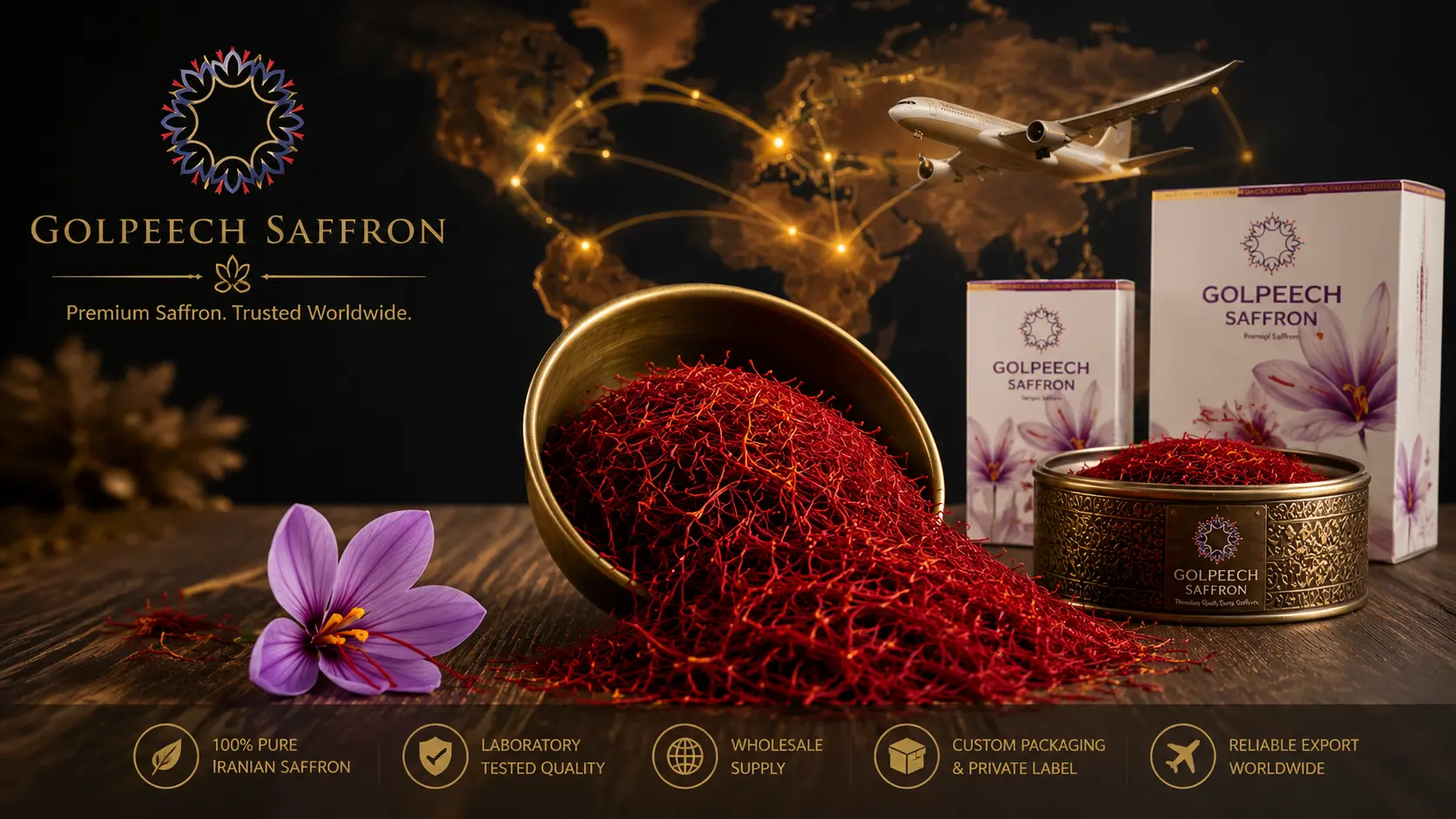
Bulk Saffron: A Complete Guide to Buying Premium Iranian Saffron for International Markets
Saffron is one of the world’s most valuable agricultural products, but purchasing it in bulk requires far more than simply comparing prices. For importers, distributors, food manufacturers, and private label brands, every purchasing decision directly affects product quality, customer satisfaction, and long-term profitability.
Bulk saffron sourcing involves evaluating product grades, laboratory quality, packaging options, export capabilities, and supplier reliability. A small difference in quality or processing standards can significantly influence the final product received by customers and the reputation of a business.
As the world’s leading producer of saffron, Iran supplies the majority of premium saffron traded internationally. Choosing the right Iranian supplier is therefore one of the most important decisions for companies involved in the global saffron market.
This guide explains everything professional buyers should know before purchasing bulk saffron—from understanding different grades and laboratory quality indicators to selecting a reliable exporter capable of meeting international market requirements.
What Is Bulk Saffron?
Bulk saffron refers to saffron threads supplied in commercial quantities rather than retail consumer packages. Depending on the buyer’s requirements, bulk orders may range from a few hundred grams to several kilograms and are commonly purchased by:
- Importers
- Wholesalers
- Food manufacturers
- Spice companies
- Private label brands
- Hospitality suppliers
- Pharmaceutical and nutraceutical manufacturers
- Beverage and confectionery producers
Unlike retail packaging, bulk saffron is prepared for industrial distribution or repackaging, making product consistency, traceability, and quality assurance essential considerations throughout the supply chain.
Why Businesses Buy Saffron in Bulk
Purchasing saffron in bulk offers significant commercial advantages beyond lower unit costs.
Better Cost Efficiency
Larger purchasing volumes generally provide more competitive pricing and improved profitability after repackaging or redistribution.
Consistent Product Quality
Working with a reliable supplier allows buyers to maintain uniform quality across multiple production batches, helping preserve brand reputation.
Flexible Packaging
Bulk saffron can later be packed into various retail formats based on each market’s requirements, including private label solutions.
Stable Supply
Long-term sourcing relationships reduce supply interruptions during seasonal demand fluctuations.
Custom Specifications
Professional suppliers can often provide customized grades, moisture specifications, packaging formats, and documentation according to buyer requirements.
Why Iranian Bulk Saffron Leads the Global Market
Iran produces the vast majority of the world’s saffron and has developed centuries of expertise in cultivation, harvesting, drying, grading, and processing.
Several factors contribute to the global reputation of Iranian saffron:
- Favorable climate conditions
- Traditional harvesting methods
- Skilled processing techniques
- High concentrations of coloring, aroma, and flavor compounds
- Wide availability of commercial grades
- Extensive export experience
For international buyers, Iranian saffron remains the benchmark for premium quality when sourced from experienced and reputable exporters.
Understanding Bulk Saffron Grades
One of the first questions buyers should ask is:
Which saffron grade best fits my market?
Different grades vary in appearance, purity, price, and intended application.
Super Negin Saffron
Super Negin represents one of the highest commercial grades available.
Characteristics include:
- Long, thick red stigmas
- Minimal yellow or white portions
- Excellent visual appearance
- High coloring strength
- Premium export quality
This grade is commonly selected for luxury retail brands and premium international markets.
Negin Saffron
Negin saffron offers an excellent balance between appearance, quality, and commercial value.
It is widely used by wholesalers, distributors, and private label companies seeking premium quality with competitive pricing.
Sargol Saffron
Sargol consists almost entirely of red stigmas without yellow style.
Advantages include:
- Strong coloring performance
- Attractive appearance
- High consumer acceptance
- Broad international demand
Pushal Saffron
Pushal saffron retains a small portion of the yellow style attached to the red stigma.
Many buyers appreciate Pushal because it demonstrates authenticity while offering excellent value for certain markets.
Bunch Saffron
Also known as traditional saffron, Bunch saffron contains the complete stigma attached to the style.
Although less common in premium retail markets, it remains popular in specific regions and traditional distribution channels.
How Bulk Saffron Quality Is Evaluated
Professional buyers rarely rely solely on visual appearance.
Instead, they evaluate several quality indicators before placing large orders.
Appearance
Uniform red threads, minimal broken pieces, and clean processing generally indicate careful harvesting and grading.
Aroma
Premium saffron produces a rich, distinctive aroma resulting from naturally occurring volatile compounds developed during proper drying and storage.
Coloring Strength
One of saffron’s most important commercial characteristics is its coloring ability.
Higher coloring strength typically reflects better quality and greater efficiency in food manufacturing and culinary applications.
Flavor Profile
Authentic saffron delivers a balanced taste with subtle bitterness that distinguishes it from adulterated or artificially colored products.
Cleanliness
Professional exporters carefully remove foreign materials, dust, floral residues, and other contaminants to meet international quality expectations.
Laboratory Verification
For commercial purchases, laboratory analysis provides objective confirmation of product quality.
Testing may include evaluation of coloring strength, aroma compounds, flavor components, moisture content, and purity according to internationally recognized analytical methods.
ISO 3632 and International Quality Standards
For professional buyers, visual inspection alone is never sufficient when purchasing bulk saffron. International trade increasingly relies on measurable quality parameters that allow buyers and suppliers to communicate using objective standards rather than subjective opinions.
The most widely recognized reference for saffron quality is ISO 3632, an international standard that classifies saffron according to laboratory analysis of its key quality characteristics.
The standard evaluates several important factors, including:
Coloring strength
Aroma compounds
Flavor characteristics
Moisture content
Purity and cleanliness
Rather than relying solely on appearance, buyers can compare products using laboratory data to better understand the expected quality level.
It is important to note that ISO 3632 itself is not a certification issued to companies. Instead, it is a testing and classification standard used by laboratories to evaluate saffron samples. Understanding this distinction helps buyers interpret laboratory reports correctly when comparing different suppliers.
Laboratory Testing for Bulk Saffron
Professional laboratory analysis plays an increasingly important role in international saffron trading, especially for importers purchasing large volumes.
Typical laboratory evaluations may include:
Crocin Analysis
Crocin is responsible for saffron’s coloring strength.
Higher crocin values generally indicate stronger coloring performance, which is particularly important for food manufacturers and industrial users.
Safranal Analysis
Safranal is the natural compound responsible for saffron’s characteristic aroma.
Proper harvesting, drying, and storage help preserve this important quality attribute.
Picrocrocin Analysis
Picrocrocin contributes to saffron’s distinctive flavor profile and serves as another indicator of product quality.
Moisture Measurement
Excess moisture can negatively affect:
Maintaining appropriate moisture levels is therefore an essential aspect of quality control.
Purity Assessment
Laboratory examination also helps identify:
Foreign materials
Plant residues
Artificial colorants
Possible adulteration
This provides additional confidence for importers purchasing commercial quantities.
Packaging Options for Bulk Saffron
Packaging is much more than a transportation requirement—it directly influences product protection, freshness, traceability, and customer perception.
Depending on customer requirements, bulk saffron may be supplied in different packaging formats suitable for wholesale distribution or further retail packing.
Typical considerations include:
Selecting the appropriate packaging depends on shipment volume, destination market, storage conditions, and intended application.
Private Label and OEM Solutions
Many international buyers prefer marketing saffron under their own brand rather than importing finished retail products.
Private Label manufacturing allows importers and distributors to build their own market presence while relying on an experienced producer for sourcing, processing, packaging, and quality management.
Depending on market requirements, private label projects may include:
Customized retail packaging
Multilingual labeling
Barcode integration
Market-specific packaging sizes
Branding support
Regulatory labeling requirements
For distributors looking to establish long-term brand value, private label solutions often provide greater commercial flexibility than purchasing generic retail products.
Storage and Shelf Life
Proper storage is essential for maintaining saffron quality throughout international distribution.
To preserve aroma, color, and flavor, saffron should generally be stored:
When stored correctly, premium saffron can retain its quality for an extended period while maintaining its valuable natural compounds.
What Determines Bulk Saffron Price?
Bulk saffron pricing is influenced by multiple factors rather than a single market rate.
Among the most significant are:
Professional buyers should therefore evaluate overall value rather than selecting suppliers based solely on the lowest quotation.
How to Choose a Reliable Bulk Saffron Supplier
Selecting the right supplier is one of the most important decisions in the purchasing process.
Beyond competitive pricing, experienced buyers typically evaluate suppliers based on several key criteria.
Product Consistency
Can the supplier maintain uniform quality across future shipments?
Quality Control
Does the company follow documented quality control procedures and provide laboratory support when required?
Export Experience
Has the supplier successfully served international customers with different regulatory and market requirements?
Packaging Capability
Can the supplier provide packaging solutions suitable for wholesale distribution or private label projects?
Communication
Professional communication, technical knowledge, and responsive customer support often indicate a reliable long-term business partner.
Common Mistakes When Buying Bulk Saffron
Even experienced buyers can encounter avoidable challenges.
Some of the most common mistakes include:
Selecting suppliers based only on price
Ignoring laboratory quality data
Failing to verify product consistency
Choosing inappropriate packaging
Overlooking storage conditions during transportation
Not confirming production capacity for future orders
Purchasing without requesting representative samples
A systematic supplier evaluation process helps reduce commercial risks and supports long-term business relationships.
Why International Buyers Choose Golpeech
Successful saffron sourcing depends not only on product quality but also on the reliability of the company behind it.
Golpeech has been supplying premium Iranian saffron to international markets for decades, serving importers, wholesalers, distributors, food manufacturers, and private label businesses across multiple regions.
Our approach focuses on:
Premium Iranian saffron sourced from leading production areas
Careful grading and quality control
Laboratory-supported quality evaluation
Flexible bulk packaging solutions
Private Label and OEM services
Export-oriented documentation
Long-term cooperation with international partners
Rather than offering a one-size-fits-all solution, our export team works closely with customers to understand their market requirements and recommend suitable grades, packaging options, and commercial solutions.
Conclusion
Purchasing bulk saffron is a strategic decision that influences product quality, customer satisfaction, and business profitability.
Successful sourcing requires much more than comparing prices. Buyers should evaluate saffron grades, laboratory quality indicators, packaging solutions, supplier experience, and long-term reliability before making purchasing decisions.
Working with an experienced exporter helps reduce supply risks while ensuring consistent quality, professional documentation, and flexible commercial support for international markets.
If your company is looking for a reliable supplier of premium Iranian saffron, selecting a partner with proven export experience, strong quality management, and customer-focused service can make a significant difference to your business.
Frequently Asked Questions
What is bulk saffron?
Bulk saffron refers to saffron sold in commercial quantities for importers, wholesalers, manufacturers, and private label businesses rather than individual retail consumers.
Which saffron grade is best for export?
The most suitable grade depends on the target market, budget, product positioning, and customer expectations. Super Negin, Negin, and Sargol are among the most widely traded export grades.
How is saffron quality verified?
Professional buyers typically rely on laboratory analysis, visual inspection, product consistency, and supplier quality management procedures.
Does ISO 3632 certify saffron companies?
No. ISO 3632 is an international testing and classification standard used to evaluate saffron quality. It is not a company certification.
Can bulk saffron be supplied under a private label?
Yes. Many international suppliers offer private label and OEM packaging solutions tailored to customer branding requirements.
What affects bulk saffron prices?
Price depends on grade, laboratory quality, harvest conditions, order quantity, packaging requirements, logistics, and destination market.
How should bulk saffron be stored?
Bulk saffron should be kept in sealed food-grade packaging, protected from moisture, heat, direct sunlight, and strong odors.
Is requesting a sample recommended before placing a large order?
Yes. Evaluating representative samples before purchasing commercial quantities is considered a standard practice in international saffron trade.