Saffron Supplier: How to Choose a Reliable Saffron Supplier
A saffron supplier is more than a company that sells saffron.
For international buyers, a professional saffron supplier is a business partner responsible for providing the right product specification, maintaining quality, preparing orders, supporting documentation, coordinating packaging and export requirements, and maintaining reliable supply over time.
Importers, wholesalers, distributors, food manufacturers, retailers, hospitality businesses, and private-label brands may all work with saffron suppliers, but their requirements are not necessarily the same.
Understanding what a professional saffron supplier does — and knowing how to evaluate one — can help buyers reduce sourcing risks and build more reliable long-term supply relationships.
What Is a Saffron Supplier?
A saffron supplier is a business that provides saffron products to commercial customers through an organized supply process.
Depending on its business model, a supplier may manage or coordinate:
The key difference between a professional supplier and a simple seller is the ability to provide a consistent product according to an agreed specification.
For a B2B buyer, the relationship should therefore be evaluated on more than the supplier’s ability to offer a particular price or grade.
What Does a Professional Saffron Supplier Do?
The role of a professional supplier can extend across several stages of the saffron supply chain.
Sourcing
The supplier must have access to suitable saffron and reliable production sources.
This becomes particularly important when buyers require:
Specific commercial grades
Defined quality specifications
Large quantities
Regular shipments
Consistent product characteristics
Quality Management
Professional suppliers need systems for inspecting and controlling saffron before it reaches the customer.
Depending on the operation, this may involve:
Packaging
The supplier may provide saffron in different formats depending on the customer’s requirements, from bulk industrial packaging to retail-ready and private-label products.
Export Preparation
For international customers, the supplier may also coordinate:
Commercial documentation
Packing information
Certificates
Shipping requirements
Export procedures
Logistics coordination
The exact documents and procedures depend on the destination market and transaction.
Customer Support
A professional supplier should also be able to communicate clearly with buyers about product specifications, samples, quotations, documentation, packaging, and repeat orders.
Where Does a Saffron Supplier Fit in the Supply Chain?
A simplified saffron supply chain can be represented as:
Farmers → Processors → Quality Control → Supplier → Importers → Distributors → Retailers / Food Manufacturers
In practice, these stages are not always separate companies.
A supplier may source directly from producers, work with processors, operate its own processing facilities, or combine several functions within one organization.
The important point is that the supplier acts as a commercial link between saffron production and the buyer’s market.
For an international buyer, this can reduce the need to coordinate multiple parties independently.
Supplier, Producer, Processor, Trader, and Distributor: What Is the Difference?
The terms used in the saffron industry can sometimes be confusing.
Producer
A producer cultivates and harvests saffron.
Processor
A processor handles post-harvest activities such as cleaning, separation, drying, sorting, and preparation.
Supplier
A supplier provides saffron to commercial buyers and may coordinate sourcing, quality control, packaging, storage, documentation, and export.
Trader
A trader primarily facilitates the buying and selling of products between different parties.
Distributor
A distributor purchases products and supplies them to customers within a particular market or distribution network.
One company can perform more than one of these roles.
For example, an integrated saffron company may combine production, processing, laboratory control, packaging, and international supply under one organization.
Different Types of Saffron Suppliers
Not every saffron supplier serves the same type of customer.
Bulk Saffron Suppliers
These suppliers focus primarily on commercial quantities for:
Importers
Wholesalers
Food manufacturers
Ingredient companies
Distributors
Buyers interested specifically in the bulk purchasing process can also consult our Bulk Saffron Buying Guide.
Export Saffron Suppliers
Export-oriented suppliers are equipped to serve international customers and may provide support with:
Export documentation
Packaging
Shipping
International logistics
Destination requirements
Private-Label Saffron Suppliers
These suppliers provide saffron that can be sold under the buyer’s own brand.
Services may include:
Retail Packaging Suppliers
These suppliers focus on consumer-ready saffron products for retailers, supermarkets, specialty stores, and online businesses.
Integrated Saffron Suppliers
An integrated supplier may manage several stages of the operation, including sourcing, processing, quality control, packaging, warehousing, and export.
For international B2B buyers, this type of structure can simplify communication and supply management.
What Services Can a Professional Saffron Supplier Provide?
Depending on the supplier and the project, commercial services may include:
Not every supplier provides every service.
Therefore, buyers should identify the services they actually require before choosing a supplier.
How to Evaluate a Saffron Supplier
Choosing a supplier should be based on more than price.
Before entering into a significant commercial relationship, international buyers should evaluate several factors.
1. Product Capability
Can the supplier provide the specific saffron product you need?
Check:
Commercial grade
Product form
Origin
Quantity
Quality specification
Packaging format
For information about the main Iranian commercial grades, see the Saffron Grades Guide.
2. Quality Management
Ask how the supplier controls product quality.
Important questions include:
How is incoming saffron inspected?
Is each batch identified?
Is laboratory testing available?
How is product traceability maintained?
How is consistency between batches controlled?
A supplier should be able to explain its quality process clearly rather than relying only on general claims such as “premium quality.”
For more information about objective saffron quality evaluation, see the Saffron Quality Guide.
3. Laboratory Documentation
For professional B2B purchases, laboratory documentation can provide important evidence about the product supplied.
Depending on the buyer’s requirements, this may include a Certificate of Analysis and other relevant laboratory information.
International buyers should agree on the required quality parameters before placing an order.
The International Organization for Standardization (ISO) currently lists ISO 3632-1:2025 as the published specification standard for dried saffron in filament, cut-filament, and powder forms. (ISO)
The supplier does not necessarily need to hold an “ISO 3632 certificate” simply because its saffron is tested against the standard. Buyers should distinguish between testing a product against a standard and being certified to a management system.
4. Supply Capacity
A supplier may be able to provide a small order but have limited capacity for regular commercial supply.
Ask:
How much can the supplier supply?
Can the same product be supplied repeatedly?
What is the expected lead time?
Can the supplier support seasonal or recurring demand?
For importers and brands, repeat-order capability can be just as important as the quality of the first shipment.
5. Export Experience
International supply involves requirements that do not apply to domestic sales.
An experienced export supplier should understand the practical requirements associated with:
6. Packaging Capability
Packaging requirements vary significantly between bulk, food-service, retail, and private-label projects.
Ask whether the supplier can provide:
Bulk packaging
Retail packaging
Customized packaging
Private-label packaging
Appropriate labeling
For more information, see the Saffron Packaging Guide.
7. Communication and Responsiveness
Communication is often overlooked when evaluating suppliers.
A professional supplier should be able to provide clear answers about:
Product specifications
Samples
Pricing
MOQ
Lead times
Documentation
Packaging
Shipping
Poor communication during the quotation stage can become a larger problem after an order has been placed.
What Makes a Reliable Saffron Supplier?
A reliable supplier should be able to demonstrate more than the ability to provide saffron today.
Look for evidence of:
Consistent Product Quality
The supplier should have processes for maintaining agreed specifications between batches.
Traceability
Products should be identifiable by batch or another appropriate tracking system.
Quality Documentation
The supplier should be able to provide relevant specifications and laboratory documentation when required.
Supply Continuity
The supplier should have sufficient sourcing and production capability to support repeat orders.
Export Capability
The supplier should understand the practical requirements of international shipments.
Clear Commercial Communication
Prices, quantities, specifications, payment terms, packaging, delivery terms, and documentation should be clearly discussed.
Long-Term Orientation
A strong supplier relationship should not depend solely on the lowest price for one shipment.
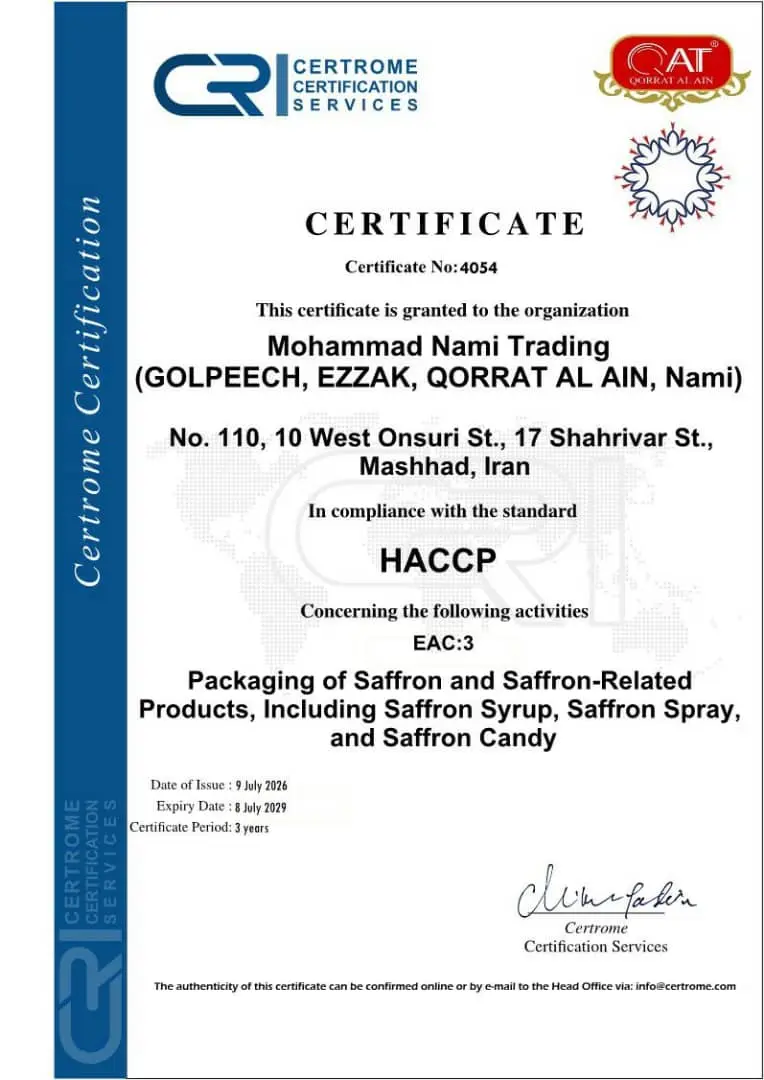
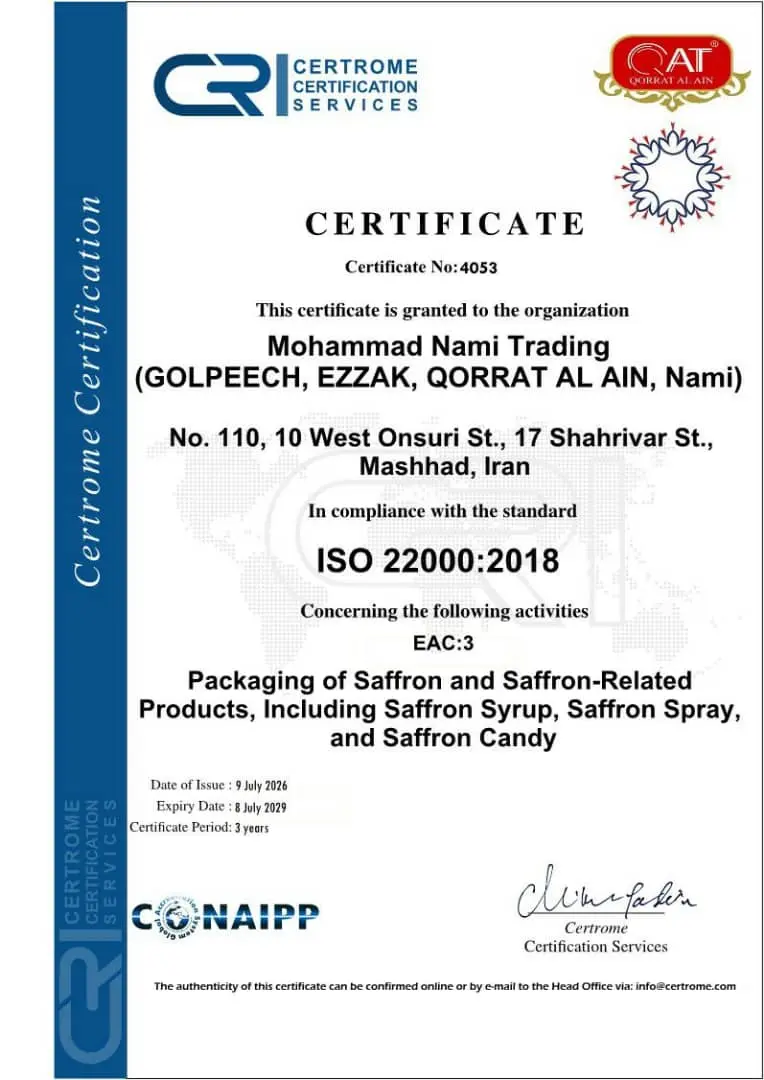
Why HACCP and ISO 22000 Matter When Choosing a Supplier
For food-industry buyers, food safety management is an important part of supplier evaluation.
Two internationally recognized frameworks commonly encountered in food supply chains are:
These systems address areas such as food safety hazards, preventive controls, traceability, and systematic food safety management.
However, buyers should verify exactly what certification applies to the supplier, facility, or product rather than treating the words “HACCP” or “ISO” as general quality claims.
For buyers specifically interested in certified saffron manufacturing, see the Golpeech guide to HACCP & ISO 22000 Certified Saffron Manufacturing.
How Professional Suppliers Create Value for Buyers
A professional supplier can reduce the amount of work an importer or manufacturer has to manage internally.
Supply Stability
Established sourcing and inventory systems can help reduce supply interruptions.
Quality Consistency
Defined quality procedures can help maintain agreed product characteristics.
Operational Efficiency
Working with one coordinated supplier can simplify sourcing, packaging, documentation, and logistics.
Flexibility
Suppliers may be able to provide different grades, quantities, product forms, or packaging options.
Risk Management
Clear specifications, traceability, documentation, and quality control can reduce avoidable purchasing and supply-chain risks.
The value of a supplier is therefore not simply the product itself.
It is the reliability of the entire supply process.
Private Label and Customized Saffron Supply
Many international brands do not want to sell saffron under the supplier’s existing brand.
Instead, they may require:
A supplier capable of managing these requirements can make private-label sourcing considerably simpler.
However, buyers should establish packaging specifications, minimum quantities, artwork requirements, labeling responsibilities, and lead times before starting production.
What Questions Should You Ask a Saffron Supplier?
Before placing a significant order, international buyers should consider asking:
Product
What commercial grades do you supply?
What product forms are available?
What is the declared origin?
What quality specifications apply?
Quality
How is each batch inspected?
Is laboratory testing available?
Can you provide a COA?
How do you maintain batch consistency?
Is product traceability available?
Supply
What quantities can you supply?
What is your MOQ?
What is the normal lead time?
Can you support repeat orders?
Packaging
What bulk packaging options are available?
Do you offer private-label packaging?
Can packaging be customized for the destination market?
Export
Which export documents can you provide?
Which Incoterms are available?
Can you arrange international shipping?
Commercial Relationship
Can you provide a representative sample?
Can you maintain the agreed specification for future orders?
Who will be the main contact for ongoing orders?
These questions can help buyers distinguish between a supplier that simply sells saffron and one capable of supporting a long-term B2B relationship.
How to Verify a Saffron Supplier Before Ordering
Before placing a large order with a new supplier, buyers can follow a simple verification process.
Step 1: Review the Company
Check:
Company identity
Business history
Physical presence
Website
Contact information
Export markets
Step 2: Review Product Information
Confirm:
Product origin
Grade
Form
Specifications
Packaging options
Step 3: Request Documentation
Ask for relevant:
Step 4: Request a Sample
Whenever practical, evaluate a representative sample before making a significant purchase.
Step 5: Compare Commercial Terms
Compare suppliers using the same:
Step 6: Assess Communication
Evaluate how clearly and professionally the supplier responds to technical and commercial questions.
Step 7: Start With a Controlled Order
For a new supplier relationship, an initial order can provide an opportunity to evaluate the actual supply process before increasing purchasing volumes.
Red Flags When Choosing a Saffron Supplier
Buyers should investigate suppliers carefully when they encounter:
Unusually Low Prices
A very low quotation may reflect differences in:
Grade
Quality
Quantity
Packaging
Delivery terms
Vague Quality Claims
Terms such as “Premium,” “A+,” or “Super Quality” are not substitutes for a defined specification.
No Product Documentation
If a supplier cannot clearly explain the product specifications or provide appropriate documentation when required, further verification may be necessary.
Inconsistent Information
Differences between the quotation, product description, laboratory information, and commercial documentation should be clarified before ordering.
Pressure to Place a Large Order
A professional supplier should be able to discuss specifications, samples, documentation, and commercial terms before expecting a significant commitment.
Poor Communication
Slow, unclear, or inconsistent communication can create problems later in the supply relationship.
Why Businesses Choose Professional Saffron Suppliers
For international businesses, the supplier relationship can influence much more than the initial purchase.
A capable supplier can support:
Reliable sourcing
Consistent quality
Product development
Packaging
Private labeling
Export operations
Repeat orders
Market expansion
This is particularly important for businesses whose customers expect the same product quality from one purchase to the next.
For this reason, supplier selection should be viewed as a long-term sourcing decision, not simply a price comparison.
Why Choose Golpeech as Your Saffron Supplier?
Golpeech supplies Iranian saffron to international importers, wholesalers, distributors, food manufacturers, hospitality businesses, retailers, and private-label brands.
Our supply approach combines product sourcing, quality management, laboratory support, packaging, and export capabilities to serve different B2B requirements.
Golpeech operates with HACCP and ISO 22000 certified facilities and can support customers with:
The objective is not simply to sell a particular saffron grade.
It is to provide a product and supply solution that matches the buyer’s specification, application, market, and commercial requirements.
Conclusion
A professional saffron supplier is more than a seller.
For international buyers, the right supplier can coordinate sourcing, quality management, laboratory verification, packaging, documentation, export operations, and ongoing supply.
The most important question is therefore not:
“Who sells saffron?”
but:
“Who can consistently supply the saffron I need, according to an agreed specification and with the level of quality, documentation, service, and reliability my business requires?”
Before choosing a supplier, evaluate:
Product Capability + Quality Management + Supply Capacity + Export Experience + Documentation + Packaging + Communication + Long-Term Reliability
A supplier that performs well across these areas is far more likely to become a dependable long-term business partner.
Frequently Asked Questions
What is a saffron supplier?
A saffron supplier is a business that provides saffron to commercial buyers and may manage or coordinate sourcing, quality control, packaging, documentation, storage, and export.
What does a professional saffron supplier do?
A professional supplier can coordinate product sourcing, quality management, laboratory testing, packaging, export documentation, logistics, and customer support.
What is the difference between a saffron supplier and a trader?
A supplier generally manages or coordinates an ongoing product supply process, while a trader primarily facilitates buying and selling between different parties. In practice, some companies may perform both roles.
How do I choose a reliable saffron supplier?
Evaluate the supplier’s product capability, quality systems, laboratory documentation, supply capacity, export experience, packaging capabilities, communication, and ability to maintain consistent specifications.
Should I request a sample from a saffron supplier?
Yes. For a new supplier, requesting a representative sample is recommended whenever practical, particularly before placing a significant commercial order.
What documents should a saffron supplier provide?
Depending on the transaction and destination market, documents may include product specifications, COA, commercial invoice, packing list, certificate of origin, and other required export or regulatory documents.
Why are HACCP and ISO 22000 important for saffron suppliers?
They are recognized food-safety management frameworks that can provide evidence of structured approaches to food-safety risks, controls, and management. Buyers should verify the specific certification and its scope.
Do saffron suppliers offer private-label services?
Many professional suppliers offer private-label solutions, including customized packaging, labeling, product specifications, and retail formats.
Can a saffron supplier provide different grades?
Many commercial suppliers offer multiple grades, such as Super Negin, Negin, Sargol, Pushal, and Bunch, depending on their sourcing and production capabilities.
Why is batch consistency important?
For importers, manufacturers, retailers, and brands, inconsistent shipments can affect product performance, customer expectations, and brand reputation. A reliable supplier should therefore have systems for maintaining agreed specifications across repeat orders.
Related Golpeech Saffron Guides
Looking for a Reliable Iranian Saffron Supplier?
If you are an importer, wholesaler, distributor, food manufacturer, retailer, hospitality business, or private-label brand, the right supplier should be able to provide more than saffron.
Golpeech can help international buyers discuss their requirements for:
Grade · Form · Quantity · Quality Specification · Packaging · Documentation · Destination · Long-Term Supply
Contact Golpeech to discuss your saffron sourcing requirements and find a supply solution suited to your market.