Saffron Grades
logo golpeech Golpeech Saffron

Golpeech Saffron

Table of Contents

Saffron Grades Explained: Negin, Sargol, Super Negin, Pushal & Bunch

Not all saffron is the same.

For international buyers, understanding saffron grades is important because different commercial grades offer different physical characteristics, appearances, applications, and price positions.

Terms such as Super Negin, Negin, Sargol, Pushal, and Bunch are commonly used in the Iranian saffron trade to describe different forms and commercial grades of saffron.

However, one important distinction should always be kept in mind:

Commercial grade and laboratory quality are not the same thing.

A premium commercial grade is generally associated with specific physical characteristics such as longer, thicker, and more visually uniform red stigmas. Laboratory testing, on the other hand, evaluates measurable quality and safety parameters.

For importers, distributors, food manufacturers, hospitality businesses, retailers, and private-label brands, the right purchasing decision is therefore not simply about choosing the highest grade.

It is about selecting the right saffron grade, quality specification, packaging, and supply solution for the intended application and target market.

This guide explains the main Iranian saffron grades, how they differ, how commercial grading relates to laboratory quality, and how international buyers can select the most suitable grade for their business.


What Are Saffron Grades?

Saffron grades are commercial classifications used to describe the physical characteristics and processing form of saffron.

The classification of saffron is influenced by characteristics such as:

  • The proportion of red stigma

  • Presence of yellow style

  • Thread length

  • Thread thickness

  • Degree of breakage

  • Visual uniformity

  • Cleanliness

  • Processing and sorting

The way saffron is separated from the flower after harvesting plays an important role in determining its commercial form.

This is why Negin, Sargol, Pushal, and Bunch should not simply be considered different names for the same product.

They represent different physical forms and commercial specifications.

For buyers, understanding these differences is particularly important when saffron is being purchased for retail packaging, private-label products, food manufacturing, hospitality, or wholesale distribution.


How Iranian Saffron Is Commercially Graded

Saffron comes from the three red stigmas inside each saffron flower.

After harvesting, the flowers are carefully processed to separate the stigmas from the rest of the flower.

Depending on how the red stigma and yellow style are retained or separated, different commercial forms are produced.

The resulting saffron may differ in:

  • Amount of red stigma retained

  • Amount of yellow style retained

  • Thread length

  • Thread integrity

  • Visual appearance

  • Sorting level

The grade therefore tells buyers important information about the physical presentation of the product.

It does not, by itself, provide a complete measurement of chemical quality.

This distinction becomes particularly important when comparing premium retail saffron with saffron intended for industrial or food-manufacturing applications.


The Main Iranian Saffron Grades

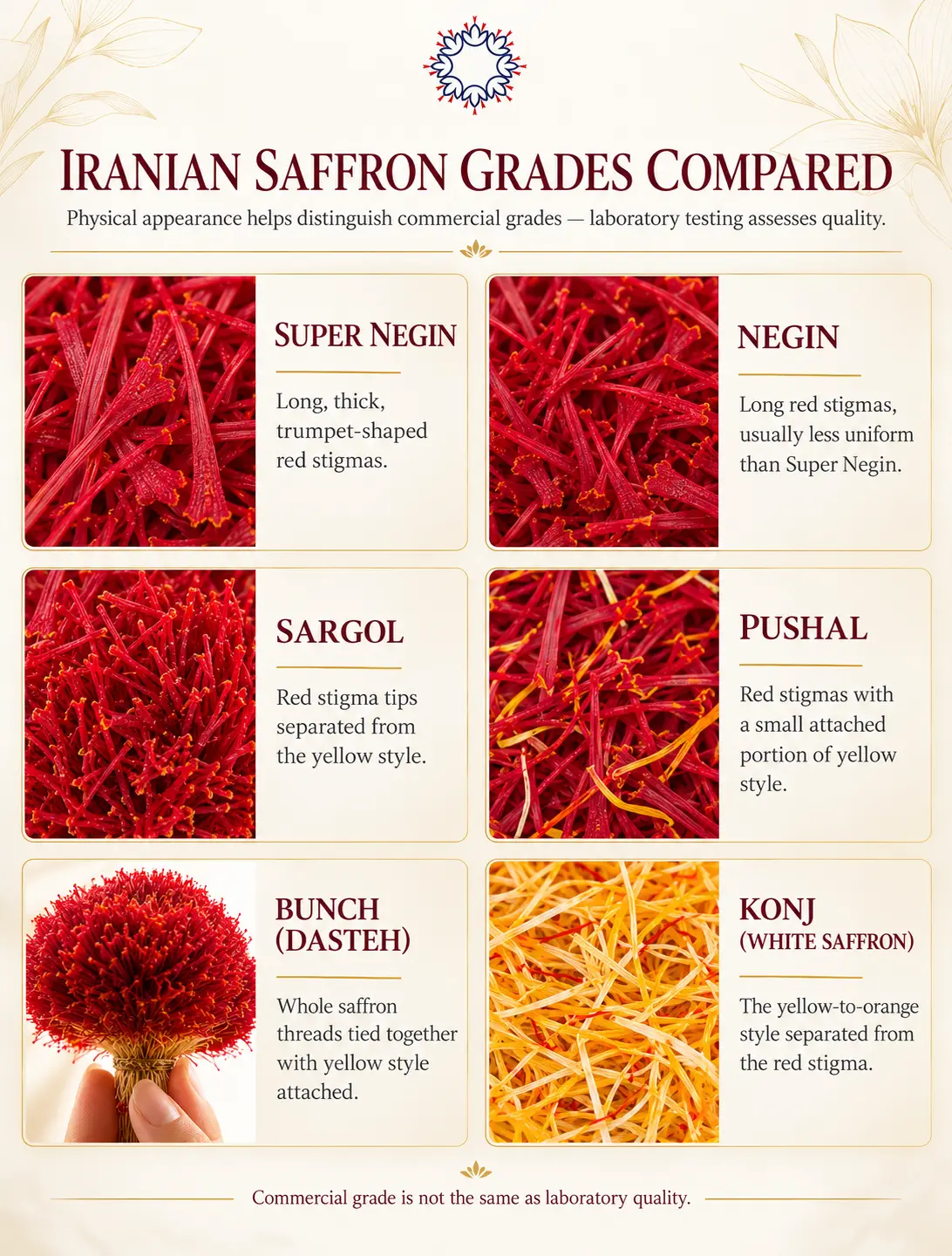
Super Negin Saffron

Super Negin is generally positioned at the premium end of the Iranian commercial saffron market.

It is selected for long, thick, intact, and visually attractive red stigmas.

Typical characteristics include:

  • Extra-long red threads

  • Thick stigmas

  • Fully red appearance

  • High visual uniformity

  • Low visible breakage

  • Premium presentation

The main commercial advantage of Super Negin is its appearance.

This makes it particularly attractive for products where consumers can see the saffron threads.

Typical Applications

Super Negin is commonly considered for:

  • Luxury retail

  • Premium supermarkets

  • Gourmet products

  • Gift boxes

  • Premium private-label products

  • High-end hospitality presentation

For these applications, the visual appearance of the saffron can contribute significantly to the perceived value of the final product.


Negin Saffron

Negin is another premium commercial form of Iranian saffron.

It generally consists of long, thick, fully red stigmas selected for attractive appearance and good thread integrity.

Typical characteristics include:

  • Long red threads

  • Thick appearance

  • Fully red stigmas

  • No yellow style

  • Attractive visual presentation

Negin offers a strong combination of premium appearance and commercial practicality.

Typical Applications

Negin can be suitable for:

  • Premium retail

  • Private-label brands

  • Gourmet products

  • Specialty food stores

  • Export markets

  • Premium packaging

  • Gift products

The exact distinction between Negin and Super Negin can vary according to commercial specifications used by different suppliers and markets.

For this reason, professional buyers should always confirm the physical specifications of the product rather than purchasing solely on the grade name.


Sargol Saffron

Sargol consists of the red part of the saffron stigma without the yellow style.

It is one of the most widely traded commercial forms of Iranian saffron.

Typical characteristics include:

  • Fully red threads

  • No yellow style

  • Relatively shorter red stigmas compared with long-thread premium selections

  • Clean visual appearance

  • Broad commercial availability

Sargol is particularly attractive when the buyer needs red saffron but does not require exceptionally long threads.

Typical Applications

Sargol can be suitable for:

  • Food manufacturing

  • Wholesale distribution

  • Restaurants

  • Hospitality

  • Spice products

  • Retail

  • Private-label products

For industrial applications, Sargol can offer an attractive balance between physical quality and commercial value.

However, it is important not to assume that Sargol automatically has stronger coloring power than Negin.

Coloring strength is a laboratory parameter and should be determined through testing rather than commercial grade alone.


Pushal Saffron

Pushal retains the red stigma together with a portion of the yellow style.

This gives Pushal a different appearance from fully trimmed red saffron such as Sargol or Negin.

Typical characteristics include:

  • Red stigma

  • A portion of yellow style

  • Natural thread structure

  • Distinctive appearance

  • Competitive commercial positioning

Some markets and buyers appreciate Pushal because the retained style gives the saffron a more natural and recognizable structure.

Typical Applications

Pushal can be suitable for:

  • Retail

  • Restaurants

  • Hospitality

  • Food service

  • Traditional markets

  • Regional distribution

  • Selected private-label products

The amount of yellow style should be clearly specified when purchasing Pushal in bulk.


Bunch Saffron (Dasteh)

Bunch saffron, commonly known as Dasteh, is the traditional form in which the saffron stigmas remain attached to the style and are arranged into bundles.

It has a distinctly traditional appearance.

Typical characteristics include:

  • Red stigmas

  • Significant yellow style

  • Bundled structure

  • Traditional presentation

  • Lower trimming level

Bunch saffron remains relevant in traditional and regional markets, although it is less commonly used for premium modern retail packaging.

Typical Applications

Bunch saffron may be suitable for:

  • Traditional markets

  • Regional distribution

  • Specialty products

  • Traditional culinary applications

  • Markets where the original structure of saffron is valued

Bunch saffron should not automatically be described as low quality.

It is better understood as a different commercial form with different physical characteristics and market applications.


Konj or White Saffron

Konj, sometimes referred to as white saffron, is the yellow style portion separated from the red stigma.

It is therefore fundamentally different from the principal red saffron grades used in premium food and retail products.

Because the red stigma contains the major compounds responsible for saffron’s characteristic color, aroma, and taste, Konj should not be considered equivalent to premium red saffron.

Its uses and commercial value depend on the specific market and application.


Saffron Grades at a Glance

GradeKey Characteristics
Super NeginExtra-long, thick, fully red and highly uniform threads
NeginLong, thick and fully red threads
SargolRed stigma without yellow style
PushalRed stigma with a portion of yellow style
Bunch / DastehRed stigma attached to substantial yellow style in bundles
KonjYellow style separated from the red stigma

These descriptions refer to commercial and physical characteristics.

They should not be interpreted as laboratory quality rankings.


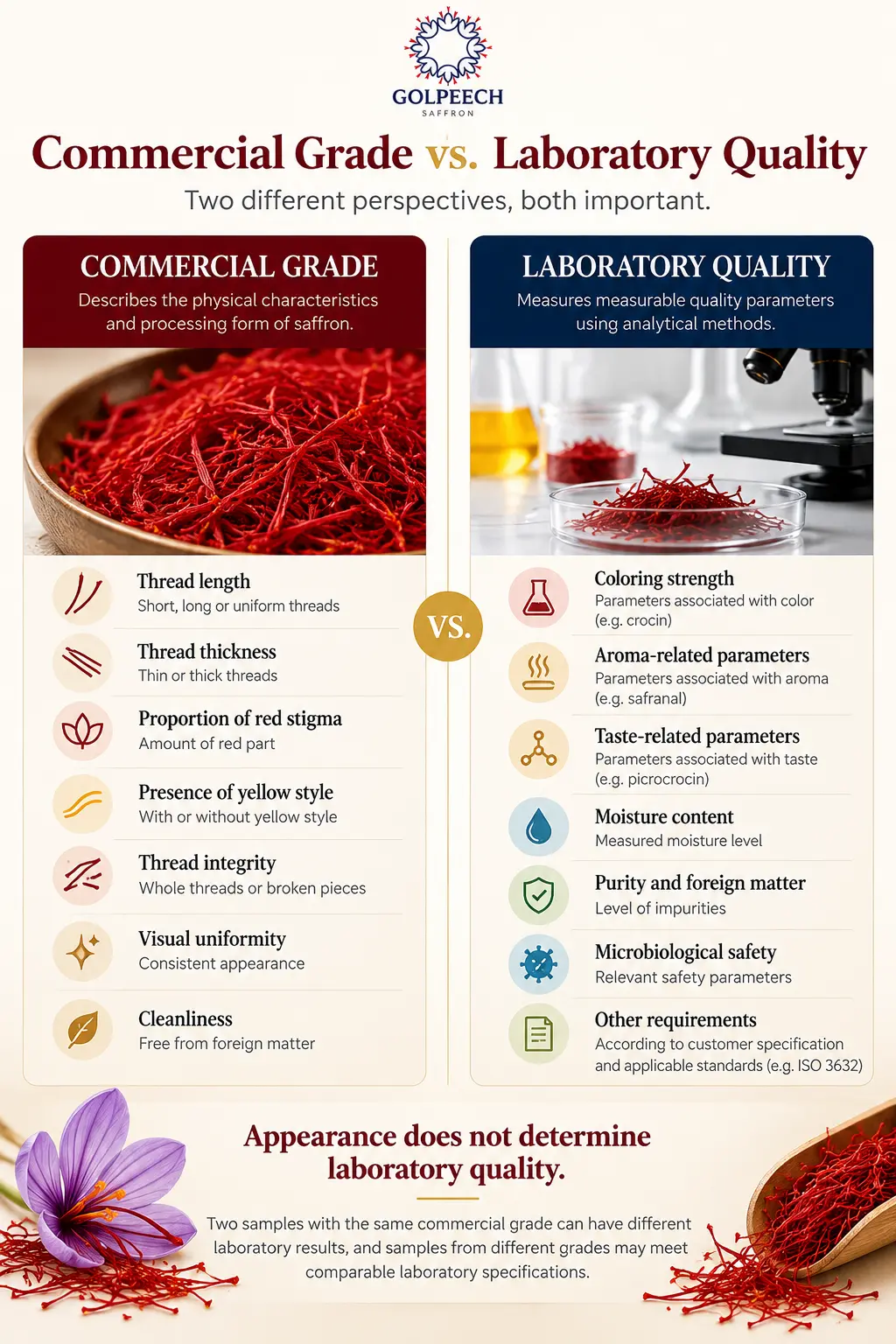
Commercial Grade vs. Laboratory Quality

This distinction is one of the most important concepts for professional saffron buyers.

Commercial grade describes what the saffron looks like and how it has been processed. Laboratory testing measures objective quality and safety parameters.

These two systems complement each other, but they should not be confused.

Commercial Grade

Commercial grading focuses primarily on physical characteristics such as:

  • Thread length

  • Thread thickness

  • Percentage of red stigma

  • Presence of yellow style

  • Thread integrity

  • Visual uniformity

  • Cleanliness

  • Overall appearance

These characteristics are particularly important for retail products and premium packaging.

Laboratory Quality

Laboratory evaluation focuses on measurable characteristics of the product.

Depending on the product, market, customer specification, and applicable requirements, quality control may include evaluation of:

  • Coloring-related parameters

  • Aroma-related parameters

  • Taste-related parameters

  • Moisture

  • Purity

  • Foreign matter

  • Microbiological safety

  • Other required quality and safety parameters

International saffron buyers may also use ISO 3632 as an important reference when defining saffron quality specifications.

The current international specification is ISO 3632-1:2025, which specifies requirements for dried saffron in filament, cut-filament, and powder forms. The previous ISO 3632-1:2011 edition has been withdrawn and replaced by the 2025 edition. (ISO)

However, an important distinction must be made:

ISO 3632 is a standard for saffron specifications and testing; it is not the same thing as a commercial saffron grade.


Does Golpeech Have ISO 3632 Certification?

Golpeech does not claim to hold an ISO 3632 certification.

Instead, Golpeech uses quality-control and laboratory testing processes to evaluate saffron according to the product requirements and specifications relevant to each order.

Golpeech products are selected and controlled to meet demanding quality requirements, and where required by the customer or application, relevant saffron quality parameters can be evaluated against the specifications associated with ISO 3632.

This means buyers can discuss their required quality specification with Golpeech without confusing:

ISO 3632 product specifications

with

ISO 3632 certification of the supplier.

This distinction is important for professional buyers because a supplier may provide saffron that meets specified quality parameters without claiming to be an ISO 3632-certified company.


Does a Higher Saffron Grade Mean Better Quality?

Not necessarily.

A higher commercial grade generally means that the saffron meets more demanding physical or visual specifications.

That can be highly valuable for premium retail products.

However, commercial grade alone does not guarantee superior laboratory performance.

For example, a food manufacturer may obtain better commercial value from a well-specified Sargol batch with suitable laboratory results than from paying a premium for exceptionally long Negin threads that will later be ground, infused, or incorporated into another food product.

The right question is therefore not:

“Which grade is the highest?”

It is:

“Which grade provides the right combination of appearance, laboratory quality, performance and price for my application?”


Can Sargol Have Better Laboratory Results Than Negin?

Yes.

Commercial grade and chemical quality are separate dimensions.

A particular Sargol batch can have stronger laboratory results than another batch commercially classified as Negin.

Factors such as:

  • Growing conditions

  • Harvest timing

  • Drying

  • Processing

  • Storage

  • Moisture exposure

  • Age

  • Packaging

can influence the measurable quality of saffron.

Therefore, professional buyers should use laboratory testing when chemical quality is an important part of the purchasing specification.


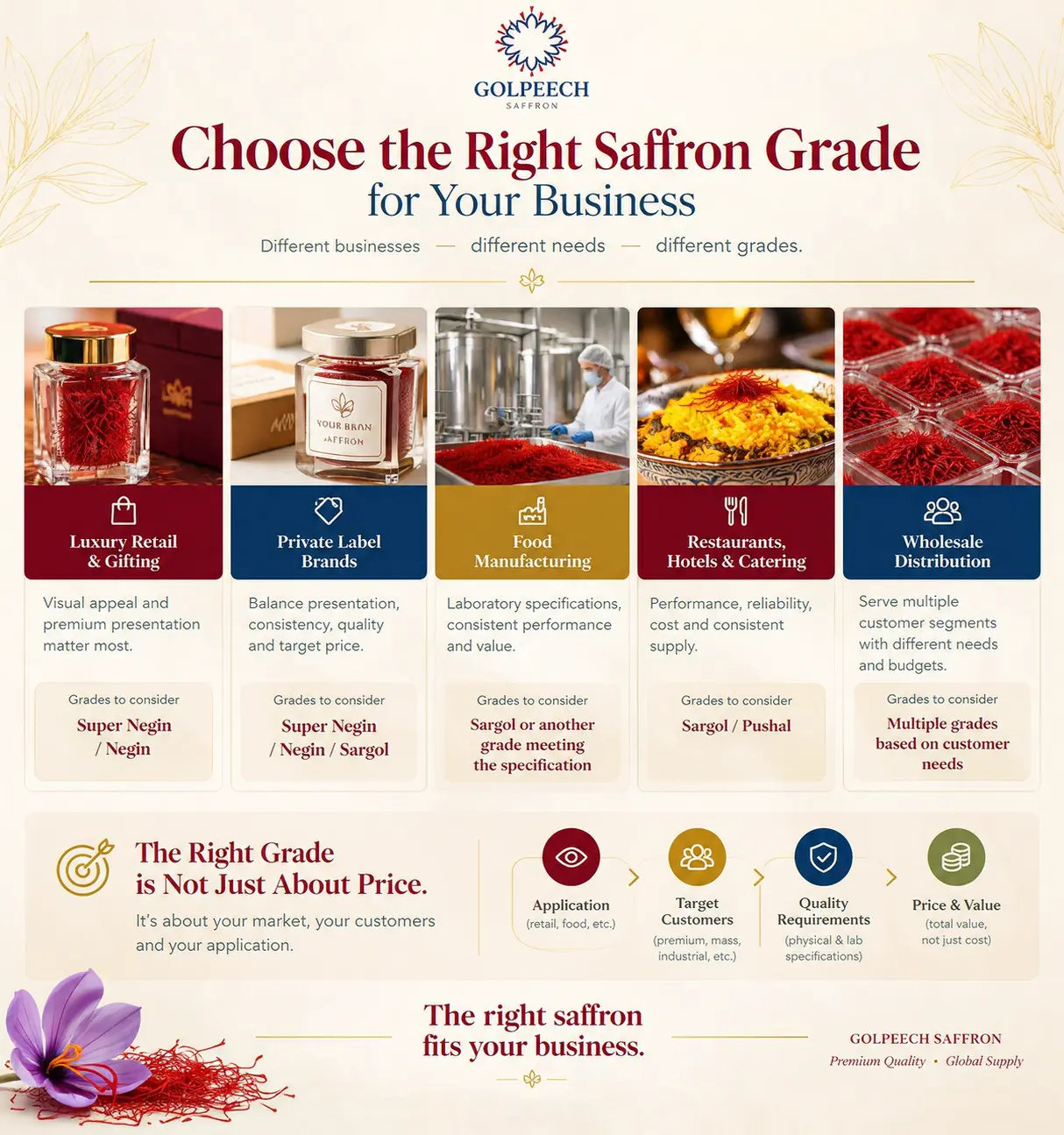
Which Saffron Grade Is Best for Different Businesses?

There is no universal “best” saffron grade.

The right choice depends on the product, customer, market, packaging, and budget.

Premium Retail Brands

Premium retail products often benefit from visually attractive saffron because consumers can see the threads.

Common choices include:

  • Super Negin

  • Negin

Key priorities:

  • Appearance

  • Thread uniformity

  • Premium positioning

  • Packaging

  • Consumer perception


Private-Label Brands

Private-label brands need to balance appearance, consistency, quality and target price.

Possible choices include:

  • Super Negin

  • Negin

  • High-quality Sargol

A luxury private-label product may benefit from Negin or Super Negin, while a more price-sensitive premium product may achieve better value with Sargol.


Food Manufacturers

Food manufacturers often use saffron as an ingredient rather than displaying whole threads.

Their priorities may include:

  • Consistent quality

  • Laboratory specifications

  • Reliable performance

  • Supply continuity

  • Cost efficiency

Sargol can therefore be a practical commercial choice for many food applications.

The final selection should always be based on the manufacturer’s formulation and required specifications.


Restaurants and Horeca

Restaurants, hotels and catering businesses usually need a balance between:

  • Quality

  • Cost

  • Reliability

  • Performance

  • Supply continuity

Sargol and Pushal can both be suitable depending on the application and desired presentation.


Wholesale Distributors

Wholesale distributors often serve several customer segments simultaneously.

Instead of relying on one grade, a distributor may benefit from offering:

  • Premium grades

  • Mid-range grades

  • Cost-efficient grades

  • Customized specifications

This approach allows different products to be matched to different customer requirements.


Saffron Grade by Business Application

Business ApplicationMain Purchasing Priority
Luxury RetailAppearance and presentation
Private LabelAppearance, consistency and target price
Food ManufacturingQuality specification, consistency and value
HorecaPerformance, reliability and cost
WholesaleProduct range and supply continuity
Gift ProductsThread appearance and premium presentation

These are general commercial guidelines rather than fixed rules.

The final grade should always be selected according to the buyer’s actual requirements.


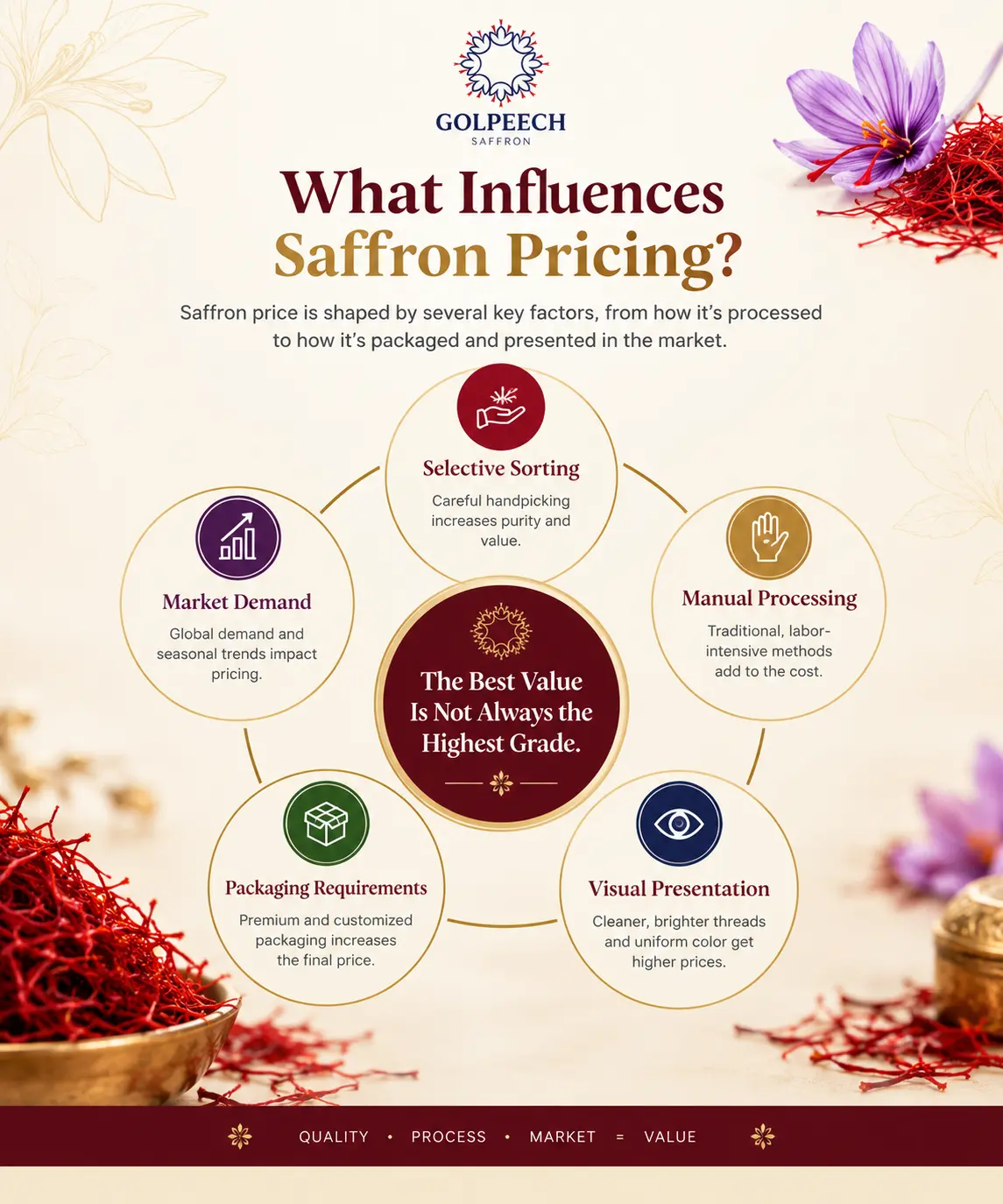
How Saffron Grade Influences Pricing

Saffron pricing is influenced by much more than the commercial grade.

Important factors include:

  • Harvest conditions

  • Raw material availability

  • Selective sorting

  • Labor requirements

  • Market demand

  • Laboratory specifications

  • Packaging

  • Order volume

  • Destination market

  • Delivery terms

Premium grades such as Super Negin and Negin generally require more selective sorting because buyers expect longer, thicker and more visually uniform threads.

The greater the selection required, the smaller the proportion of raw saffron that may qualify for a particular specification.

This can contribute to a higher commercial price.

However, actual export quotations vary according to market conditions and contractual specifications.


Why Appearance Influences Saffron Pricing

Appearance matters most when the consumer can see the saffron.

A retail package containing long, intact red threads communicates a different level of visual presentation from a package containing shorter or mixed pieces.

This makes thread appearance particularly important for:

  • Luxury gift boxes

  • Premium jars

  • Transparent packaging

  • Gourmet retail

  • Premium private-label products

For industrial buyers, however, paying more for visual characteristics that will disappear during processing may not provide the same commercial benefit.

This is why professional buyers should evaluate value for application, not simply price per kilogram.


Choosing the Best Value Instead of the Highest Grade

Professional buyers rarely need the most expensive saffron available.

They need the saffron that best fits their business model.

Premium Retail Brand

Priority:

  • Exceptional appearance

  • Premium consumer experience

  • Luxury packaging

Potential grades:

  • Super Negin

  • Negin


Private-Label Brand

Priority:

  • Attractive presentation

  • Consistent quality

  • Competitive pricing

  • Brand positioning

Potential grades:

  • Negin

  • Super Negin

  • High-quality Sargol


Food Manufacturer

Priority:

  • Reliable performance

  • Laboratory specifications

  • Batch consistency

  • Cost efficiency

Potential grade:

  • Sargol, depending on the required specification


Restaurant Chain

Priority:

  • Consistent performance

  • Reliable supply

  • Balanced cost

  • Suitable presentation

Potential grades:

  • Sargol

  • Pushal


Wholesale Distributor

Priority:

  • Multiple customer segments

  • Different price points

  • Consistent supply

  • Product portfolio

Potential approach:

Maintain several grades rather than relying on a single commercial specification.


How to Choose the Right Grade for Your Market

There is no single saffron grade that is automatically best for every country.

Market selection should take into account:

  • Consumer expectations

  • Distribution channel

  • Product positioning

  • Culinary application

  • Packaging

  • Target price

  • Regulatory requirements

  • Customer preferences

A premium retail buyer may prioritize appearance.

A food manufacturer may prioritize laboratory specifications and consistency.

A distributor may need several grades to serve different customer groups.

Therefore, successful saffron procurement starts with the customer and application, not simply the grade name.


Saffron Grades Across International Markets

Middle East and GCC

Premium visual presentation can be particularly important in markets where saffron is sold as a luxury culinary ingredient or premium gift product.

Potentially suitable grades include:

  • Super Negin

  • Negin

Sargol and Pushal can also serve different applications and price segments.


Europe

Professional European buyers may place strong emphasis on:

  • Traceability

  • Quality specifications

  • Food safety

  • Consistency

  • Documentation

  • Laboratory testing

Depending on the application, both premium whole-thread grades and more cost-efficient grades can be relevant.


China

Premium presentation, authenticity, gifting and consistent quality can all influence purchasing decisions.

Premium whole-thread grades may therefore be attractive for selected retail and gifting applications.


North America

The market includes both premium retail and industrial food applications.

Retail buyers may prioritize:

  • Appearance

  • Branding

  • Authenticity

  • Packaging

Industrial buyers may focus more strongly on:

  • Consistency

  • Quality specifications

  • Reliable supply

  • Cost efficiency

The appropriate grade therefore depends heavily on the intended distribution channel.


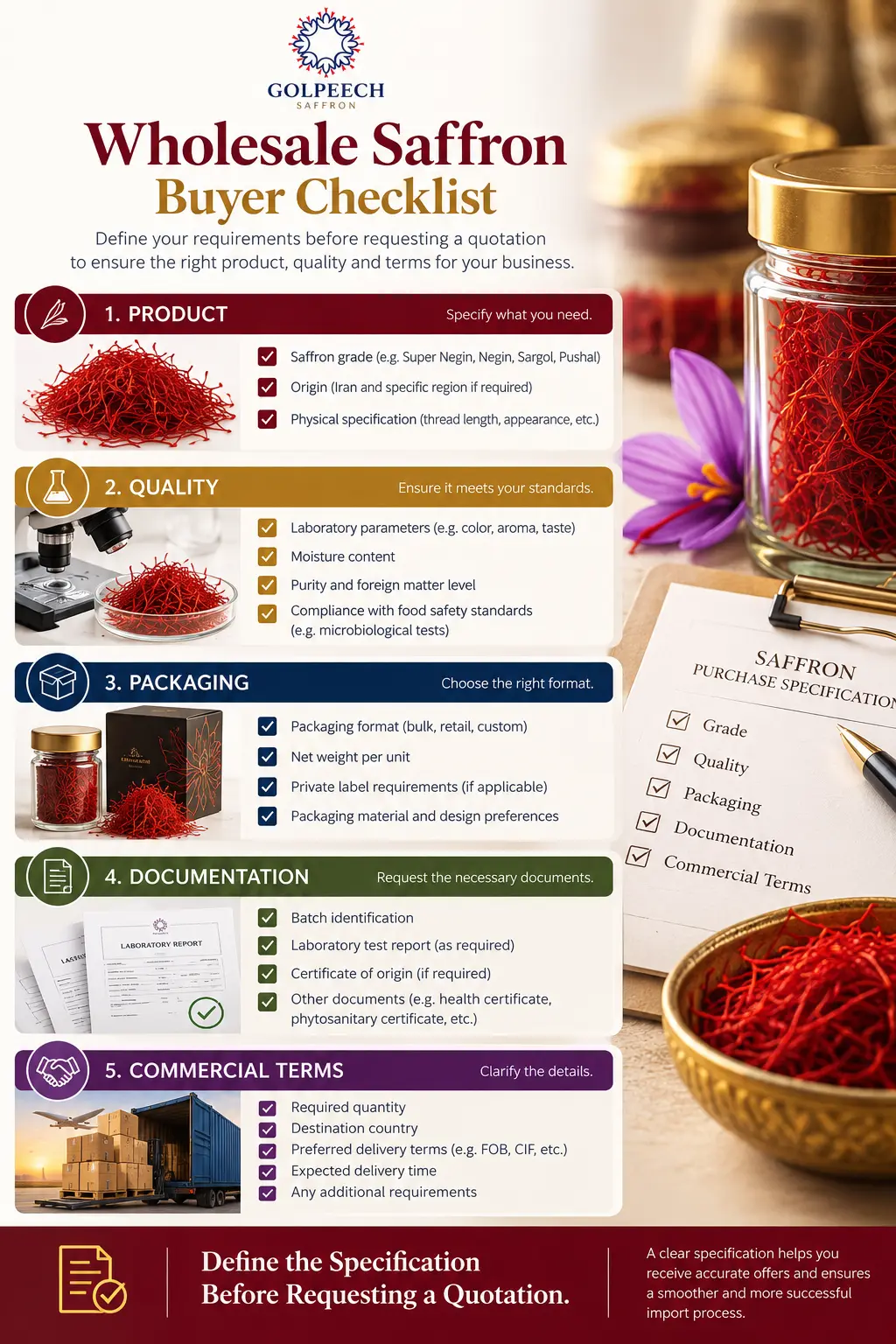
What International Buyers Should Specify Before Ordering Saffron

One of the most common purchasing mistakes is relying only on a grade name.

For example, simply requesting:

“Negin saffron”

may not provide enough information to define the exact product required.

A professional purchasing specification should include the relevant details.

Recommended Specifications

  • Commercial grade

  • Origin

  • Physical characteristics

  • Red stigma requirements

  • Yellow style tolerance, where applicable

  • Thread integrity

  • Laboratory quality requirements

  • Moisture requirements

  • Purity requirements

  • Microbiological requirements, where applicable

  • Packaging

  • Net weight

  • Batch identification

  • Required documentation

  • Order quantity

  • Delivery terms

  • Private-label requirements

The more precisely the product is specified, the lower the risk of misunderstanding between buyer and supplier.


Why Laboratory Testing Matters

Commercial appearance is only one part of saffron quality.

Professional buyers may require laboratory evaluation to verify that the product meets agreed specifications.

Depending on the product and customer requirements, saffron quality control can involve testing for relevant:

  • Chemical quality parameters

  • Moisture

  • Purity

  • Foreign matter

  • Microbiological parameters

  • Other food-safety and quality requirements

At Golpeech, required quality and safety testing is carried out as part of the quality-control process.

This allows buyers to evaluate saffron not only by its commercial appearance but also by objective quality and safety parameters.


Golpeech Quality and Food Safety System

For international B2B buyers, saffron quality is not limited to the appearance of the threads.

The production and handling system behind the product is equally important.

Golpeech operates with ISO 22000 and HACCP-based food-safety requirements, supporting a structured approach to food safety, hazard control, quality management and process control.

In addition, the necessary quality and safety tests are performed according to the product, application, customer requirements and applicable specifications.

This may include evaluation of relevant:

  • Physical characteristics

  • Chemical quality parameters

  • Moisture

  • Purity

  • Microbiological safety

  • Other required product specifications

The purpose of this process is to ensure that saffron supplied to international buyers is not evaluated only by appearance, but through a broader quality-control system.


ISO 3632 and Golpeech: An Important Distinction

ISO 3632 is an international reference for saffron specifications and testing.

Golpeech does not claim ISO 3632 certification.

Instead, Golpeech evaluates saffron quality through its quality-control and laboratory processes and can work with buyers who require saffron to meet specified quality parameters associated with international standards.

This distinction is particularly important for professional importers.

A supplier can provide saffron with quality characteristics that meet a buyer’s specified requirements without claiming that the company itself is certified to ISO 3632.

When a buyer requires a particular ISO-related specification, the required parameters should therefore be clearly agreed and documented before the order is finalized.


How Golpeech Ensures Consistent Saffron Grades

Selecting the right saffron grade is only the first step.

For importers and private-label brands, consistency between shipments is equally important.

A supplier should be able to maintain agreed product specifications over time.

Golpeech’s quality-control approach focuses on:

  • Careful raw-material selection

  • Commercial grading

  • Sorting

  • Quality verification

  • Laboratory testing

  • Appropriate packaging

  • Batch control

  • Customer-specific specifications

This approach helps reduce unwanted variation between shipments.

For private-label brands, this is especially important because customers expect the product they purchase today to maintain the same quality and appearance in future purchases.


Packaging and Grade Integrity

Even high-quality saffron can lose commercial value if it is not properly packaged.

Packaging should help protect saffron against factors that can negatively affect its quality and appearance during storage and transportation.

Important considerations include:

  • Moisture protection

  • Aroma protection

  • Physical protection

  • Thread breakage

  • Transportation conditions

  • Storage conditions

  • Retail presentation

Premium whole-thread saffron also requires packaging that protects its visual appearance.

For this reason, packaging should be considered part of the overall purchasing specification rather than an afterthought.

Saffron Packaging Guide:
https://golpeechsaffron.com/saffron-packaging/


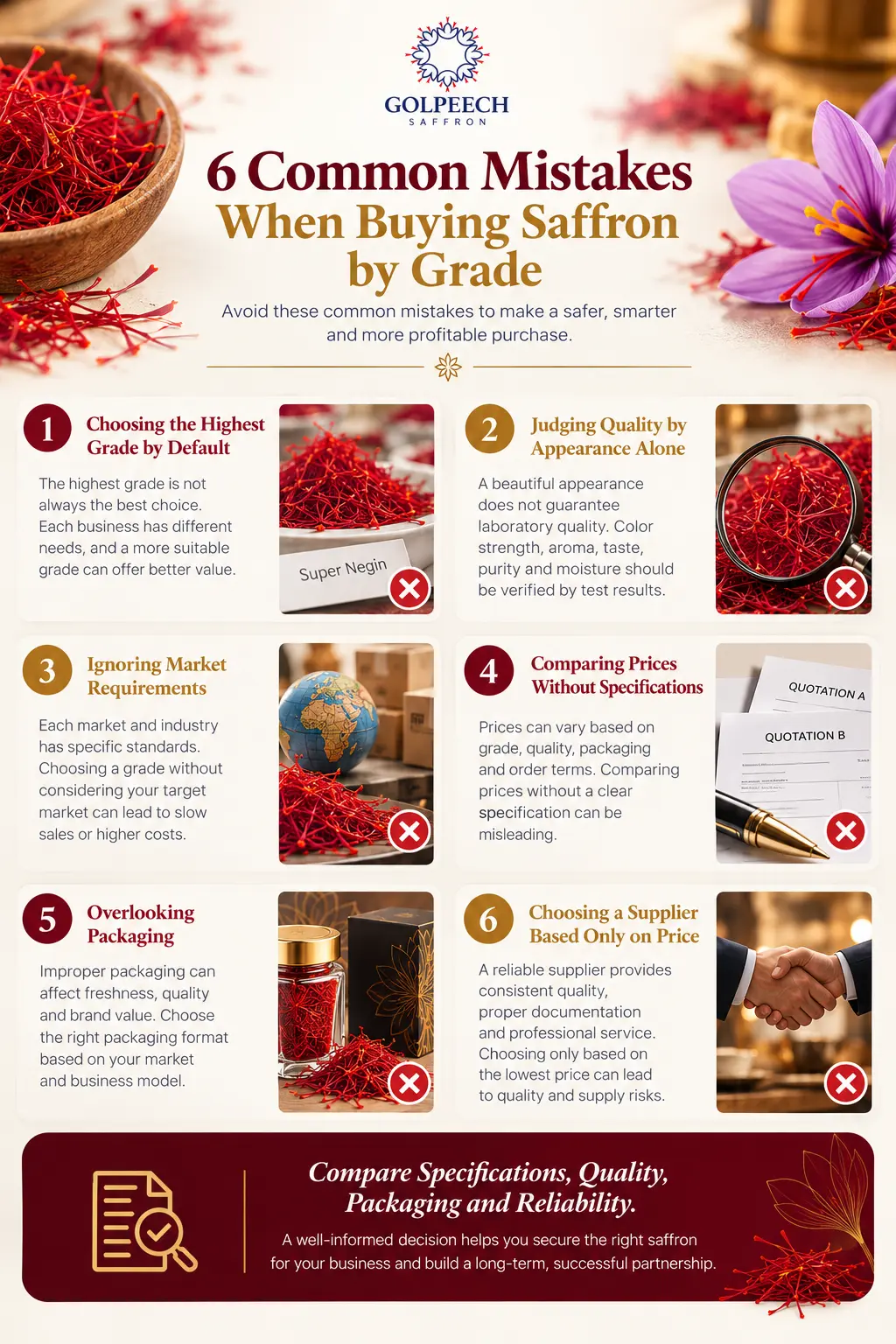
Common Mistakes When Buying Saffron by Grade

Mistake 1: Assuming the Highest Grade Is Always the Best Choice

Many first-time buyers automatically request Super Negin because it is positioned at the premium end of the commercial market.

But a food manufacturer may gain little value from paying for exceptionally long threads that will later be processed.

The best grade is the one that fits the application.


Mistake 2: Treating Commercial Grade as a Laboratory Certificate

Negin, Sargol, Pushal and Bunch are commercial classifications.

They should not be used as substitutes for laboratory testing when measurable quality parameters are important.


Mistake 3: Comparing Prices Without Comparing Specifications

Two suppliers can offer different products under the same grade name.

Before comparing quotations, buyers should confirm:

  • Commercial specification

  • Laboratory requirements

  • Packaging

  • Quantity

  • Documentation

  • Delivery terms


Mistake 4: Judging Quality by Appearance Alone

Beautiful saffron threads create a strong first impression.

But professional buyers should also consider:

  • Purity

  • Moisture

  • Laboratory quality

  • Processing

  • Storage

  • Food safety

  • Supplier reliability


Mistake 5: Ignoring Packaging

Poor packaging can contribute to:

  • Moisture exposure

  • Aroma loss

  • Thread breakage

  • Reduced shelf appeal

  • Quality deterioration

The packaging specification should therefore be agreed before shipment.


Mistake 6: Choosing a Supplier Based Only on Price

The lowest quotation does not always provide the best commercial value.

Problems such as:

  • Inconsistent batches

  • Quality complaints

  • Delivery delays

  • Packaging problems

  • Unreliable supply

can cost significantly more than a small difference in purchase price.

Professional buyers should evaluate the supplier’s overall capability rather than focusing only on the initial quotation.


Professional Buyer Checklist

Before placing a wholesale saffron order, confirm:

  • Is the commercial grade clearly defined?

  • Does the physical appearance match the agreed specification?

  • Is the yellow style percentage defined where relevant?

  • Are laboratory requirements clearly specified?

  • Are moisture and purity requirements clear?

  • Are microbiological requirements defined where necessary?

  • Is the batch identifiable?

  • Is the packaging suitable for transportation and storage?

  • Can the supplier maintain consistency between shipments?

  • Are required quality documents available?

  • Are export documents available?

  • Are payment and delivery terms clearly defined?

  • Does the product provide the right value for the intended application?


A Practical Way to Select the Right Saffron Grade

Instead of beginning with the question:

“Which is the highest saffron grade?”

professional buyers should begin with five questions:

1. Who is the final customer?

Retail consumers, food manufacturers, restaurants, distributors and private-label brands have different requirements.

2. Will the saffron be visible?

If consumers will see whole threads, appearance becomes more important.

3. Will the saffron be processed?

If the saffron will be ground, infused or incorporated into another product, laboratory quality and consistency may become more important than thread length.

4. What quality specification is required?

The buyer should define the relevant laboratory and food-safety requirements before ordering.

5. What is the target price?

The best commercial decision balances quality and cost rather than automatically selecting the most expensive grade.


Saffron Grade Is Only One Part of the Buying Decision

For professional buyers, the purchase decision should be based on several factors together:

Commercial Grade + Laboratory Quality + Food Safety + Application + Packaging + Consistency + Price

This approach provides a much more reliable basis for international saffron procurement than simply comparing grade names.

A luxury retailer may need Super Negin.

A premium private-label brand may prefer Negin.

A food manufacturer may achieve better value with Sargol.

A hospitality business may choose Sargol or Pushal.

A distributor may need several grades.

None of these choices is inherently wrong.

The correct choice depends on the commercial objective.


Frequently Asked Questions

Which saffron grade is considered the highest?

Super Negin is generally positioned at the premium end of the Iranian commercial saffron market because of its long, thick and visually uniform red threads.

However, commercial grade should not be confused with laboratory quality.


Is Negin better than Sargol?

Not universally.

Negin generally offers stronger visual presentation because of its long and intact red threads, while Sargol can offer excellent commercial value when thread length is less important.

Laboratory testing is required to compare measurable quality.


What is the difference between Super Negin and Negin?

Both are premium commercial forms of red saffron.

Super Negin generally represents a more selective specification focused on characteristics such as thread length, thickness, integrity and visual uniformity.

Exact specifications should always be confirmed with the supplier.


What is the difference between Sargol and Negin?

Both consist primarily of the red stigma without the yellow style.

The main commercial distinction relates to physical characteristics such as thread length, integrity and selection.

The exact specification should be agreed between buyer and supplier.


Is Pushal lower quality than Negin?

Not automatically.

Pushal is a different commercial form because part of the yellow style remains attached to the red stigma.

Its suitability depends on the application, market and purchasing specification.


Is Bunch saffron low quality?

Not necessarily.

Bunch saffron is a traditional form in which the red stigmas remain attached to the style and are arranged into bundles.

It is better understood as a different commercial form rather than simply a lower-quality version of Negin or Sargol.


Which saffron grade is best for food manufacturing?

Sargol can be a practical choice for many food-manufacturing applications because thread length may be less important than laboratory specifications, consistency and cost efficiency.

The final choice should depend on the manufacturer’s requirements.


Which saffron grade is best for private-label products?

Negin and Super Negin are common choices for premium private-label products because of their visual appeal.

High-quality Sargol can also be suitable when the brand prioritizes value and ingredient performance.


Does saffron grade determine coloring strength?

No.

Commercial grade does not by itself determine coloring strength.

Laboratory testing is required to evaluate the relevant chemical quality parameters.


Can Sargol have stronger laboratory quality than Negin?

Yes.

A particular Sargol batch can have stronger laboratory results than another batch sold as Negin.

Commercial grade and laboratory quality are separate dimensions.


What is ISO 3632 for saffron?

ISO 3632 is an international standard framework covering specifications and testing of dried saffron.

The current specification standard is ISO 3632-1:2025. (ISO)


Does Golpeech have ISO 3632 certification?

No.

Golpeech does not claim ISO 3632 certification.

Golpeech instead uses quality-control and laboratory testing processes and can supply saffron according to agreed quality specifications, including relevant parameters associated with international saffron quality standards.


Does Golpeech have ISO 22000 and HACCP?

Yes.

Golpeech operates with ISO 22000 and HACCP food-safety systems as part of its quality and food-safety management approach.


Which saffron grade is best for restaurants?

Sargol and Pushal can both be suitable depending on the restaurant’s application, presentation requirements, budget and required quality specification.


Does premium saffron always cost more?

Premium commercial grades generally occupy a higher price position because they require more selective sorting and offer stronger visual presentation.

However, actual prices depend on harvest conditions, supply, demand, laboratory specifications, quantity, packaging and destination.


Related Golpeech Guides

If you are sourcing Iranian saffron for international distribution, the following guides can help you evaluate the product and supplier more comprehensively:

What Is Saffron?
Learn about saffron, its origin, cultivation and characteristics:
https://golpeechsaffron.com/what-is-saffron/

Saffron Laboratory Testing & ISO 3632
Understand saffron quality parameters, laboratory testing and the role of ISO 3632:
https://golpeechsaffron.com/iso-3632-saffron-standard/

Saffron Packaging Guide
Explore packaging solutions for bulk, retail and private-label saffron:
https://golpeechsaffron.com/saffron-packaging/

Saffron Wholesale
Learn more about bulk saffron purchasing and wholesale supply:
https://golpeechsaffron.com/saffron-wholesale/

Saffron Supplier
Understand the key factors when selecting an Iranian saffron supplier:
https://golpeechsaffron.com/saffron-supplier/

Iranian Saffron Suppliers
Explore important considerations when sourcing saffron from Iran:
https://golpeechsaffron.com/iranian-saffron-suppliers/


Why Choose Golpeech for Your Saffron Requirements?

Selecting the right saffron grade is only the beginning of a successful supply relationship.

International buyers also need a supplier capable of supporting:

  • Consistent product specifications

  • Laboratory quality control

  • Food-safety management

  • Appropriate packaging

  • Export documentation

  • Bulk supply

  • Private-label requirements

  • Long-term commercial cooperation

Golpeech combines commercial saffron grading with quality-control and food-safety processes designed for international B2B buyers.

With ISO 22000 and HACCP, together with comprehensive product testing and quality verification, Golpeech focuses on supplying saffron according to clearly defined customer and product requirements.

The objective is not simply to offer the most expensive grade.

It is to help each buyer identify the right saffron specification for the right application and market.


Find the Right Saffron Grade for Your Business

Whether you need Super Negin for premium retail, Negin for private label, Sargol for food manufacturing, or Pushal for hospitality and regional distribution, the right choice depends on your specific requirements.

When discussing a wholesale saffron order, provide information about:

  • Target market

  • Intended application

  • Preferred grade

  • Required quality specification

  • Order volume

  • Packaging requirements

  • Private-label requirements

  • Delivery destination

The Golpeech team can then work with you to identify the appropriate saffron specification for your business.

The right saffron is not necessarily the highest grade. It is the grade and quality specification that deliver the best combination of performance, presentation, consistency and commercial value for your market.

Contact Golpeech to discuss your bulk saffron requirements and develop a supply solution tailored to your business.

Visual Comparison of Major Grades

Super Negin

  • Red Threads: 100%

  • Yellow Style: None

  • Appearance: Excellent

  • Typical Market: Luxury Retail

Negin

  • Red Threads: 100%

  • Yellow Style: None

  • Appearance: Excellent

  • Typical Market: Export

Sargol

  • Red Threads: 100%

  • Yellow Style: None

  • Appearance: Very Good

  • Typical Market: Wholesale

Pushal

  • Red Threads: Mostly Red

  • Yellow Style: Small Amount

  • Appearance: Good

  • Typical Market: Retail & Food Service

Bunch (Dasteh)

  • Red Threads: Mixed

  • Yellow Style: Significant

  • Appearance: Traditional

  • Typical Market: Regional Markets

White (Konj)

  • Red Threads: None

  • Yellow Style: Yellow Only

  • Appearance: No

  • Typical Market: Herbal Products


Choosing the Right Grade for Your Business

Different businesses require different saffron grades.

Retail Brands

Usually prefer:

  • Super Negin
  • Negin

because consumers value appearance.


Food Manufacturers

Often choose:

  • Sargol

because coloring performance and consistency are more important than thread length.


Restaurants and Horeca

Common choices include:

  • Sargol
  • Pushal

depending on budget and intended presentation.


Importers

Professional importers often purchase multiple grades simultaneously to address different customer segments.


Do Higher Grades Always Mean Better Quality?

Not necessarily.

Many buyers mistakenly assume that the highest commercial grade always delivers the best value.

In reality, the most suitable saffron depends on:

  • Intended application
  • Target market
  • Packaging style
  • Customer expectations
  • Budget

For example, a food manufacturer producing sauces may achieve excellent results using Sargol, while a luxury retail brand may prioritize the visual elegance of Negin.


Commercial Factors That Influence Grade Selection

Professional buyers usually evaluate:

  • Customer preferences
  • Market positioning
  • Price sensitivity
  • Packaging format
  • Distribution channel
  • Regulatory requirements
  • Color performance
  • Aroma profile

Rather than focusing on a single grade, experienced importers often maintain a portfolio of different saffron types.


How Laboratory Testing Complements Commercial Grades

Commercial names such as Negin or Sargol describe the physical appearance of saffron, but laboratory analysis provides objective measurements of quality.

Testing may include evaluation of:

  • Coloring strength
  • Aroma compounds
  • Bitterness compounds
  • Moisture content
  • Purity

Together, physical grading and laboratory testing help buyers make informed purchasing decisions.


Why Choose Golpeech for Different Saffron Grades

Golpeech supplies a wide selection of Iranian saffron grades tailored to international wholesale and private-label requirements.

Our product range includes carefully selected saffron suitable for:

  • Importers
  • Food manufacturers
  • Retail chains
  • Distributors
  • Private-label brands
  • Hospitality suppliers

Each shipment is prepared according to customer specifications, packaging requirements and export standards to ensure consistent quality across every order.


Frequently Asked Questions

Which saffron grade is considered premium?

Super Negin and Negin are generally regarded as the premium commercial grades because of their long, fully red stigmas and attractive appearance.


Is Negin better than Sargol?

Not universally. Negin offers superior visual presentation, while Sargol provides excellent coloring performance and may be a better choice for food production.


Why does Pushal contain yellow parts?

Pushal retains a small portion of the style to preserve the natural structure of the saffron thread, which can also make authenticity easier to verify.


Which saffron grade is best for restaurants?

Many restaurants prefer Sargol or Pushal because they offer a practical balance between quality, performance and cost.


Does grade affect coloring strength?

Commercial grade alone does not determine coloring strength. Laboratory analysis is required to measure chemical quality accurately.


Which saffron grade is best for private label brands?

Premium retail brands commonly choose Negin or Super Negin for their visual appeal, while the final selection depends on the target market and pricing strategy.


Can different grades meet the same quality standards?

Yes. Different commercial grades can all achieve high laboratory quality when properly harvested, processed and stored.


Is Bunch saffron lower quality?

Not necessarily. Bunch saffron is simply processed differently and remains popular in traditional markets.

Commercial Grade vs Laboratory Quality: Understanding the Difference

One of the most common misconceptions among international buyers is assuming that a commercial saffron grade automatically reflects its laboratory quality. In reality, commercial grading and laboratory testing measure two different aspects of saffron, and understanding this distinction is essential for making informed purchasing decisions.

Commercial grades—such as Super Negin, Negin, Sargol, Pushal, and Bunch—describe the physical characteristics of saffron threads. These include thread length, the presence or absence of the yellow style, overall appearance, and visual uniformity. They help buyers identify a product that matches the expectations of a specific market or customer segment.

Laboratory quality, on the other hand, evaluates the chemical properties of saffron. Independent testing measures the compounds responsible for saffron’s color, aroma, and flavor, as well as factors such as moisture content and purity. These objective measurements provide a scientific assessment of quality that cannot be determined by appearance alone.

As a result, two saffron samples classified under the same commercial grade may perform differently in laboratory analysis. Likewise, saffron from different commercial grades can sometimes achieve similarly strong laboratory results when cultivated, harvested, and processed correctly.

For professional buyers, the best purchasing decisions are made by considering both physical grading and laboratory evaluation together rather than relying on either one alone.


Commercial Grades Describe Appearance

Commercial grading focuses on how saffron looks after harvesting and processing.

Typical evaluation criteria include:

  • Length of the stigma

  • Thickness of the thread

  • Percentage of red stigma

  • Presence of yellow style

  • Uniformity of the threads

  • Percentage of broken pieces

  • Overall visual presentation

These characteristics influence how attractive saffron appears on retail shelves and how it is perceived by end consumers.

For example, Super Negin is valued for its long, thick, uniformly red threads, making it highly desirable for premium retail packaging. Pushal, meanwhile, intentionally retains a small portion of the yellow style, giving it a more natural appearance that some markets associate with authenticity.


Laboratory Testing Measures Performance

Scientific testing focuses on the compounds that determine saffron’s functional quality rather than its appearance.

Laboratory analysis may evaluate:

  • Coloring strength

  • Aroma intensity

  • Flavor-related compounds

  • Moisture level

  • Purity

  • Foreign matter

  • Overall compliance with quality standards

These tests help buyers verify that saffron meets the specifications required for food production, export regulations, or customer quality requirements.

For industrial users and food manufacturers, laboratory consistency is often more important than thread length or visual presentation.


Can Two Negin Samples Have Different Laboratory Results?

Yes.

The commercial designation “Negin” only indicates that the saffron meets certain physical characteristics. It does not guarantee identical chemical composition.

Several factors influence laboratory quality, including:

  • Growing conditions

  • Climate

  • Harvest timing

  • Drying technique

  • Storage conditions

  • Packaging quality

  • Time elapsed after harvest

Consequently, two visually similar Negin batches may differ in coloring performance, aroma intensity, or shelf life.


Can Sargol Perform Better Than Negin?

Surprisingly, yes.

Although Negin is generally considered the more premium commercial grade due to its appearance, a well-produced Sargol batch may achieve laboratory results equal to—or even better than—a lower-quality Negin batch.

For businesses using saffron as an ingredient rather than displaying whole threads, laboratory performance is often the more relevant criterion.


Why Professional Buyers Evaluate Both

Experienced importers rarely purchase saffron based solely on appearance or laboratory reports.

Instead, they consider both aspects together:

Evaluation AreaPurpose
Commercial GradeDetermines appearance, presentation, and market positioning
Laboratory TestingConfirms measurable quality and product consistency

This combined approach helps ensure that saffron not only looks appealing but also delivers the expected performance in retail, culinary, or industrial applications.


Golpeech’s Quality Approach

At Golpeech, commercial grading and quality control are treated as complementary processes.

Each production batch is carefully sorted according to its physical characteristics, while quality verification supports consistency throughout the supply chain. This enables international buyers to select the saffron grade that best aligns with their product positioning, customer expectations, and application requirements.

Whether the requirement is premium retail packaging, private-label production, food manufacturing, or wholesale distribution, selecting the appropriate commercial grade together with verified quality standards helps create long-term value for both buyers and end consumers.

Saffron Grades Across International Markets

Although saffron grades are defined by physical characteristics, market preferences vary considerably from one region to another. A grade that performs exceptionally well in one country may not be the preferred choice in another due to differences in consumer expectations, culinary traditions, packaging formats, and price positioning.

For exporters, understanding these regional preferences is just as important as understanding the grades themselves. Selecting the right grade for the right market can improve customer satisfaction, strengthen brand positioning, and reduce unnecessary costs.


Middle East (GCC)

The Gulf Cooperation Council (GCC) countries—including the UAE, Saudi Arabia, Kuwait, Qatar, Bahrain, and Oman—represent some of the world’s largest import markets for premium saffron.

Consumers in these markets typically associate long, bright red saffron threads with superior quality and luxury. As a result, visually attractive grades are highly valued, particularly for gifting and premium retail products.

Typical preferences include:

  • Super Negin for luxury retail collections

  • Negin for premium supermarkets

  • Sargol for food service and hospitality

  • Elegant glass, crystal, or premium gift packaging

  • Strong emphasis on brand image and presentation

Private-label opportunities are also significant, as many regional distributors sell saffron under their own brands.


European Markets

European buyers often prioritize traceability, consistency, and regulatory compliance alongside appearance.

Importers supplying gourmet retailers, specialty food stores, and premium supermarkets frequently seek saffron that offers:

  • Consistent grading

  • Reliable quality control

  • Clean processing

  • Uniform packaging

  • Stable long-term supply

While Negin remains popular in the premium retail sector, Sargol is widely used by food manufacturers because of its excellent balance between performance and cost.

European industrial buyers also tend to request detailed product specifications before placing large orders.


China

China has become an increasingly important destination for premium saffron, driven by demand in both culinary and wellness markets.

Chinese buyers often appreciate:

  • Long, intact saffron threads

  • Attractive visual presentation

  • Premium gift packaging

  • Consistent quality between shipments

For luxury gifting, Super Negin and Negin are generally preferred because of their elegant appearance.


North America

In the United States and Canada, saffron is sold through several channels, including specialty grocery stores, gourmet retailers, online marketplaces, and food manufacturers.

Demand is divided between two major segments:

Retail Consumers

Retail customers often value:

  • Attractive thread appearance

  • Convenient packaging

  • Premium branding

  • Product authenticity

Food Industry

Industrial buyers typically focus on:

  • Consistent quality

  • Reliable supply

  • Batch uniformity

  • Competitive pricing

For many food applications, Sargol provides an excellent balance of performance and commercial value.


Food Manufacturing Worldwide

Manufacturers producing sauces, ready meals, bakery products, dairy products, confectionery, beverages, and spice blends generally evaluate saffron differently from retail buyers.

Their purchasing priorities usually include:

  • Consistent batch performance

  • Reliable coloring characteristics

  • Stable quality

  • Cost efficiency

  • Long-term supply capability

Because the threads are often ground or infused during production, appearance becomes less important than consistency.


Hospitality and Food Service

Hotels, restaurants, and catering businesses require saffron that performs reliably in everyday use.

Their purchasing decisions often balance:

  • Quality

  • Cost

  • Ease of use

  • Supply continuity

Depending on the cuisine and presentation, many hospitality businesses select either Sargol or Pushal to achieve the desired balance between appearance and value.


Regional Preferences at a Glance

MarketMost Common GradesPrimary Purchasing Priorities
GCCSuper Negin, NeginLuxury appearance, premium packaging
EuropeNegin, SargolConsistency, compliance, traceability
ChinaSuper Negin, NeginLong threads, premium presentation
North AmericaNegin, SargolQuality, branding, reliable supply
Food ManufacturingSargolPerformance, consistency, value
HospitalitySargol, PushalPracticality, cost-performance balance

Choosing the Right Grade for the Right Market

There is no single “best” saffron grade for every customer or every country.

Successful exporters match the grade to the specific requirements of each market by considering:

  • Consumer expectations

  • Distribution channel

  • Product positioning

  • Packaging format

  • Target price range

  • Intended application

  • Brand strategy

This market-oriented approach allows importers and private-label brands to optimize both customer satisfaction and commercial performance, rather than relying solely on the highest available grade.

How Saffron Grades Influence Pricing

One of the first questions international buyers ask is, “Why does one saffron grade cost more than another?” While appearance is an important factor, pricing is influenced by a combination of production costs, market demand, processing requirements, and export expectations.

Understanding these pricing factors enables importers to choose a grade that delivers the best commercial value for their target market rather than simply selecting the highest-priced option.


1. Harvest Yield

The premium grades of saffron are produced through more selective sorting.

For example, Super Negin and Negin require only the finest, longest, and most uniform red stigmas. During sorting, many threads that do not meet these visual criteria are separated into other grades.

Because only a portion of the harvested saffron qualifies as premium grade, the available quantity is naturally more limited, increasing its market value.


2. Manual Sorting and Processing

Unlike many agricultural commodities, saffron grading remains a highly skilled manual process.

Experienced workers carefully inspect each thread to ensure it meets the required specifications for:

  • Thread length

  • Thickness

  • Color uniformity

  • Cleanliness

  • Percentage of red stigma

  • Breakage

The more demanding the grading standard, the greater the labor required, which contributes to the final cost.


3. Visual Appeal

Appearance has a significant impact on consumer purchasing decisions, particularly in retail environments.

Premium grades command higher prices because they offer:

  • Long, elegant threads

  • Uniform deep-red color

  • Minimal broken pieces

  • Attractive presentation inside transparent packaging

Luxury brands often consider this visual impact an essential part of their product value.


4. Market Demand

Supply and demand also influence pricing.

Certain grades consistently experience stronger demand in international markets.

For example:

  • Super Negin is highly sought after for luxury retail.

  • Negin remains a preferred choice for premium export.

  • Sargol enjoys broad demand across both retail and industrial sectors.

  • Pushal serves markets seeking a balance between authenticity and affordability.

As buyer preferences shift over time, relative prices may also change.


5. Packaging Requirements

The intended packaging format can affect the most suitable saffron grade.

Premium retail packaging—such as crystal containers, luxury gift boxes, or high-end jars—typically showcases whole threads, making appearance especially important.

Conversely, saffron destined for food manufacturing or bulk industrial use is often processed further, reducing the importance of thread length or visual perfection.


Typical Commercial Positioning

Although prices fluctuate depending on harvest conditions and market dynamics, the commercial positioning of the main grades generally follows this pattern:

GradeTypical Price PositionCommon Applications
Super NeginHighestLuxury retail, premium gifts
NeginHighExport, private label, gourmet retail
SargolMedium to HighFood industry, horeca, wholesale
PushalMediumRetail, hospitality, regional distribution
BunchEconomy to MediumTraditional markets
White (Konj)LowestHerbal and specialty applications

Actual export quotations depend on order volume, harvest season, packaging specifications, destination market, and contractual requirements.


Choosing the Best Value Instead of the Highest Grade

Professional buyers rarely aim to purchase the most expensive saffron available.

Instead, they seek the best value for their intended application.

For example:

Premium Retail Brand

Priority:

  • Outstanding appearance

  • Premium consumer experience

  • Luxury packaging

Recommended grades:

  • Super Negin

  • Negin


Private Label Brand

Priority:

  • Attractive presentation

  • Consistent quality

  • Competitive pricing

Recommended grades:

  • Negin

  • High-quality Sargol


Food Manufacturer

Priority:

  • Reliable performance

  • Batch consistency

  • Cost efficiency

Recommended grade:

  • Sargol


Restaurant Chain

Priority:

  • Everyday reliability

  • Balanced cost

  • Consistent flavor and color

Recommended grades:

  • Sargol

  • Pushal


Wholesale Distributor

Priority:

  • Product portfolio covering multiple customer segments

Recommended approach:

Maintain inventory across several grades to serve premium, mid-range, and value-oriented buyers.


A Strategic Purchasing Perspective

The most successful importers view saffron grades not as a hierarchy of “good” to “better,” but as different products designed for different commercial objectives.

Selecting the appropriate grade requires balancing:

  • Target customer expectations

  • Brand positioning

  • Product application

  • Packaging format

  • Pricing strategy

  • Long-term supply reliability

By aligning the saffron grade with these business objectives, importers can maximize profitability while delivering consistent quality to their customers.


Golpeech Insight

At Golpeech, we work closely with importers, distributors, food manufacturers, and private-label partners to recommend the saffron grade that best fits their market—not simply the highest grade available. This consultative approach helps customers optimize quality, pricing, and long-term commercial success.

How Golpeech Ensures Consistent Saffron Grades

Selecting the right saffron grade is only part of the purchasing process. For importers and private-label brands, consistency from one shipment to the next is equally important. Even a premium grade can become a commercial challenge if its appearance, performance, or quality varies significantly between orders.

At Golpeech, consistency is achieved through a structured quality management process that combines careful raw material selection, standardized grading procedures, and rigorous quality control before export.


Sourcing from Established Growing Regions

Consistent grading begins long before the sorting process.

Golpeech works with carefully selected saffron-growing regions in Iran that are known for producing high-quality stigmas with strong visual characteristics. By maintaining long-term relationships with experienced growers, we can source saffron that meets the expectations of international wholesale buyers.

This approach helps reduce variation in:

  • Thread size

  • Color uniformity

  • Harvest maturity

  • Overall product quality


Careful Selection and Grading

After harvesting and drying, saffron is carefully examined and sorted according to its physical characteristics.

The grading process considers factors such as:

  • Length of the stigma

  • Percentage of red threads

  • Presence of yellow style

  • Thread thickness

  • Uniformity

  • Cleanliness

  • Broken thread percentage

Every batch is evaluated against predefined grading criteria before being assigned to the appropriate commercial category.

This systematic approach helps ensure that customers receive the grade they have specified in their purchase order.


Batch-to-Batch Consistency

One of the biggest challenges for importers is receiving products that differ noticeably between shipments.

To minimize this risk, Golpeech emphasizes batch consistency by maintaining standardized grading procedures and quality control throughout production.

This helps customers maintain:

  • Consistent retail presentation

  • Reliable product specifications

  • Stable customer expectations

  • Long-term brand reputation

For private-label businesses, this consistency is especially important because consumers expect the same appearance and quality every time they purchase the product.


Quality Verification

In addition to commercial grading, quality verification supports confidence in every shipment.

Depending on customer requirements, product evaluation may include verification of:

  • Product purity

  • Moisture level

  • Physical cleanliness

  • General quality parameters

  • Compliance with agreed specifications

This combination of visual grading and quality verification provides buyers with greater confidence when sourcing saffron for international markets.


Packaging That Protects Grade Integrity

Even perfectly graded saffron can lose its visual appeal if packaging fails to protect it during transportation.

Golpeech offers packaging solutions designed to preserve product quality throughout the export supply chain.

Available options include:

  • Bulk export packaging

  • Retail-ready packaging

  • Private-label packaging

  • Gift packaging

  • Customized branding solutions

Appropriate packaging helps reduce thread breakage, protect aroma, and maintain the premium appearance of saffron until it reaches the final customer.


Tailored Solutions for Different Businesses

Different buyers have different priorities, and a single saffron grade rarely fits every business model.

Golpeech supports a wide range of customers, including:

Importers

Looking for reliable long-term supply and consistent quality across multiple shipments.

Private-Label Brands

Seeking premium presentation, customized packaging, and products aligned with their brand positioning.

Food Manufacturers

Requiring dependable quality and consistency for large-scale production.

Wholesale Distributors

Serving multiple customer segments with different quality and pricing requirements.

By understanding each customer’s business objectives, Golpeech helps identify the saffron grade and packaging solution best suited to their market.


Why Long-Term Partnerships Matter

For professional buyers, purchasing saffron is not simply a transaction—it is an ongoing supply relationship.

Reliable partners contribute to business success by providing:

  • Consistent grading standards

  • Transparent communication

  • Dependable export support

  • Flexible packaging options

  • Stable long-term supply

  • Responsiveness to changing market needs

These factors often have a greater impact on long-term profitability than small differences in purchase price alone.


Final Thoughts

Understanding saffron grades is about more than recognizing names such as Super Negin, Negin, Sargol, or Pushal. It is about selecting the grade that best aligns with your product strategy, customer expectations, and commercial objectives.

The most successful buyers evaluate saffron from multiple perspectives: physical appearance, laboratory quality, intended application, packaging requirements, and supply consistency. By considering all of these factors together, businesses can make informed purchasing decisions that strengthen their brands and create lasting value.

Whether you are sourcing saffron for retail shelves, food manufacturing, hospitality, or a private-label program, choosing a supplier with consistent grading practices and export experience is essential to long-term success.


Call to Action

Find the Right Saffron Grade for Your Business

Whether you need Super Negin for a premium retail collection, Sargol for food manufacturing, or a customized solution for your private-label brand, the Golpeech team is ready to help.

Contact us today to discuss your sourcing requirements, packaging preferences, and target market. Our specialists will help you identify the saffron grade that best supports your commercial goals and provide a solution tailored to your business.

Common Mistakes When Buying Saffron by Grade

Selecting saffron based solely on its commercial grade can lead to costly purchasing mistakes. While names such as Super Negin, Negin, or Sargol are useful indicators, experienced buyers know that a successful purchase depends on evaluating the product from multiple perspectives.

Below are some of the most common mistakes made by new importers and wholesale buyers.


Mistake 1: Assuming the Highest Grade Is Always the Best Choice

Many first-time buyers automatically request Super Negin without considering whether it is the most appropriate grade for their business.

For example:

  • A luxury retail brand may benefit from Super Negin because consumers appreciate its elegant appearance.
  • A food manufacturer producing sauces or beverages may gain no additional value from paying more for longer threads that will ultimately be ground or infused.

The “best” grade is the one that fits the intended application—not necessarily the most expensive one.


Mistake 2: Judging Quality by Appearance Alone

Beautiful saffron threads can create an excellent first impression, but appearance tells only part of the story.

Professional buyers also evaluate:

  • Product consistency
  • Purity
  • Moisture content
  • Processing quality
  • Storage conditions
  • Overall reliability

A visually attractive product should always be supported by consistent quality management.


Mistake 3: Ignoring Market Preferences

Different markets have different expectations.

For example:

  • Luxury retailers in the GCC often prioritize long, elegant threads.
  • European food manufacturers may place greater importance on consistency and compliance.
  • Hospitality businesses frequently seek the best balance between quality and cost.

Understanding the target market helps prevent purchasing a grade that exceeds—or fails to meet—customer expectations.


Mistake 4: Comparing Prices Without Comparing Specifications

A lower quotation does not necessarily represent better value.

Before comparing offers, buyers should confirm that they refer to the same:

  • Commercial grade
  • Packaging format
  • Net weight
  • Quality specifications
  • Delivery terms
  • Export services

Two quotations labeled simply as “Negin Saffron” may represent products with noticeably different characteristics.


Mistake 5: Overlooking Packaging

Premium saffron deserves packaging that protects both its quality and its appearance.

Poor packaging can result in:

  • Broken threads
  • Aroma loss
  • Moisture exposure
  • Reduced shelf appeal

For export markets, packaging should be selected as carefully as the saffron grade itself.


Mistake 6: Choosing a Supplier Based Only on Price

The lowest purchase price can become the highest long-term cost if it leads to:

  • Inconsistent shipments
  • Delayed deliveries
  • Variable grading
  • Customer complaints
  • Brand reputation issues

Professional importers typically evaluate suppliers based on long-term reliability rather than price alone.


Checklist for Professional Buyers

Before placing an order, consider the following questions:

  • Is this grade appropriate for my target market?
  • Does the appearance match my brand positioning?
  • Is the quality consistent from batch to batch?
  • Will the packaging protect the product during transportation?
  • Can the supplier support long-term growth?
  • Does the grade provide the best value for my application?
  • Are product specifications clearly defined before shipment?

Answering these questions helps reduce purchasing risk and supports better long-term business decisions.


Related Articles

To build a deeper understanding of saffron quality and international sourcing, continue with these guides in the Golpeech Knowledge Center:

  • What is Saffron? – Learn about the origin, cultivation, and characteristics of saffron.
  • Bulk Saffron Buying Guide – Best practices for sourcing saffron in wholesale quantities.
  • Saffron Laboratory Testing & ISO 3632 – Understand laboratory evaluation and internationally recognized quality parameters.
  • Saffron Packaging Guide – Explore packaging solutions for retail, wholesale, and private-label markets.
  • Global Saffron Market Guide – Discover major importing countries, market trends, and export opportunities.
  • Why Choose Golpeech – Learn how Golpeech supports importers, distributors, and private-label brands worldwide.

Related Saffron Guides

Golpeech Saffron packging

Self-Supplied Saffron

In today’s world, where global supply chains face constant disruptions, the idea of being self-sufficient Saffron is more valuable than ever. Saffron, one of the most precious and delicate spices in existence, demands exceptional care at every stage—from soil to shelf.

Read More »
pushal Golpeech Saffron

Purity Guaranteed Under the Shield of Science

In the saffron industry, quality is not a mere claim; it is a precise figure on an analysis sheet. While the 50-year legacy of the Nami family forms the foundation of trust for the Golpeech brand, the group’s specialized laboratory serves as the vigilant guardian of this quality.

Read More »