Saffron Grades Explained: Negin, Sargol, Super Negin, Pushal & Bunch
Choosing the right saffron grade is an important decision for importers, distributors, food manufacturers, retailers, hospitality businesses, and private-label brands. Different commercial grades offer different physical characteristics, appearances, and price positions, making some more suitable for particular products and markets than others.
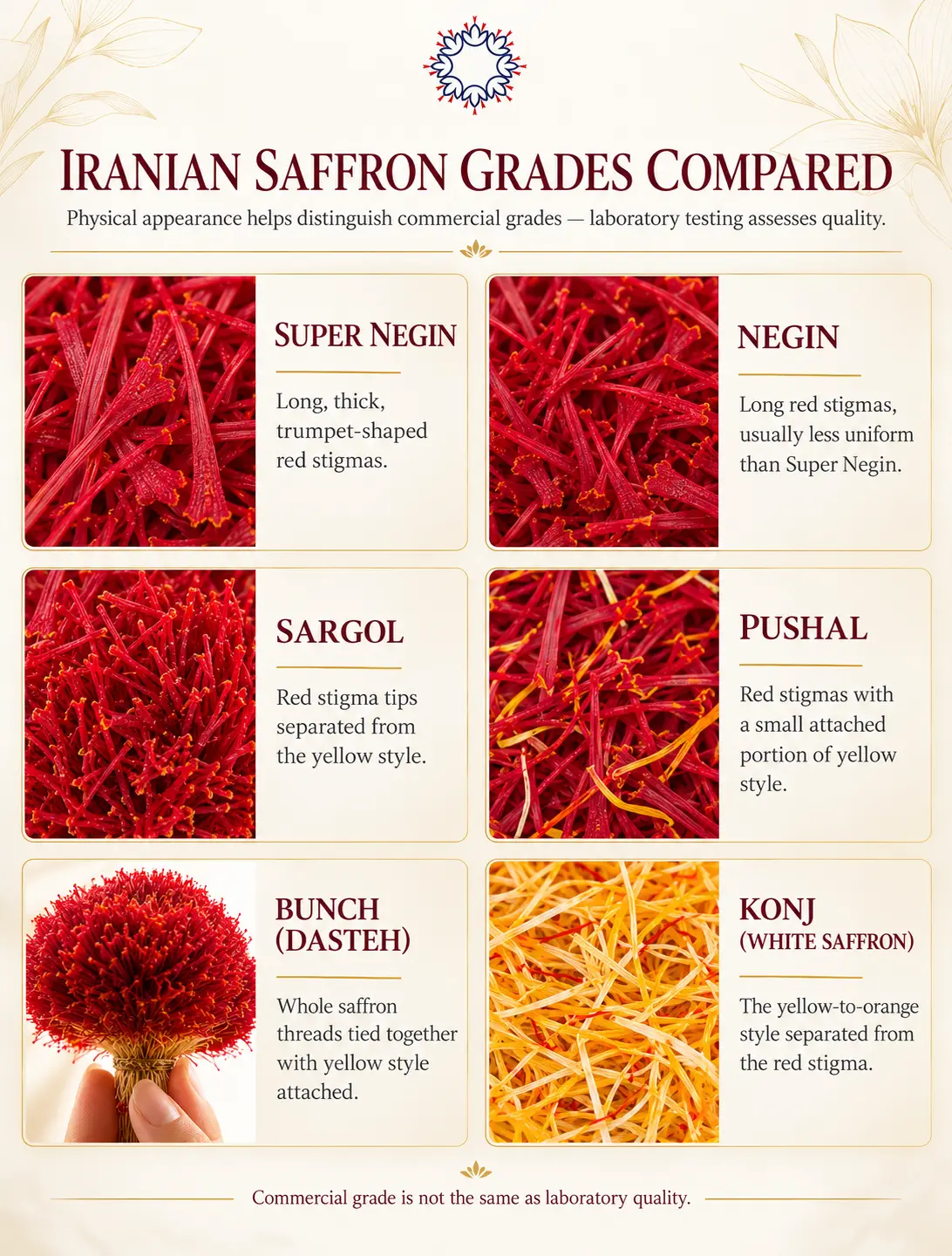
In the Iranian saffron trade, the most familiar commercial classifications include Super Negin, Negin, Sargol, Pushal, and Bunch (Dasteh). Konj, also known as white saffron, refers to the yellow style separated from the red stigma and is a different product form.
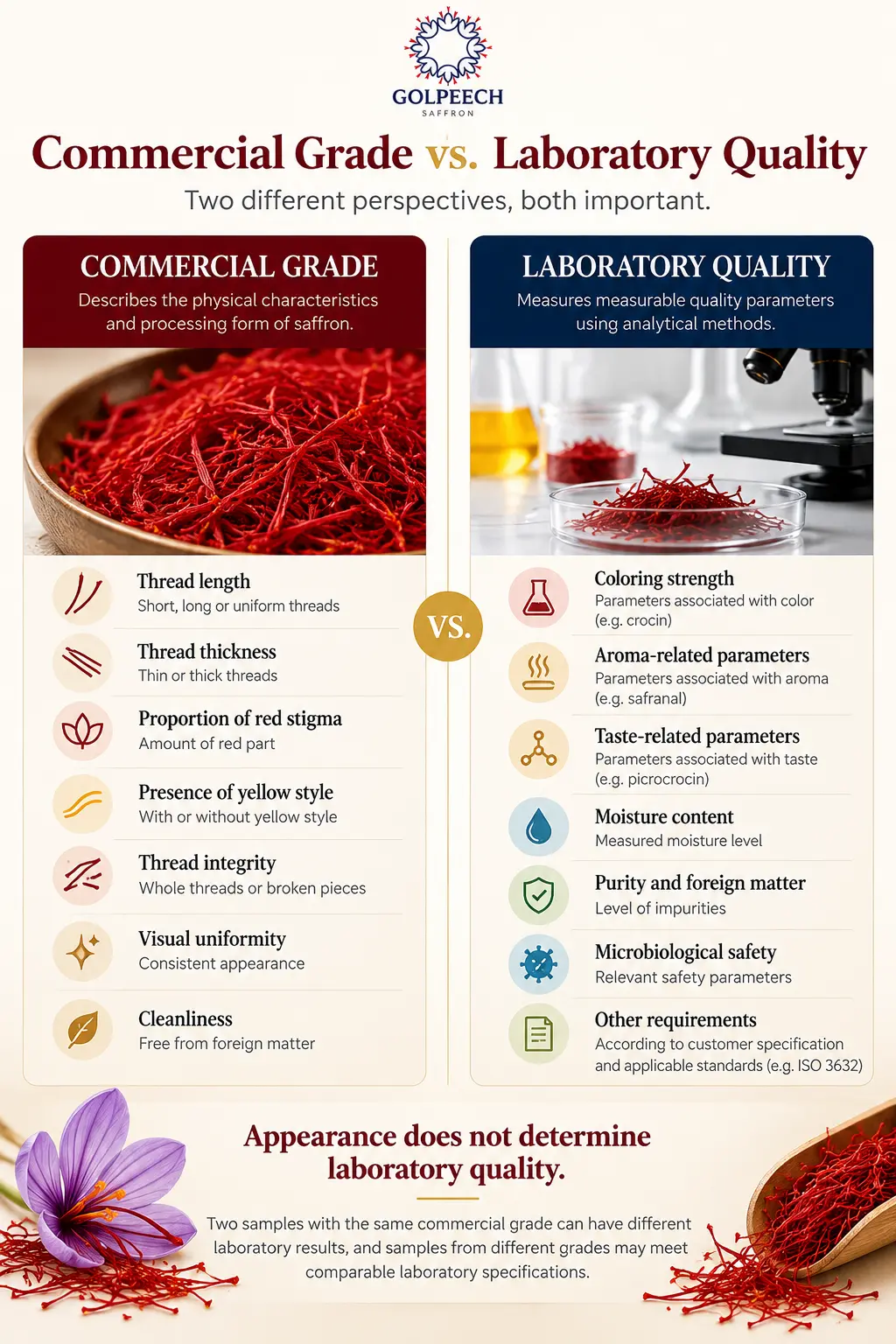
However, one distinction is essential: commercial grade and laboratory quality are not the same thing. A grade describes the physical characteristics and processing form of saffron, while laboratory testing evaluates measurable quality parameters.
For international buyers, the best purchasing decision is therefore not simply to choose the highest commercial grade. It is to select the right combination of physical characteristics, laboratory specifications, intended application, packaging, consistency, and price.
This guide explains the main Iranian saffron grades, their differences, their commercial applications, the factors influencing price, and how to specify saffron for international purchasing.
1. What Are Saffron Grades?
Saffron is obtained from the three red stigmas inside each flower of Crocus sativus L. After harvesting, the flowers are processed to separate the stigmas from the other floral parts. The resulting saffron is sorted according to its physical characteristics and the requirements of the intended commercial specification.
Commercial grading may consider:
The proportion of red stigma.
The presence and amount of yellow style.
Thread length and thickness.
Thread integrity and the percentage of broken pieces.
Visual uniformity and cleanliness.
The processing and sorting method.
These characteristics influence the product’s appearance, presentation, and suitability for different uses. They do not, by themselves, establish the saffron’s chemical quality or food safety.
The terms used for commercial grades can also vary between suppliers and markets. For example, the precise specifications separating Negin from Super Negin may not be identical across all suppliers. Buyers should therefore confirm the actual product specification rather than relying on the grade name alone.
2. The Main Iranian Saffron Grades
Super Negin Saffron
Super Negin is generally positioned at the premium end of the Iranian commercial saffron market. It is selected for its long, thick, intact, and visually uniform red stigmas.
Typical characteristics include:
Long, thick red threads.
A high proportion of red stigma.
Attractive visual uniformity.
Limited visible breakage.
Premium presentation.
Its main commercial advantage is its appearance, making it suitable for products in which consumers can see the saffron threads.
Typical applications
Luxury retail products.
Premium supermarkets and gourmet stores.
Gift boxes and premium collections.
Private-label products positioned at the luxury end of the market.
Hospitality applications where whole-thread presentation matters.
Super Negin may be a strong choice when visual presentation is central to the product’s perceived value. Its suitability should still be assessed against the buyer’s quality requirements, target price, and intended use.
Negin Saffron
Negin is another premium commercial form of Iranian saffron. It generally consists of long, thick, fully red stigmas selected for attractive appearance and good thread integrity.
Typical characteristics include:
Long red threads.
A high proportion of red stigma.
Attractive appearance and thread integrity.
Little or no yellow style in accordance with the agreed specification.
Negin offers a combination of premium presentation and commercial practicality. It is commonly considered for retail products, gourmet foods, export markets, gift packaging, and private-label brands.
The distinction between Negin and Super Negin depends on the commercial criteria used by the supplier. Buyers should clarify the required thread length, thickness, uniformity, and tolerance for broken pieces before placing an order.
Sargol Saffron
Sargol consists primarily of the red stigma separated from the yellow style. It is one of the widely traded commercial forms of Iranian saffron.
Typical characteristics include:
Red stigma without the yellow style.
A clean, red appearance.
Threads that may be shorter than those selected for long-thread premium grades.
Suitability for a broad range of culinary and commercial applications.
Sargol is useful when buyers require red saffron but do not need exceptionally long threads. Depending on the specification and laboratory results, it can provide an attractive balance between product requirements and cost.
Typical applications
Food manufacturing.
Restaurants and catering.
Wholesale distribution.
Retail and private-label products.
Spice blends and other food applications.
Sargol should not automatically be assumed to have greater coloring strength than Negin or Super Negin. Coloring strength is a laboratory parameter and must be evaluated through appropriate testing.
Pushal Saffron
Pushal retains the red stigma together with a portion of the yellow style. This gives it a different physical appearance from more closely trimmed forms such as Sargol and Negin.
Typical characteristics include:
Red stigma with a portion of yellow style.
A recognizable natural thread structure.
A distinct appearance compared with fully trimmed red saffron.
Commercial specifications that should define the acceptable amount of yellow style.
Pushal may be suitable for retail, restaurants, hospitality, food service, traditional markets, and regional distribution. Its suitability depends on the intended application and the buyer’s expectations.
When purchasing Pushal in bulk, buyers should specify the acceptable amount of yellow style and other relevant physical requirements. Its presence does not, by itself, establish that the saffron is of lower laboratory quality.
Bunch Saffron (Dasteh)
Bunch saffron, commonly known as Dasteh, is a traditional form in which the red stigmas remain attached to the style and are arranged into bundles.
Typical characteristics include:
Red stigmas attached to the style.
A noticeable amount of yellow style.
A bundled structure.
Traditional visual presentation.
Less extensive trimming than in grades consisting primarily of red stigma.
Bunch saffron remains relevant in markets and applications where its traditional form is preferred. It may be considered for traditional retail, regional distribution, specialty products, and culinary applications.
It should not automatically be described as low quality. It is a different commercial form, and its suitability depends on the customer’s requirements and the agreed product specification.
Konj or White Saffron
Konj, sometimes called white saffron, refers to the yellow style separated from the red stigma. It is therefore different from the principal red saffron grades used in many premium retail and culinary products.
The red stigma contains important compounds associated with saffron’s characteristic color, aroma, and taste. Konj should not be treated as equivalent to premium red saffron.
Its potential applications and commercial value depend on the specific product, buyer requirements, and market. Buyers should confirm the product identity and specification before purchasing it.
Saffron Grades at a Glance
Grade
Main physical characteristics
Potential applications
Super Negin
Long, thick, visually uniform red threads
Luxury retail, premium gifts
Negin
Long, fully red threads selected for presentation
Premium retail, export, private label
Sargol
Red stigma separated from yellow style
Food manufacturing, retail, wholesale
Pushal
Red stigma with a portion of yellow style
Retail, hospitality, traditional markets
Bunch / Dasteh
Stigmas attached to the style in bundles
Traditional and regional markets
Konj / White saffron
Yellow style separated from red stigma
Applications defined by the buyer’s specification
These descriptions explain commercial form and appearance. They are not a laboratory ranking of saffron quality.
3. Commercial Grade vs. Laboratory Quality
Commercial grading and laboratory testing answer two different questions.
Commercial grading describes the physical characteristics of saffron. Laboratory testing measures relevant quality parameters using appropriate analytical methods.
What Commercial Grading Evaluates
Commercial grading may consider:
Thread length and thickness.
The proportion of red stigma.
The presence of yellow style.
Thread integrity and breakage.
Visual uniformity.
Cleanliness and physical appearance.
These characteristics are particularly important when whole saffron threads are displayed in transparent jars, premium packaging, gift boxes, or retail products.
What Laboratory Testing Evaluates
Depending on the product, application, customer specification, and applicable requirements, laboratory evaluation may include:
Parameters associated with coloring strength.
Aroma-related parameters.
Taste-related parameters.
Moisture content.
Purity and foreign matter.
Microbiological safety.
Other relevant quality and food-safety requirements.
The compounds associated with saffron’s color, aroma, and taste are important to its performance, but visual inspection alone cannot reliably establish their measured levels.
Two samples sold under the same commercial grade may produce different laboratory results. Likewise, samples from different commercial grades may meet comparable laboratory specifications.
Can Sargol Have Better Laboratory Results Than Negin?
Yes. A particular Sargol batch can achieve stronger results for a measured quality parameter than another batch classified as Negin.
Laboratory performance can be influenced by growing conditions, harvest timing, drying, processing, storage, moisture exposure, and packaging. Commercial grade alone does not determine the result.
For this reason, buyers should assess the relevant laboratory results whenever measurable quality is important to the intended application.
Understanding ISO 3632
ISO 3632 is an international reference for saffron specifications and testing. The ISO 3632-1:2025 specification covers dried saffron in filament, cut-filament, and powder forms.
It is important to distinguish between a product’s conformity with specified quality parameters and certification of a supplier or company. ISO 3632 is a saffron specification standard; a commercial grade such as Negin or Sargol is not an ISO certification.
Buyers who require compliance with particular ISO-related parameters should identify the applicable requirements, testing expectations, and documentation before confirming an order.
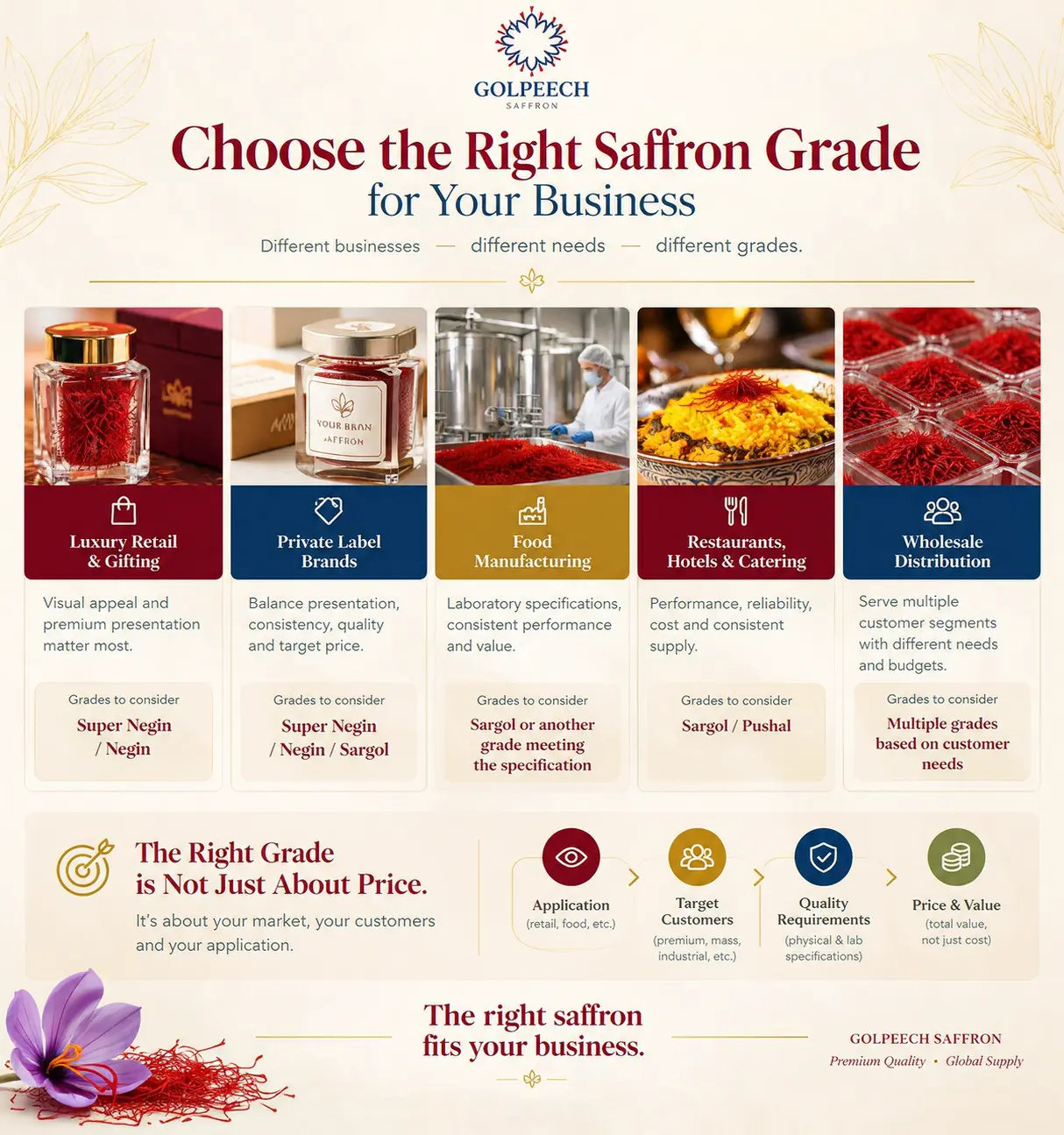
4. Which Saffron Grade Is Best for Different Businesses?
There is no single grade that is best for every business. The appropriate choice depends on whether the saffron will be displayed as whole threads, incorporated into another product, used in food service, or sold through a particular retail channel.
Premium Retail Brands
Premium retail products often benefit from attractive, intact threads because consumers can see the product before purchasing it.
Potential choices include Super Negin and Negin.
Key considerations include visual uniformity, presentation, packaging, brand positioning, and the expectations of the target customer.
Private-Label Brands
Private-label buyers need to balance presentation, consistency, quality specifications, and target price.
Super Negin or Negin may suit a premium positioning, while a properly specified Sargol may be suitable for products in which long-thread appearance is less important.
The final decision should reflect the brand’s target market and product format.
Food Manufacturers
Food manufacturers often use saffron as an ingredient rather than displaying whole threads. Depending on the formulation, saffron may be ground, infused, or incorporated into another product.
Their priorities may include:
Defined laboratory specifications.
Consistent performance between batches.
Reliable supply.
Suitability for the formulation.
Cost efficiency.
Sargol can be a practical option for many applications, but the final choice should be based on the manufacturer’s product requirements and verified quality parameters.
Restaurants, Hotels, and Catering Businesses
Hospitality and food-service buyers usually need a balance between quality, performance, cost, presentation, and supply continuity.
Sargol and Pushal may both be suitable, depending on whether the application requires a more closely trimmed red saffron or a different physical presentation.
Wholesale Distributors
Distributors often serve multiple customer segments with different budgets and product requirements. Offering more than one grade can help them serve premium retail, food manufacturing, hospitality, and traditional markets without relying on a single specification.
Application Guide
Business application
Main purchasing priorities
Grades to consider
Luxury retail and gifting
Appearance and presentation
Super Negin, Negin
Premium private label
Presentation, consistency, target price
Super Negin, Negin, Sargol
Food manufacturing
Laboratory specifications, performance, value
Sargol or another grade meeting the specification
Restaurants and hospitality
Performance, reliability, cost
Sargol, Pushal
Wholesale distribution
Product range and supply continuity
Multiple grades, depending on customers
Traditional markets
Familiarity and preferred physical form
Pushal, Bunch, or other specified grades
These are general commercial guidelines, not fixed rules. The appropriate grade must be confirmed against the buyer’s actual requirements.
5. Choosing the Right Grade for International Markets
Market preferences can differ according to culinary traditions, customer expectations, distribution channels, product positioning, and price sensitivity. Regional tendencies can help guide initial discussions, but they should not replace research into the target customer or a clear purchasing specification.
Middle East and GCC
In premium retail and gifting segments, visual presentation may be an important purchasing consideration. Super Negin and Negin may therefore be relevant for products positioned around long, attractive red threads.
Sargol and Pushal can also serve food-service, retail, and other market segments, depending on the required specification and price.
Europe
Professional European buyers may place considerable emphasis on traceability, food safety, documentation, consistency, and defined product specifications. Both premium whole-thread grades and more cost-efficient grades can be appropriate, depending on the application.
Importers should establish the applicable regulatory requirements and documentation expectations for their particular market and product.
China
For selected retail and gifting applications, presentation and consistency may influence grade selection. Super Negin and Negin may be considered where long, intact threads and premium packaging are important.
The final selection should be based on the requirements of the intended distribution channel and customer.
North America
The market includes premium retail, specialty grocery, online sales, hospitality, and industrial food production.
Retail buyers may prioritize appearance, packaging, authenticity, and brand positioning. Industrial buyers may place greater emphasis on specifications, batch consistency, supply reliability, and cost efficiency.
Food Manufacturing and Hospitality Worldwide
Manufacturers, restaurants, hotels, and catering businesses generally need saffron that meets their requirements for performance, consistency, and cost. For applications in which whole threads are not displayed, thread length may be less important than verified quality parameters and suitability for the process.
The best export strategy is to match the grade to the customer, application, and market—not to assume that one grade is universally preferred in a particular country.
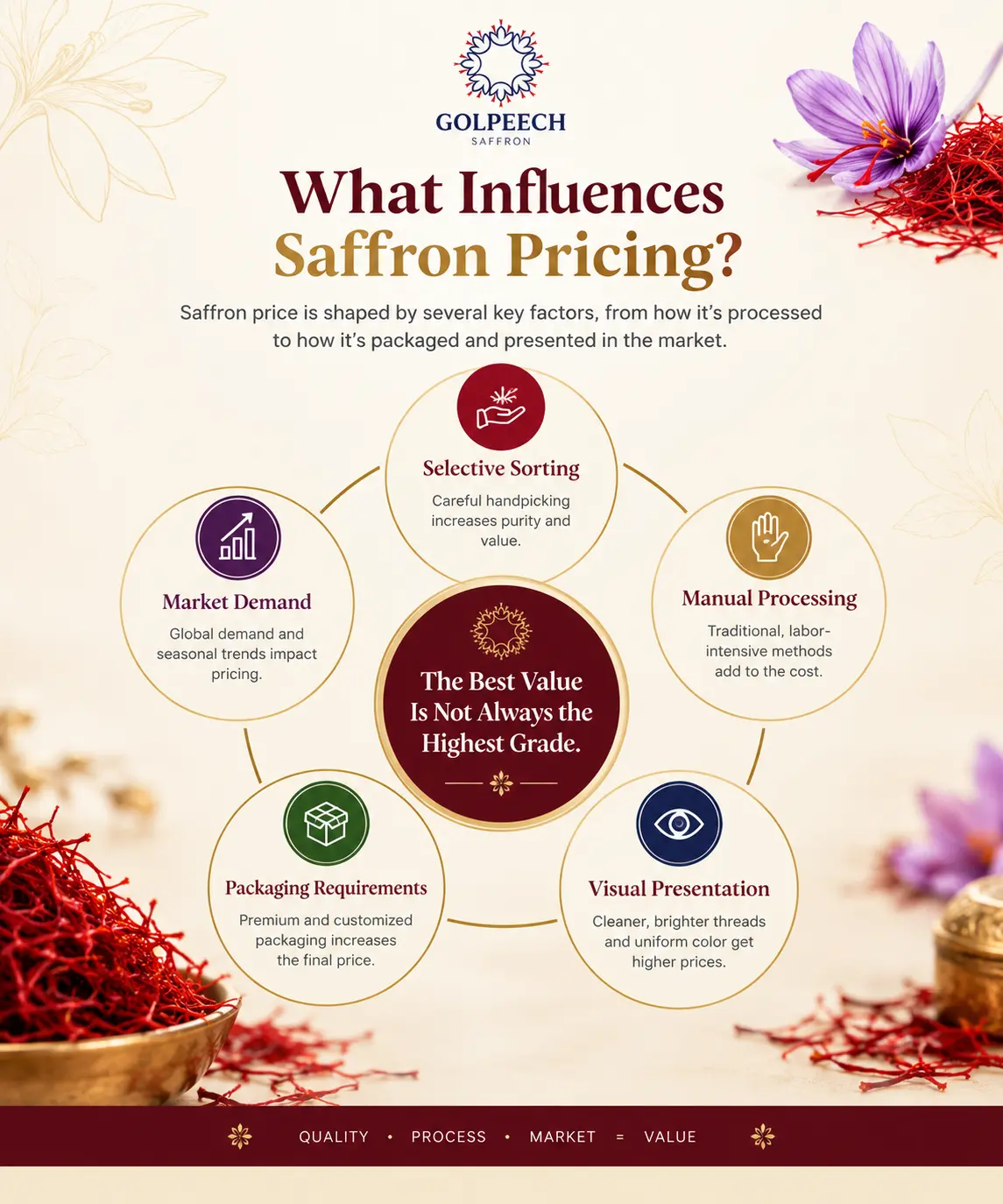
6. How Saffron Grades Influence Pricing
Saffron pricing depends on more than the grade name. Important factors include the raw material, sorting requirements, available supply, market demand, quality specifications, order quantity, packaging, destination, and delivery terms.
Selective Sorting and Yield
Premium grades generally require more selective sorting to obtain the required thread length, thickness, integrity, and visual uniformity.
Only part of the raw material may meet a particularly demanding specification. The additional selection and the limited quantity that qualifies can contribute to a higher commercial price.
Manual Processing
Saffron grading involves careful inspection and sorting. More demanding specifications can require additional labor to separate threads according to the buyer’s requirements.
Visual Presentation
Long, intact, uniform red threads can be especially valuable for transparent retail packaging, luxury gift boxes, and premium products. Buyers may pay more for this presentation when it contributes directly to the perceived value of the finished product.
For industrial applications in which saffron will be processed further, paying extra for visual characteristics may offer less benefit. In those cases, the buyer should prioritize the requirements that affect the final product.
Market Demand and Packaging
Demand for particular grades changes across markets and over time. Packaging requirements can also influence the most suitable product: a premium jar may showcase whole threads, while bulk ingredient use may place less emphasis on their appearance.
There is no fixed price difference that applies to every supplier, harvest, or order. Actual quotations depend on the product specification and commercial terms.
The right comparison is value for the intended application, not simply price per kilogram or the highest available grade.
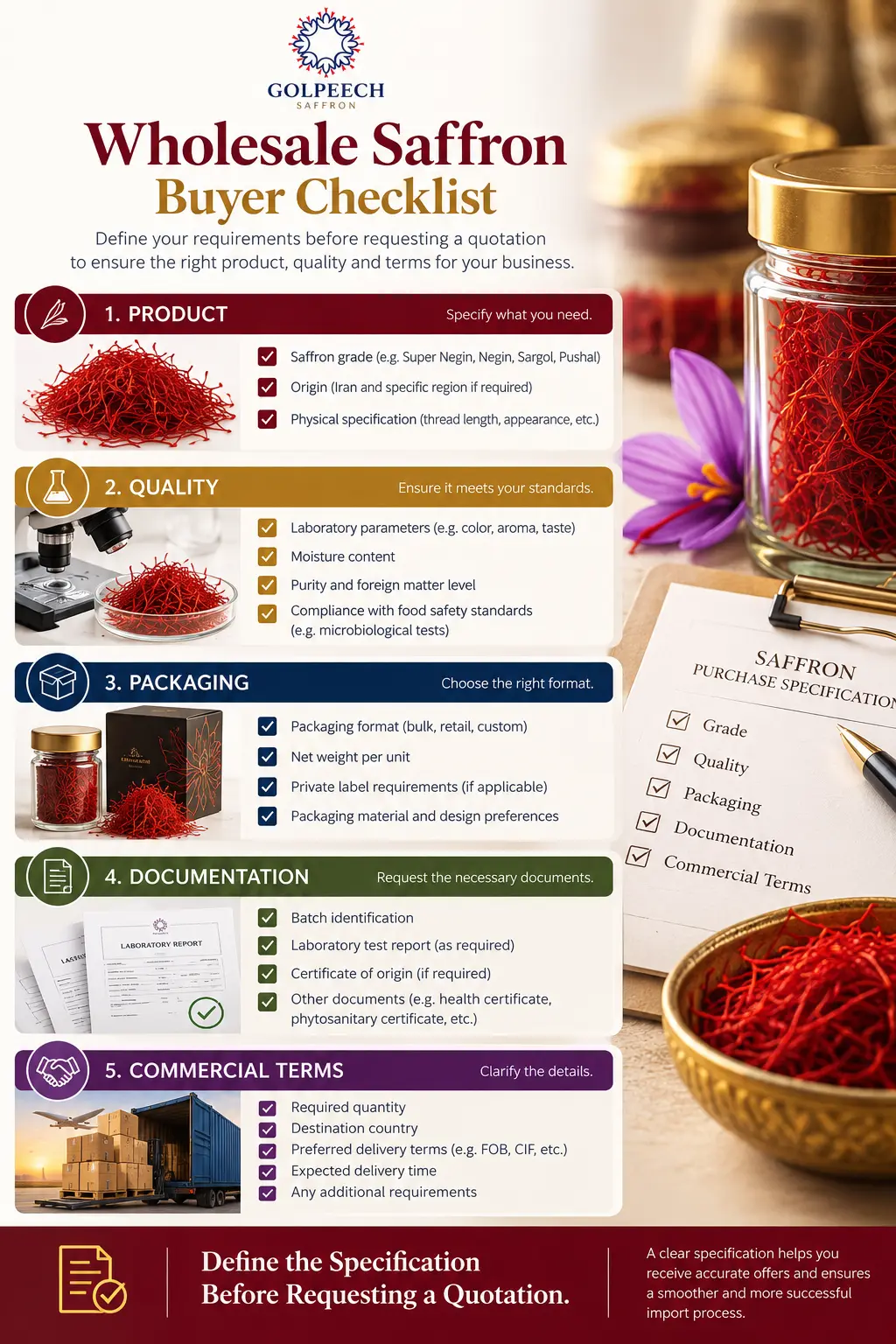
7. What Buyers Should Specify Before Ordering
Requesting only “Negin saffron” or “Sargol saffron” may leave room for differences in interpretation between suppliers. A clear purchasing specification reduces the risk of receiving a product that does not match the buyer’s expectations.
Before requesting a quotation, define the relevant items below.
Product Specification
Commercial grade.
Origin.
Required physical characteristics.
Red stigma requirements.
Yellow style tolerance, where applicable.
Thread integrity and acceptable breakage.
Required laboratory quality parameters.
Moisture and purity requirements.
Microbiological requirements, where applicable.
Any additional product-specific requirements.
Packaging and Order Details
Packaging type and material.
Net weight per unit.
Bulk, retail, gift, or private-label format.
Labeling and branding requirements.
Batch identification and traceability expectations.
Required product and export documentation.
Order quantity.
Delivery destination and terms.
Target price range and delivery schedule.
Not every requirement applies to every product. Buyers should define the parameters relevant to their intended use and the regulations of the destination market.
When comparing quotations, make sure the offers refer to comparable specifications, quantities, packaging, documentation, and delivery terms.
8. Quality Control, Consistency, and Packaging at Golpeech
For international B2B buyers, the purchasing decision extends beyond the appearance of a sample. The supplier should understand the agreed specification and be able to manage the product accordingly.
Golpeech’s stated quality and food-safety approach includes ISO 22000 and HACCP-based systems, together with quality verification and testing according to the product, customer requirements, and applicable specifications.
The distinction regarding ISO 3632 is important: Golpeech does not claim to hold ISO 3632 certification. Instead, buyers can discuss the relevant saffron quality parameters required for their orders and clarify the testing and documentation needed for their application.
A structured approach to grading and quality control may include:
Selection of raw material.
Sorting according to defined physical characteristics.
Verification against agreed product specifications.
Relevant laboratory testing.
Batch identification and control.
Packaging appropriate to the product and shipment.
Preparation according to customer and export requirements.
For repeat orders and private-label programs, consistency between shipments is especially important. Buyers should agree on the product specification in advance and clarify how conformity will be assessed.
Why Packaging Matters
Packaging helps protect saffron during storage and transportation. Poorly selected or handled packaging may expose the product to moisture, reduce aroma retention, cause thread breakage, or damage its visual presentation.
Important considerations include:
Protection from moisture.
Aroma retention.
Physical protection during handling and transport.
Suitability for the intended storage conditions.
Retail presentation, where relevant.
Packaging and labeling requirements for the destination market.
Packaging should therefore be part of the purchasing specification rather than an afterthought.
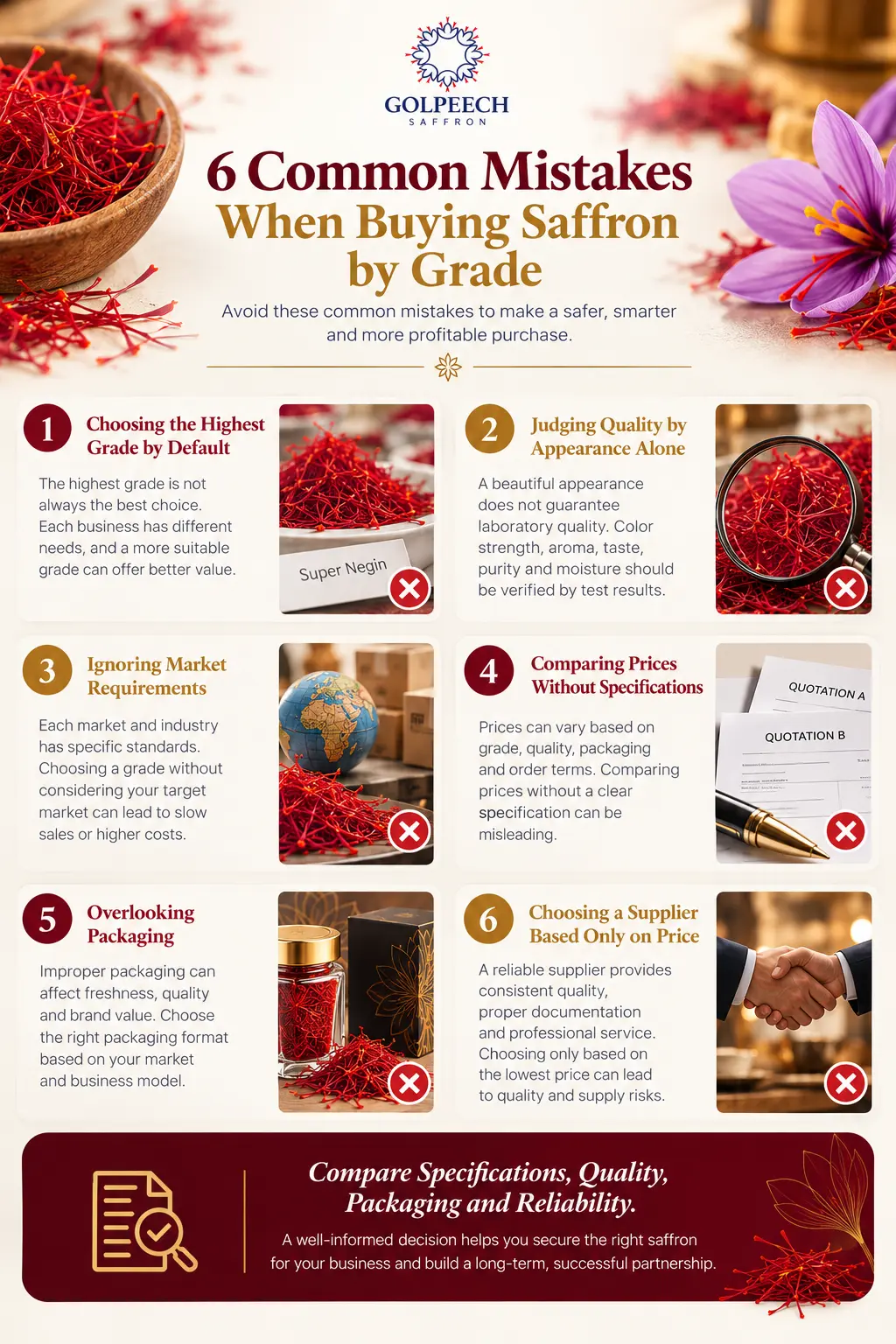
Mistake 1: Assuming the Highest Grade Is Always the Best
Super Negin may be suitable for luxury retail, but a food manufacturer may gain little benefit from paying extra for long threads that will be ground or infused. Select the grade according to the intended application.
Mistake 2: Treating the Grade Name as Proof of Laboratory Quality
Commercial grades describe physical characteristics. They do not replace laboratory testing when measurable quality parameters are part of the purchasing specification.
Mistake 3: Comparing Quotations Without Comparing Specifications
Two offers using the same grade name may differ in physical characteristics, laboratory requirements, packaging, quantity, documentation, and delivery terms. Compare like with like.
Mistake 4: Judging Quality by Appearance Alone
An attractive sample does not establish every aspect of product quality. Buyers should consider relevant laboratory results, purity, moisture, storage, food-safety requirements, and supplier reliability.
Mistake 5: Ignoring Packaging
Packaging can affect product protection, aroma retention, thread integrity, and retail presentation. Agree on the packaging requirements before confirming the order.
Mistake 6: Choosing a Supplier Based Only on Price
A low initial quotation may not provide the best long-term value if it is accompanied by inconsistent specifications, delayed shipments, packaging problems, or unreliable supply. Evaluate the supplier’s ability to meet the agreed requirements over time.
10. A Practical Checklist for Professional Buyers
Before placing a wholesale saffron order, confirm:
Is the commercial grade clearly defined?
Does the sample match the agreed physical specification?
Is the acceptable amount of yellow style defined where relevant?
Are laboratory quality requirements clear?
Are moisture, purity, and applicable safety requirements specified?
Is batch identification or traceability required?
Is the packaging suitable for the product and destination?
Are the required quality and export documents agreed?
Can the supplier support the expected order volume and schedule?
Are delivery terms and other commercial conditions clear?
Does the product offer the right value for the intended application?
A clear specification helps buyers make more informed decisions and reduces misunderstandings during purchasing and repeat orders.
Frequently Asked Questions
Which Iranian saffron grade is considered the highest?
Super Negin is generally positioned at the premium end of the commercial market because it is selected for long, thick, visually uniform red threads. This commercial position should not be interpreted as a guarantee of superior laboratory results.
Is Negin better than Sargol?
Not universally. Negin generally emphasizes long-thread presentation, while Sargol consists primarily of red stigma without yellow style and may be a practical option for applications where thread length is less important. Laboratory quality must be assessed separately.
What is the difference between Super Negin and Negin?
Both are premium commercial forms of red saffron. Super Negin generally uses a more selective specification for characteristics such as thread length, thickness, integrity, and visual uniformity. Exact criteria vary by supplier and should be confirmed before ordering.
Is Pushal lower quality than Negin?
Not automatically. Pushal retains a portion of the yellow style, which gives it a different physical form. Its suitability depends on the buyer’s application and specification.
Is Bunch saffron low quality?
Not necessarily. Bunch saffron is a traditional form in which the red stigmas remain attached to the style and are arranged into bundles. It should be evaluated according to its specification and intended use.
Which saffron grade is best for food manufacturing?
Sargol may be suitable for many food-manufacturing applications, particularly where whole-thread appearance is not essential. The final choice should be based on the formulation, required quality parameters, consistency, and cost.
Which grade is best for private-label products?
Super Negin and Negin may suit premium positioning because of their visual presentation. Sargol may also be appropriate where the product specification and target price make it a better fit. Packaging and consistency are important considerations for every private-label program.
Does saffron grade determine coloring strength?
No. Commercial grade describes physical characteristics, while coloring strength is assessed through appropriate laboratory testing.
What is ISO 3632?
ISO 3632 provides international specifications for dried saffron and is used as a reference for defining and evaluating relevant quality parameters. Buyers should identify the applicable edition and specific requirements for their product.
Does Golpeech have ISO 3632 certification?
Golpeech does not claim ISO 3632 certification. Buyers can discuss the quality specifications required for their order, including relevant parameters associated with international saffron standards.
Does premium saffron always cost more?
Premium commercial grades generally involve more selective sorting and may command higher prices. Actual quotations depend on availability, market demand, product specifications, quantity, packaging, destination, and delivery terms.
Related Golpeech Guides
For additional information about saffron sourcing and product requirements, explore these resources:
What Is Saffron? — Learn about saffron’s origin, cultivation, and characteristics.
Successful saffron procurement begins with a clear understanding of the buyer’s market, application, and quality requirements.
A luxury retailer may prioritize the appearance of Super Negin or Negin. A food manufacturer may focus on laboratory specifications, consistency, and value. A hospitality business may consider Sargol or Pushal, while a distributor may need several grades to serve different customer segments.
Golpeech works with international B2B buyers to discuss saffron grades, product specifications, packaging requirements, and supply needs.
When contacting the Golpeech team, share your target market, intended application, preferred grade, required quality parameters, order quantity, packaging format, and delivery destination.
The right saffron is not necessarily the highest grade. It is the product whose physical characteristics, verified quality, consistency, and price best meet your business requirements.
Contact Golpeech to discuss your wholesale saffron requirements and identify a specification suited to your market.
In today’s world, where global supply chains face constant disruptions, the idea of being self-sufficient Saffron is more valuable than ever. Saffron, one of the most precious and delicate spices in existence, demands exceptional care at every stage—from soil to shelf.
In the saffron industry, quality is not a mere claim; it is a precise figure on an analysis sheet. While the 50-year legacy of the Nami family forms the foundation of trust for the Golpeech brand, the group’s specialized laboratory serves as the vigilant guardian of this quality.
After the delicate dawn harvest, saffron’s transformation truly begins. In this stage—known as processing—the focus shifts from field to facility. The moment the crocus flowers arrive, the race against time resumes, and the stakes are high.