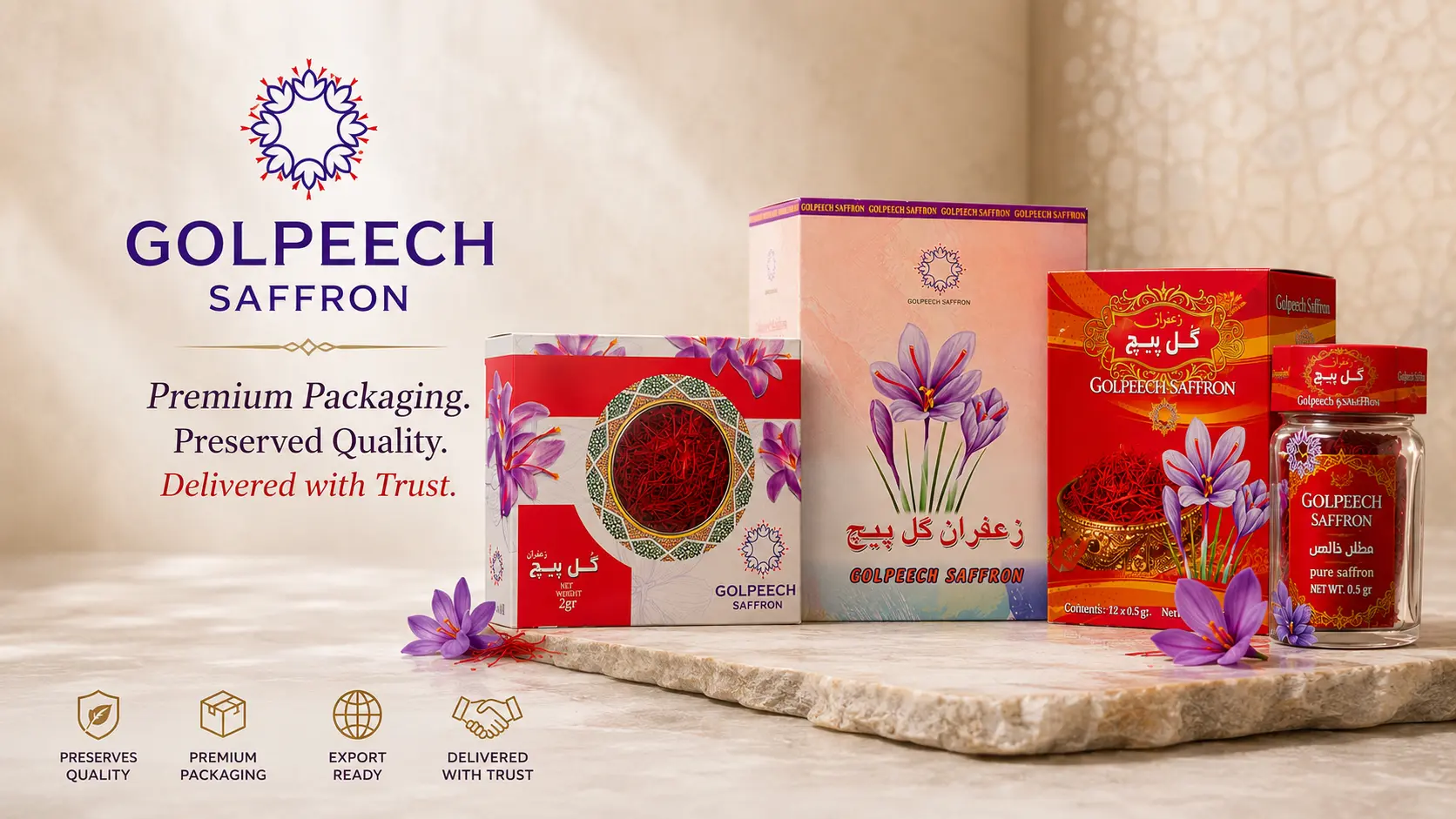
Saffron Packaging: A Complete Guide for International Buyers
When buying saffron for international markets, packaging is much more than a container. It is part of the product protection, supply chain, regulatory process, and commercial presentation.
Saffron is a valuable and delicate spice whose quality can be affected by light, moisture, oxygen, heat, contamination, and physical handling. Even high-quality saffron can lose some of its commercial value if it is packaged or stored improperly.
For importers, wholesalers, distributors, food manufacturers, and private label brands, choosing the right saffron packaging therefore requires more than selecting an attractive container.
The packaging must protect the saffron, suit the intended market, support transportation and storage, and meet the buyer’s commercial and regulatory requirements.
This guide explains the main types of saffron packaging, packaging materials, bulk and retail formats, export considerations, private label options, and how international buyers can select the right packaging solution.
Why Saffron Packaging Matters
The primary purpose of saffron packaging is to protect the product from conditions that can reduce its quality during storage, transportation, and distribution.
Good packaging helps protect saffron from:
Light
Moisture
Oxygen
Heat
Physical damage
Foreign materials
Unwanted odors
It also helps preserve the product’s:
Aroma
Coloring performance
Flavor
Physical appearance
Cleanliness
Overall stability
For international shipments, packaging becomes even more important because saffron may spend weeks moving between suppliers, ports, warehouses, distributors, and retailers.
The right packaging should therefore be considered part of the saffron supply strategy, not simply a presentation decision.
For buyers who want to understand the broader factors that determine saffron quality, see our Saffron Quality Guide.
What Should Saffron Packaging Protect Against?
Saffron packaging should create an appropriate barrier between the product and its surrounding environment.
Protection from Light
Light can negatively affect the natural compounds responsible for saffron’s characteristic color and aroma.
For this reason, packaging that limits direct light exposure is generally preferable, particularly for long-term storage and premium products.
Opaque containers, metal tins, or protective secondary packaging can help reduce unnecessary light exposure.
Protection from Moisture
Moisture is one of the most important considerations when packaging dried saffron.
Excess humidity can affect product stability and may contribute to deterioration during storage.
Packaging should therefore provide an appropriate moisture barrier, while storage conditions should also remain dry and controlled.
Protection from Oxygen
Oxygen exposure can contribute to oxidation and gradual changes in the product’s aroma and other quality characteristics.
For this reason, packaging should be appropriately sealed and designed to limit unnecessary air exchange.
Protection from Physical Damage
Saffron threads are delicate.
During international transportation, unsuitable packaging can result in:
A suitable primary package combined with appropriate secondary and transport packaging can significantly reduce these risks.
Protection from Contamination
Packaging should prevent contact with:
For food products, the packaging material must also be appropriate for its intended use.
Primary and Secondary Saffron Packaging
Understanding the difference between primary and secondary packaging is important for international buyers.
Primary Packaging
Primary packaging is the package that directly contains the saffron.
Examples include:
The primary package has the most direct role in protecting the saffron from environmental exposure.
Secondary Packaging
Secondary packaging surrounds the primary package.
It may provide:
Additional protection
Branding
Product information
Retail presentation
Easier transportation
Improved stacking
For premium retail saffron, secondary packaging can combine product protection with a stronger visual presentation.
Transport Packaging
For larger international shipments, an additional transport layer may be required.
This can include:
Inner cartons
Outer cartons
Protective inserts
Shipping cases
Palletized loads
The objective is to protect individual packages while making the shipment easier to handle and transport.
Common Saffron Packaging Materials
The best packaging material depends on the quantity, target market, transportation conditions, product positioning, and required shelf presentation.
Glass Saffron Packaging
Glass is frequently used for premium saffron products.
Advantages include:
Strong moisture barrier
Chemically stable material
Premium appearance
Good product presentation
Reusable or recyclable characteristics depending on the system
Its main disadvantages are weight and fragility.
For international transportation, glass packaging may therefore require additional protective secondary packaging.
Metal Saffron Tins
Metal tins are another popular option, particularly for premium and export-oriented products.
They can provide:
The material and internal coating should be suitable for food contact and the intended product.
Food-Grade Plastic Containers
Plastic containers are commonly used where low weight, durability, and cost efficiency are important.
Advantages can include:
However, plastic is not one single packaging category. Different materials and structures offer different levels of protection against moisture and oxygen.
Flexible and Laminated Pouches
Flexible packaging can be particularly useful for retail and private label applications.
Depending on the material structure, multilayer pouches can provide useful barriers while offering:
The important consideration is not simply whether a package is a pouch, but whether its material structure provides the required protection for the intended product and supply chain.
How to Choose the Right Saffron Packaging
There is no universal best saffron package.
The right solution depends on several factors.
Product Form
Packaging requirements may differ for:
Whole saffron filaments
Cut filaments
Powder
The current ISO 3632-1:2025 specification applies to saffron in filament, cut-filament, and powder forms. (ISO)
Quantity
A 0.5 g retail package has completely different requirements from a 1 kg bulk package.
Target Market
Packaging designed for:
may have very different priorities.
Transportation
The longer and more complex the supply chain, the more important physical protection and barrier performance become.
Storage Conditions
Buyers should consider the expected climate and storage conditions in the destination market.
Branding Requirements
Private label brands may require customized:
Packaging shapes
Colors
Labels
Printing
Barcodes
Secondary boxes
Regulatory Requirements
Packaging and labeling must also be compatible with the requirements of the destination market.
Saffron Packaging by Market and Application
Different commercial buyers generally have different packaging priorities.
Retail Saffron Packaging
Retail packaging prioritizes:
Shelf appeal
Consumer convenience
Product protection
Clear labeling
Brand identity
Appropriate pack size
Common retail quantities can include small consumer formats such as 0.25 g, 0.5 g, 1 g, 2 g, or 5 g.
The exact size should be selected according to the target market and sales strategy.
Food Service Packaging
Restaurants, hotels, catering companies, and professional kitchens generally need larger and more practical formats.
The priorities are usually:
Bulk Saffron Packaging
Importers, wholesalers, food manufacturers, and repackers may purchase saffron in larger quantities.
Bulk packaging generally prioritizes:
For businesses sourcing large quantities, packaging should be considered together with the overall purchase specification. Our Bulk Saffron Buying Guide explains how international buyers can define product, quality, packaging, documentation, and logistics requirements before purchasing.
Bulk Saffron Packaging vs. Retail Packaging
The two formats have different commercial objectives.
| Bulk Packaging | Retail Packaging |
|---|
| Larger quantities | Small consumer quantities |
| Focus on logistics | Focus on presentation |
| Efficient transportation | Shelf appeal |
| Simplified presentation | Consumer-facing information |
| Used by importers and manufacturers | Used by retailers and brands |
| Often repacked in destination markets | Ready for final consumers |
For some international buyers, importing saffron in bulk and completing the final retail packaging locally provides greater flexibility.
Private Label Saffron Packaging
Private label packaging allows an importer, distributor, or brand owner to sell saffron under its own brand.
A private label project may involve:
The packaging should be designed around both the brand strategy and the destination market’s requirements.
For a private label buyer, packaging is therefore not only a protection system but also an important part of brand positioning and market differentiation.
Saffron Packaging for Export
Export packaging must withstand more demanding supply-chain conditions than packaging intended for short-distance local distribution.
International buyers should consider:
Transit Protection
The package may experience:
Long transportation periods
Temperature fluctuations
Handling during loading and unloading
Warehouse storage
Customs inspection
Multiple distribution stages
Packaging should therefore be selected with the complete supply chain in mind.
Labeling
Depending on the destination market and product format, labels may need information such as:
Product name
Net weight
Country of origin
Batch or lot identification
Date information
Storage instructions
Importer information where required
Other legally required information
Requirements differ between markets, so buyers should verify the applicable rules before finalizing packaging artwork.
Transport Efficiency
Export packaging should also allow efficient:
Carton packing
Palletization
Warehousing
Inventory handling
Shipment preparation
The most attractive package is not necessarily the most efficient export package.
The best solution balances product protection, presentation, regulatory requirements, and logistics.
Packaging and Saffron Shelf Life
Packaging alone does not determine saffron shelf life.
Product quality is influenced by the interaction between:
Product condition + packaging + storage + transportation
Saffron should be properly dried before packaging and subsequently protected from unfavorable environmental conditions.
The International Organization for Standardization has a specific standard, ISO 21983:2019, covering harvesting, transportation, stigma separation, drying, and storage of saffron before processing and packaging. The standard was reviewed and confirmed in 2025. (ISO)
For buyers interested in the relationship between scientific quality evaluation and saffron specifications, see our ISO 3632 Saffron Standard Guide.
Sustainable Saffron Packaging
Sustainability is becoming increasingly relevant to international food brands and retailers.
Depending on the market and product positioning, buyers may consider:
Recyclable materials
Reduced packaging volume
Lightweight materials
Reduced plastic use
Recyclable paperboard
Reusable containers
However, sustainability should not compromise the primary function of the package.
For saffron, the first priority remains protecting the product against the conditions that can reduce its quality.
A sustainable package that provides inadequate protection may ultimately create greater product waste.
Common Saffron Packaging Mistakes
Several packaging decisions can create avoidable problems.
Using Packaging With Insufficient Moisture Protection
A package that allows excessive moisture exchange may not provide adequate protection during storage or transportation.
Excessive Light Exposure
Transparent packaging without adequate secondary protection may expose saffron to unnecessary light.
Poor Sealing
Even a high-quality packaging material cannot perform properly if the package is not adequately sealed.
Choosing Packaging Only for Appearance
Premium appearance is valuable, but it should never replace functional product protection.
Ignoring Transportation Conditions
A package that works well in a local retail environment may not be appropriate for a long international shipment.
Incomplete Destination-Market Labeling
Packaging artwork should be reviewed against the destination market’s applicable requirements before production.
Using the Same Package for Every Application
Retail, food service, bulk, and private label buyers have different needs. Packaging should be selected according to the intended use.
How Buyers Should Evaluate a Saffron Packaging Solution
Before approving a packaging format, international buyers should ask:
Product Protection
Does the package protect against moisture?
Does it limit unnecessary light exposure?
Is the sealing system appropriate?
Does it protect delicate saffron threads?
Commercial Requirements
Is the pack size suitable?
Does it fit the target market?
Is the packaging appropriate for the intended sales channel?
Does it support the desired brand positioning?
Export Requirements
Is it suitable for international transportation?
Can it be packed efficiently into cartons?
Does it support appropriate batch identification?
Can the required labeling be applied?
Private Label Requirements
Can the design be customized?
Can multiple languages be included?
Can barcodes and market-specific information be added?
Can different pack sizes be produced?
This approach helps buyers evaluate packaging as part of the overall sourcing strategy rather than as a separate design decision.
How Golpeech Supports Saffron Packaging Requirements
Golpeech works with international buyers requiring saffron for wholesale distribution, retail, food manufacturing, and private label applications.
Depending on the project, packaging solutions can be discussed according to:
The objective is to match the packaging solution to the buyer’s commercial needs while protecting the saffron throughout the supply chain.
For buyers evaluating the product itself, our Saffron Quality Guide provides additional information about the characteristics used to assess saffron quality.
For buyers comparing commercial grades, see our Saffron Grades Guide.
Conclusion
Saffron packaging is an essential part of maintaining product value from the supplier to the final customer.
The right packaging should protect saffron from light, moisture, oxygen, contamination, and physical damage, while also meeting the requirements of the target market and international supply chain.
For professional buyers, the best packaging solution is not necessarily the most expensive or visually impressive option.
It is the solution that provides the right balance of:
Product Protection + Packaging Performance + Market Requirements + Logistics + Brand Positioning
By selecting packaging according to the product, application, destination market, and supply chain, importers and distributors can reduce avoidable quality risks and deliver saffron to customers in better condition.
Frequently Asked Questions
What is the best packaging for saffron?
There is no single best packaging for every saffron product. Glass, metal tins, food-grade plastic, and laminated flexible packaging can all be appropriate depending on the product, quantity, target market, transportation conditions, and required level of protection.
Does saffron packaging affect quality?
Yes. Packaging can influence how effectively saffron is protected from light, moisture, oxygen, contamination, and physical damage during storage and transportation.
What is the best material for premium saffron packaging?
Glass and metal are commonly used for premium saffron because they can provide strong product protection and a high-quality presentation. The appropriate material depends on the specific supply chain and market.
How should saffron be packaged for export?
Export saffron should be packaged in a secure, food-appropriate format that protects the product during transportation and storage while allowing the required labeling and batch information to be applied.
What is the difference between bulk and retail saffron packaging?
Bulk packaging is designed primarily for larger quantities, transportation, storage, and further distribution. Retail packaging focuses more heavily on consumer convenience, presentation, branding, and market-specific labeling.
Can saffron be supplied in private label packaging?
Yes. Private label saffron can be packaged according to the buyer’s branding, pack-size, labeling, and destination-market requirements.
Does transparent packaging damage saffron?
Transparency itself does not automatically make a package unsuitable, but prolonged light exposure can affect saffron quality. Transparent packages should therefore be evaluated together with their light protection and storage conditions.
How should packaged saffron be stored?
Packaged saffron should generally be kept in a cool, dry environment away from direct sunlight, excessive humidity, heat, and strong odors.
What information should saffron packaging contain?
Depending on the destination market and product type, packaging may need information such as product name, net weight, origin, batch identification, date information, storage instructions, importer information, and other legally required labeling.
Is sustainable saffron packaging important?
Yes, particularly for international brands and retailers. However, sustainability should be balanced with the package’s ability to protect saffron throughout the supply chain.
What should international buyers consider before choosing saffron packaging?
Buyers should consider product form, quantity, target market, transportation, storage conditions, regulatory requirements, branding, and the required level of protection.