Iranian Saffron Suppliers: How to Find a Reliable Export Partner
Introduction
Choosing the right Iranian saffron supplier is one of the most important decisions an importer can make. While Iran is widely recognized as the world’s leading producer of saffron, not every supplier offers the same level of quality, reliability, or export capability. Differences in quality control, production capacity, packaging standards, documentation, and after-sales support can significantly affect the success of your business.
For wholesalers, distributors, food manufacturers, retailers, and private label brands, selecting a supplier is about much more than finding the lowest price. A dependable export partner should consistently deliver premium saffron, comply with international food safety requirements, maintain transparent quality assurance processes, and provide the flexibility needed for long-term business growth.
This guide is designed specifically for international buyers who are evaluating Iranian saffron suppliers. Rather than explaining saffron itself—which is covered in our other Knowledge Center articles—this article focuses on how to identify trustworthy suppliers, understand the different types of companies operating in the industry, recognize warning signs, and build reliable sourcing partnerships.
By the end of this guide, you will have a practical framework for selecting an Iranian saffron supplier that can support your business with consistent quality, professional export services, and dependable long-term cooperation.
Who Are Iranian Saffron Suppliers?
The Iranian saffron supply chain includes a wide range of businesses, each serving a different role between cultivation and international distribution. Understanding these supplier types helps buyers choose the right partner based on their purchasing volume, quality requirements, and business objectives.
Although all suppliers may offer Iranian saffron, they differ considerably in production capacity, quality management systems, export experience, packaging capabilities, and customer support. For international buyers, these differences often have a greater impact on business success than price alone.
The main categories of Iranian saffron suppliers include:
Saffron Farmers – Individual growers responsible for cultivating and harvesting saffron. They typically offer limited volumes and are rarely equipped to manage international export procedures or customized packaging.
Agricultural Cooperatives – Organizations that collect saffron from multiple farms, providing greater production capacity while supporting local growers. Product consistency may vary depending on sourcing and quality control practices.
Processors and Packers – Companies that clean, sort, test, grade, and package saffron before it enters domestic or international markets. Their quality assurance systems often play a critical role in maintaining product consistency.
Export Companies – Professional organizations specializing in international trade. In addition to supplying saffron, they manage documentation, quality inspections, logistics, regulatory compliance, and customer support for overseas buyers.
Private Label Manufacturers – Suppliers that produce saffron under the buyer’s own brand, offering customized packaging, labeling, and product specifications for retailers and distributors.
Each supplier type serves a different purpose, and the most suitable choice depends on your sourcing strategy. Buyers seeking stable quality, export compliance, customized packaging, and long-term supply generally benefit from working with experienced export companies that combine sourcing expertise with comprehensive international trade services.
Which Type of Iranian Saffron Supplier Is Best for International Buyers?
Not all Iranian saffron suppliers are suitable for every type of buyer. A sourcing strategy that works for a local trader may not meet the requirements of an international distributor, food manufacturer, or private label brand. The ideal supplier depends on factors such as order volume, quality expectations, regulatory requirements, branding needs, and long-term business goals.
Below is a closer look at the strengths and limitations of each supplier type from an international buyer’s perspective.
Buying Directly from Farmers
Purchasing directly from saffron farmers may appear attractive because it removes intermediaries from the supply chain. In some cases, buyers can negotiate competitive prices and establish direct relationships with producers.
However, individual farmers are primarily agricultural producers rather than export specialists. Most do not have the infrastructure required for international trade, such as laboratory testing, food safety management systems, export documentation, multilingual communication, or customized packaging.
Best suited for:
Local buyers
Small experimental purchases
Buyers with an established export network in Iran
Potential limitations:
Limited production capacity
Seasonal availability
Inconsistent quality between harvests
No integrated export services
Working with Agricultural Cooperatives
Agricultural cooperatives bring together the production of multiple growers, allowing buyers to access larger quantities than they typically could from a single farm.
While cooperatives can improve supply capacity, the quality of saffron may vary depending on how products are collected, sorted, and inspected. Buyers should understand the cooperative’s quality control procedures before placing significant orders.
Best suited for:
Buyers looking for larger volumes
Businesses comfortable managing part of the processing or packaging themselves
Potential limitations:
Variable batch consistency
Different cultivation practices among member farms
Limited branding and value-added services
Buying from Processing and Packaging Companies
Processing companies add value after harvest by cleaning, grading, laboratory testing, and packaging saffron. Many also invest in modern quality management systems to improve consistency between production batches.
For buyers who require professionally prepared products rather than raw agricultural goods, processors often provide a more reliable solution than purchasing directly from growers.
Export capabilities differ from one company to another
International logistics may still require third-party support
Partnering with Export Companies
For most international buyers, professional export companies offer the most comprehensive sourcing solution.
Rather than acting solely as traders, established exporters typically coordinate sourcing, quality control, laboratory verification, packaging, documentation, customs procedures, and international shipping. This integrated approach reduces operational complexity and helps buyers receive consistent products backed by professional support.
Many export companies also maintain long-term relationships with selected growers and processors, allowing them to combine reliable sourcing with standardized quality assurance.
Best suited for:
Importers
Wholesalers
Distributors
Retail chains
Food manufacturers
International trading companies
Key advantages:
Professional export documentation
Stable supply throughout the year
Consistent quality management
International logistics expertise
Dedicated customer support
Better communication throughout the purchasing process
Choosing a Private Label Manufacturer
Businesses building their own brand often require more than bulk saffron. They need a supplier capable of manufacturing products under their brand identity while meeting packaging, labeling, and regulatory requirements for their target markets.
Private label manufacturers typically provide customized packaging, multilingual labeling, barcode integration, and branding support, making them valuable partners for supermarkets, specialty retailers, and e-commerce businesses.
Best suited for:
Retail brands
Supermarket chains
Online sellers
Premium gift brands
Regional distributors
Key advantages:
Brand ownership
Customized packaging
Market-specific labeling
Greater product differentiation
Which Supplier Is the Right Choice?
There is no single supplier type that fits every business. Buyers should evaluate suppliers based on their commercial objectives rather than focusing solely on price.
As a general guideline:
Farmers are appropriate for buyers seeking direct agricultural sourcing and who can manage export operations independently.
Cooperatives offer broader production capacity but require careful evaluation of quality consistency.
Processors are suitable when standardized product preparation is the primary requirement.
Export companies provide the most complete solution for international buyers who value reliability, documentation, logistics support, and long-term cooperation.
Private label manufacturers are the preferred choice for companies developing their own consumer brands.
For most international importers, working with an experienced export company significantly simplifies the sourcing process while reducing operational risks. Instead of coordinating multiple suppliers and service providers, buyers benefit from a single partner capable of managing quality assurance, export compliance, packaging, and international delivery under one integrated system.
How to Evaluate an Iranian Saffron Supplier
Once you have identified the type of supplier that best fits your business, the next step is evaluating whether that supplier can consistently meet your commercial and quality expectations. A professional-looking website or an attractive price quotation is not enough. The most reliable suppliers demonstrate their capabilities through transparent processes, documented quality systems, and a proven export track record.
The following criteria can help international buyers assess potential Iranian saffron suppliers before making a purchasing decision.
Export Experience
Experience in international trade goes far beyond shipping products overseas. An established exporter understands the regulatory requirements, documentation, logistics, and communication standards expected by buyers in different markets.
Ask questions such as:
How many years has the company been exporting saffron?
Which countries do they currently serve?
Do they have experience with your target market?
Can they provide customer references or case studies?
Suppliers with a consistent export history are generally better equipped to anticipate challenges and ensure smooth international transactions.
Product Consistency
For wholesalers, manufacturers, and retailers, consistency is often more important than obtaining the lowest possible price. Receiving one excellent shipment followed by another with different color, aroma, or moisture levels can create serious problems for production schedules and customer satisfaction.
A reliable supplier should have procedures for:
Batch identification
Standardized grading
Controlled storage conditions
Consistent sourcing practices
Routine quality inspections
Consistency helps protect your brand reputation and reduces the risk of customer complaints.
Quality Assurance and Laboratory Testing
Quality claims should always be supported by objective testing rather than marketing statements.
Professional suppliers typically perform laboratory analyses to verify important quality parameters before products are released for export. Buyers should feel comfortable requesting recent laboratory reports or asking how quality is verified throughout production.
A transparent quality assurance process demonstrates that the supplier values measurable standards rather than subjective claims.
Food Safety Management
International buyers increasingly expect suppliers to operate under recognized food safety systems.
Evaluate whether the supplier follows documented procedures for:
Hygiene management
Product traceability
Risk assessment
Preventive quality controls
Corrective action procedures
Suppliers that invest in structured food safety management are generally better prepared to meet the expectations of importers, food manufacturers, and regulatory authorities.
Production Capacity
A supplier may be able to fulfill a small trial order but struggle with larger or recurring purchases.
Before entering a long-term partnership, clarify:
Annual production capacity
Average monthly supply capability
Ability to support seasonal demand
Scalability for future business growth
Selecting a supplier with sufficient capacity reduces the risk of supply interruptions as your business expands.
Packaging Capabilities
Packaging requirements vary significantly between wholesale importers, food manufacturers, retailers, and private label brands.
A capable supplier should be able to explain:
Available bulk packaging options
Retail packaging solutions
Private label services
Custom labeling capabilities
Packaging materials suitable for international transport
Professional packaging not only protects product quality but also supports regulatory compliance and brand presentation.
Documentation and Regulatory Compliance
International shipments require accurate documentation to avoid customs delays and unnecessary costs.
Ask whether the supplier can provide the documents commonly required for export, such as:
Commercial invoices
Packing lists
Certificates of origin
Health or food safety certificates, when applicable
Other documentation requested by the destination country
Suppliers familiar with export procedures can help minimize administrative challenges throughout the shipping process.
Communication and Responsiveness
Effective communication is often overlooked during supplier selection, yet it becomes essential once regular business begins.
A dependable supplier should:
Respond promptly to inquiries
Provide clear technical information
Communicate professionally in international business settings
Keep buyers informed about production and shipping schedules
Resolve issues efficiently when they arise
Strong communication builds trust and helps prevent costly misunderstandings.
Long-Term Partnership Potential
The best suppliers view customer relationships as long-term partnerships rather than one-time transactions.
Look for companies that are willing to:
Understand your business objectives
Support future growth plans
Offer consistent service over time
Adapt to changing market requirements
Invest in mutual business success
A supplier committed to long-term cooperation is more likely to prioritize quality, reliability, and continuous improvement.
A Practical Evaluation Framework
When comparing multiple Iranian saffron suppliers, avoid making your decision based on a single factor such as price. Instead, evaluate each company across several key areas:
Export experience
Quality management
Laboratory verification
Food safety systems
Production capacity
Packaging capabilities
Documentation support
Communication quality
Long-term reliability
A balanced assessment provides a clearer picture of a supplier’s overall capability and helps reduce sourcing risks. In many cases, choosing a dependable partner with proven systems delivers greater long-term value than selecting the lowest-priced quotation.
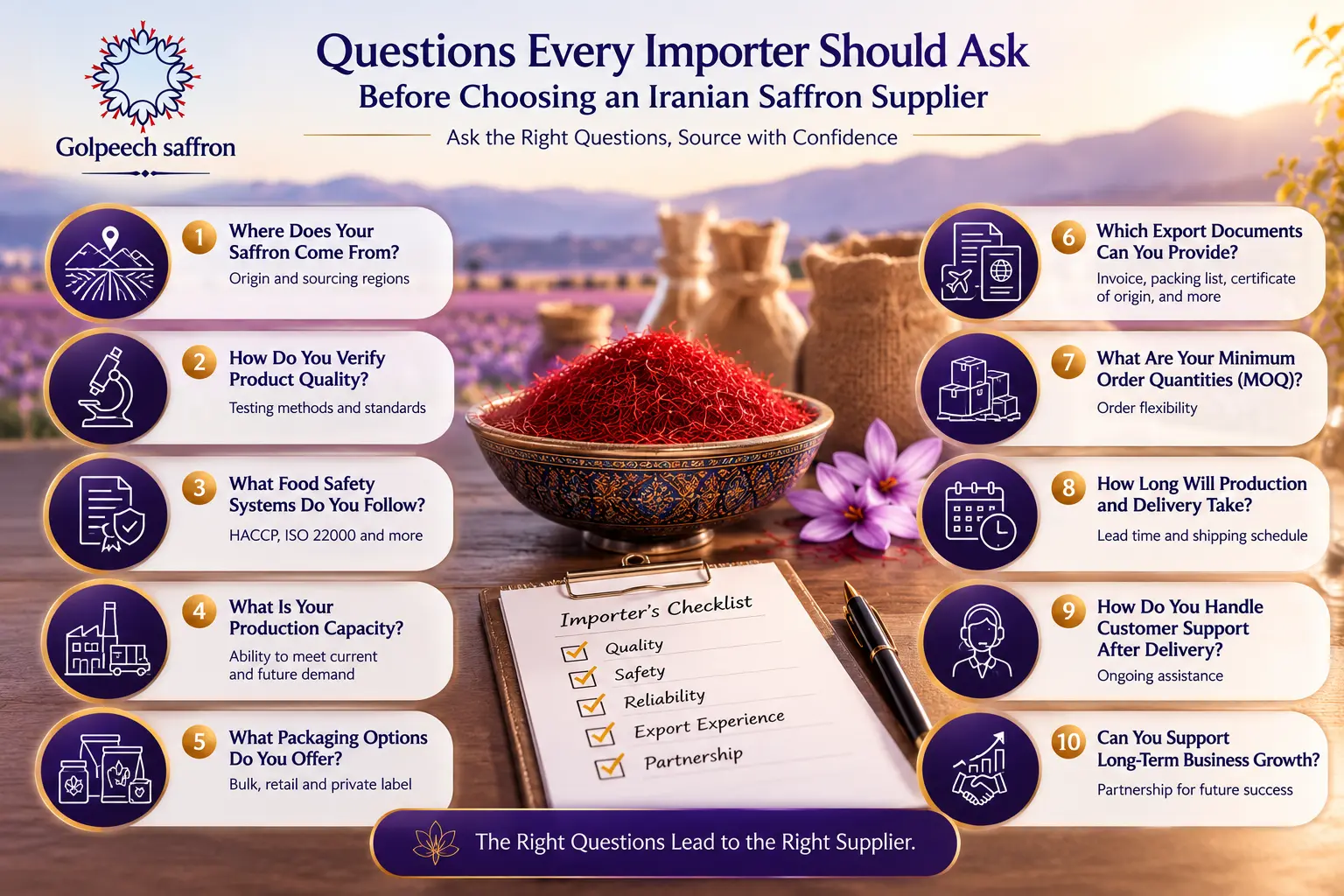
Questions Every Importer Should Ask Before Choosing an Iranian Saffron Supplier
Selecting a supplier should never be based solely on brochures, product catalogs, or online presentations. The initial conversations with a potential supplier provide an opportunity to evaluate not only their products but also their professionalism, transparency, and ability to support your business over the long term.
The questions below can help importers gather the information needed to compare suppliers objectively and reduce purchasing risks.
Where Does Your Saffron Come From?
The origin of saffron can influence product consistency, traceability, and supply reliability.
Instead of asking only whether the saffron is grown in Iran, buyers should understand how the supplier sources its products.
Useful follow-up questions include:
Do you work directly with growers?
Do you source from multiple regions?
How do you maintain consistent quality across different harvests?
Can you explain your sourcing process?
A supplier that can clearly describe its sourcing strategy is generally better positioned to provide consistent products throughout the year.
How Do You Verify Product Quality?
Quality should be supported by documented procedures rather than verbal assurances.
Ask the supplier:
How is saffron inspected before shipment?
Which quality parameters are tested?
Can recent laboratory reports be shared?
How are non-conforming batches handled?
Professional suppliers should be able to explain their quality control process confidently and provide supporting documentation when appropriate.
What Food Safety Systems Do You Follow?
Food safety is increasingly important for importers supplying supermarkets, food manufacturers, and international distributors.
Questions may include:
Which food safety management systems are implemented?
How is product traceability maintained?
What hygiene procedures are followed during processing and packaging?
How are customer complaints investigated and resolved?
Clear answers demonstrate that the supplier operates with structured quality management rather than relying solely on experience.
What Is Your Production Capacity?
Before planning long-term purchases, buyers should determine whether a supplier can reliably meet expected demand.
Consider asking:
What is your annual production or supply capacity?
Can you support recurring monthly orders?
How do you handle seasonal demand fluctuations?
Can production increase as our business grows?
Understanding capacity early helps avoid supply shortages during periods of increased demand.
What Packaging Options Do You Offer?
Different markets often require different packaging formats.
Ask whether the supplier provides:
Bulk packaging for industrial buyers
Retail-ready consumer packaging
Private label solutions
Customized labels
Packaging designed to meet destination market requirements
Packaging flexibility is particularly valuable for companies serving multiple customer segments.
Which Export Documents Can You Provide?
Incomplete documentation is one of the most common causes of shipping delays.
Importers should confirm that the supplier can prepare the documents required for international trade, including those requested by customs authorities or local regulators in the destination country.
An experienced exporter should clearly explain its documentation process and identify any buyer responsibilities before shipment.
What Are Your Minimum Order Quantities (MOQ)?
Minimum order requirements vary significantly among suppliers.
Ask questions such as:
What is the MOQ for bulk saffron?
Does the MOQ differ for private label orders?
Can trial orders be arranged?
Are mixed packaging options available within one shipment?
Flexible trial orders can be particularly helpful when establishing a new business relationship.
How Long Will Production and Delivery Take?
Reliable delivery schedules are essential for inventory planning.
Clarify:
Average production lead time
Typical order processing time
Estimated shipping timelines
Factors that may affect delivery schedules
Understanding realistic timelines helps buyers plan purchasing cycles more effectively.
How Do You Handle Customer Support After Delivery?
Supplier relationships continue after products arrive.
Ask how the company manages:
Quality concerns
Shipment issues
Product inquiries
Replacement procedures
Ongoing technical support
Strong after-sales support often reflects a supplier’s long-term commitment to customer satisfaction.
Can You Support Long-Term Business Growth?
A supplier may satisfy today’s requirements but struggle as your business expands.
Discuss topics such as:
Future production scalability
New packaging development
Product innovation
Long-term supply agreements
Strategic cooperation opportunities
Suppliers interested in building lasting partnerships are generally more willing to invest in continuous improvement and collaborative growth.
A Conversation That Reveals More Than Answers
The value of these questions lies not only in the information received but also in how the supplier responds.
Reliable suppliers typically provide clear, detailed, and transparent answers. They explain their processes, share relevant documentation when appropriate, acknowledge limitations honestly, and focus on building trust rather than making unrealistic promises.
In contrast, vague responses, reluctance to discuss quality procedures, or an unwillingness to provide basic business information should encourage buyers to conduct further due diligence before proceeding with an order.
By asking thoughtful questions early in the sourcing process, importers can make better-informed decisions and establish partnerships built on transparency, consistency, and mutual confidence.
Red Flags When Choosing an Iranian Saffron Supplier
Finding a supplier with an attractive quotation is relatively easy. Finding one that consistently delivers quality products, meets international standards, and supports long-term business growth is far more challenging.
Many sourcing problems can be avoided by recognizing warning signs during the supplier evaluation process. While a single issue does not necessarily indicate an unreliable company, multiple red flags should encourage buyers to conduct additional due diligence before committing to a purchase.
Prices That Seem Too Good to Be True
Price is naturally an important consideration, but it should never be the only factor in supplier selection.
Extremely low quotations may indicate compromises in product quality, inconsistent grading, inadequate quality control, or hidden costs that become apparent later in the purchasing process.
Rather than asking, “Who offers the cheapest saffron?”, experienced buyers ask, “Which supplier offers the best long-term value?”
A competitive price should always be evaluated alongside quality assurance, consistency, and service.
Lack of Transparency
Professional suppliers are generally open about their business operations, sourcing practices, and quality management systems.
Be cautious if a supplier is unwilling or unable to explain:
Where the saffron is sourced
How quality is verified
How products are processed
How traceability is maintained
Which export procedures are followed
Transparency builds confidence. A lack of transparency often creates unnecessary uncertainty.
No Evidence of Quality Control
Every supplier may claim to offer “premium quality” saffron. The difference lies in whether those claims are supported by documented procedures.
Reliable suppliers understand that quality should be demonstrated, not simply advertised.
Inconsistent Product Information
Product specifications should remain consistent across quotations, catalogs, technical documents, and customer communications.
If information about saffron grades, moisture levels, packaging weights, or product descriptions frequently changes, buyers should request clarification before proceeding.
Consistency in documentation often reflects consistency in operational processes.
Poor Communication
Communication during the quotation stage often reflects the quality of future cooperation.
Warning signs may include:
Slow or irregular responses
Incomplete answers
Difficulty understanding technical questions
Delayed quotations
Lack of follow-up after initial contact
International business depends on clear and timely communication. Suppliers that struggle at the beginning of a relationship may present greater challenges once orders are in progress.
Limited Export Knowledge
Exporting saffron requires more than producing a high-quality product.
If a supplier cannot clearly explain shipping procedures, documentation requirements, packaging standards, or international logistics, buyers may encounter avoidable delays and administrative complications.
Experienced exporters typically understand the complete supply chain—from production to customs clearance and international delivery.
Unclear Production Capacity
Some suppliers readily accept large orders without confirming whether they can realistically fulfill them.
Before placing significant purchases, buyers should understand:
Annual production capability
Available inventory
Seasonal limitations
Lead times
Capacity for repeat orders
Reliable suppliers set realistic expectations instead of making promises they cannot consistently meet.
No Customization or Packaging Flexibility
Different markets often require different packaging formats, languages, labeling requirements, or branding solutions.
A supplier unwilling to discuss customized packaging or private label options may not be the best fit for businesses planning long-term market expansion.
Operational flexibility is often a sign of a mature export organization.
Reluctance to Provide Business Information
Professional companies understand that international buyers must evaluate potential partners before making purchasing decisions.
Basic business information—such as company history, export experience, production capabilities, or quality management practices—should be shared openly when appropriate.
Suppliers who avoid reasonable business questions may require additional verification before further negotiations.
Focusing Only on Price Instead of Partnership
One of the most overlooked warning signs is a supplier who competes only on price.
Successful international sourcing depends on many factors, including:
Consistent quality
Reliable delivery
Professional communication
Technical support
Supply continuity
Long-term cooperation
Suppliers that emphasize partnership, continuous improvement, and customer success often create more sustainable business relationships than those focused solely on offering the lowest quotation.
Trust Through Verification
Building trust is an essential part of international trade—but trust should always be supported by verification.
Rather than relying on marketing claims or first impressions, buyers should evaluate suppliers using objective criteria, request supporting documentation when appropriate, and begin with a trial order whenever possible.
A careful evaluation process may require additional time at the beginning of a business relationship, but it can significantly reduce operational risks, protect product quality, and establish the foundation for a successful long-term partnership.
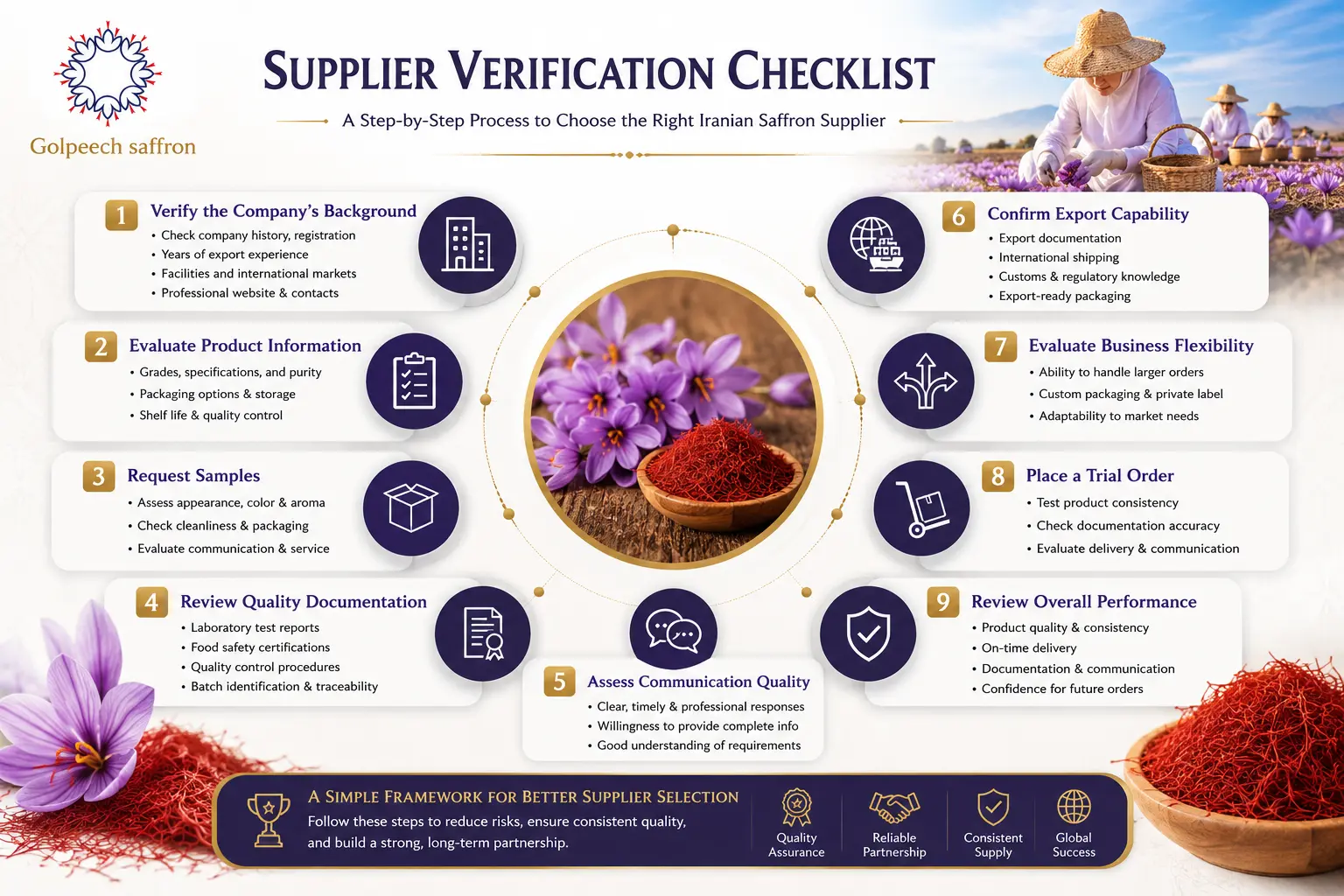
Supplier Verification Checklist
Choosing an Iranian saffron supplier should be a structured decision rather than a matter of intuition. By following a clear verification process, buyers can reduce sourcing risks, compare suppliers objectively, and build stronger long-term partnerships.
The following checklist outlines a practical due diligence process that can be applied before placing a commercial order.
Step 1: Verify the Company’s Background
Begin by confirming that the supplier is a legitimate and established business.
Review information such as:
Company history
Years of export experience
Business registration
Manufacturing or processing facilities
International markets served
Professional website and business contact details
An established company with a consistent business history generally provides greater confidence than a newly formed supplier with limited market presence.
Step 2: Evaluate Product Information
A professional supplier should provide clear and consistent product specifications.
Review whether the supplier can clearly explain:
Available saffron grades
Product specifications
Packaging options
Storage recommendations
Shelf life
Quality control procedures
Technical information should remain consistent across quotations, catalogs, and product documentation.
Step 3: Request Samples
Whenever possible, evaluate the product before committing to a large purchase.
A sample order allows buyers to assess:
Appearance
Color uniformity
Aroma
Cleanliness
Packaging quality
Overall presentation
It also provides an opportunity to evaluate how professionally the supplier handles small orders and customer communication.
Step 4: Review Quality Documentation
Reliable suppliers should have documented quality management procedures.
Depending on your business requirements, request relevant documentation such as:
Laboratory test reports
Food safety certifications
Product specifications
Quality control procedures
Batch identification methods
The goal is not simply to collect certificates, but to understand how quality is managed throughout the production process.
Step 5: Assess Communication Quality
The supplier’s responsiveness during the evaluation stage often reflects how future cooperation will be managed.
Consider whether the supplier:
Answers questions clearly
Responds within a reasonable timeframe
Provides complete information
Understands international business requirements
Communicates professionally in English or your preferred language
Effective communication reduces misunderstandings and supports smoother business operations.
Step 6: Confirm Export Capability
Not every supplier has the infrastructure required for international trade.
Before placing an order, confirm that the supplier can manage:
Export documentation
International shipping arrangements
Customs requirements
Packaging suitable for export
Coordination with freight forwarders when necessary
A supplier with established export procedures can simplify the purchasing process considerably.
Step 7: Evaluate Business Flexibility
As your business grows, your sourcing requirements may evolve.
Discuss whether the supplier can support:
Larger future orders
Customized packaging
Private label production
New product development
Market-specific requirements
Suppliers that demonstrate operational flexibility are often better long-term partners.
Step 8: Place a Trial Order
Even after completing the evaluation process, it is advisable to begin with a trial shipment before committing to a large contract.
A trial order allows buyers to evaluate the supplier’s performance under real commercial conditions, including:
Product consistency
Packaging quality
Documentation accuracy
Delivery performance
Communication throughout the order process
This practical experience often provides more valuable insights than any marketing material or sales presentation.
Step 9: Review Overall Performance
After the first shipment has been completed, conduct a structured performance review.
Consider questions such as:
Did the product meet the agreed specifications?
Was the shipment delivered on schedule?
Were all export documents accurate?
Was communication clear and timely?
Would you feel confident placing a larger order?
Documenting these observations creates a reliable benchmark for future purchasing decisions.
A Simple Framework for Better Supplier Selection
Supplier verification is not about eliminating every possible risk—it is about making informed decisions based on objective evidence rather than assumptions.
By systematically reviewing a supplier’s business background, product quality, communication, export capabilities, and operational performance, buyers can identify partners that are capable of supporting sustainable, long-term business growth.
A well-structured verification process may require additional effort before the first purchase, but it often leads to stronger supplier relationships, more consistent product quality, and greater confidence in every future shipment.
Supplier Capabilities That Matter
When comparing Iranian saffron suppliers, many buyers naturally focus on product quality and pricing. While these factors are essential, they represent only part of the equation. The capabilities that surround the product—such as packaging, documentation, logistics, and customer support—often determine whether a supplier can become a reliable long-term business partner.
The following capabilities distinguish professional export suppliers from companies that simply sell saffron.
Private Label Manufacturing
Many distributors and retailers prefer to market saffron under their own brand rather than selling products with the supplier’s identity.
A capable supplier should be able to support private label projects by offering:
Custom branding
Product labeling
Market-specific packaging
Barcode integration
Multi-language packaging
Flexible packaging formats
Private label services allow buyers to strengthen their brand while benefiting from the supplier’s manufacturing expertise.
Customized Packaging Solutions
Different markets have different packaging expectations. A wholesale importer may require large-volume containers for food production, while a retail chain may need consumer-ready packages designed for supermarket shelves.
Professional suppliers should offer packaging solutions that align with the buyer’s business model rather than providing a one-size-fits-all approach.
Packaging flexibility may include:
Bulk packaging
Retail packaging
Gift packaging
Food-service packaging
Customized weight options
Market-specific labeling
The ability to adapt packaging to customer requirements adds significant value, particularly for businesses operating in multiple markets.
Consistent Inventory Management
Reliable supply depends not only on production capacity but also on effective inventory management.
Professional suppliers typically implement systems that help maintain product availability throughout the year while preserving quality during storage.
Buyers may wish to discuss topics such as:
Inventory planning
Seasonal stock management
Batch rotation
Storage conditions
Supply continuity
Strong inventory management helps reduce the risk of unexpected shortages and supports predictable purchasing schedules.
Batch Traceability
Traceability is becoming increasingly important in international food supply chains.
A well-organized supplier should be able to identify and track individual production batches throughout sourcing, processing, packaging, and distribution.
Effective traceability supports:
Quality investigations
Product recalls, if ever required
Customer confidence
Regulatory compliance
Continuous quality improvement
The ability to trace products throughout the supply chain demonstrates operational maturity and strong quality management practices.
Export Documentation Support
International shipments require accurate documentation to move efficiently through customs and regulatory procedures.
Experienced exporters understand the documentation required for international trade and can prepare the necessary paperwork accurately and on time.
This support helps buyers reduce administrative complexity and minimizes the likelihood of shipment delays caused by documentation errors.
Logistics Coordination
Shipping saffron internationally involves more than arranging transportation.
Professional suppliers often coordinate with logistics partners to ensure products are packed appropriately, shipped according to customer requirements, and monitored throughout the delivery process.
While buyers may choose their own freight forwarders, suppliers with international logistics experience can often simplify coordination and improve overall efficiency.
Responsive Customer Support
Business relationships do not end when a shipment leaves the warehouse.
Consistent communication helps build trust and creates a stronger foundation for long-term cooperation.
Continuous Improvement
Leading suppliers continually refine their operations instead of relying solely on past experience.
Continuous improvement may include investments in:
Quality management systems
Production efficiency
Packaging technology
Staff training
Customer service
Process optimization
Suppliers committed to ongoing improvement are generally better prepared to adapt to changing customer expectations and international market requirements.
Looking Beyond the Product
Premium saffron is only one component of a successful sourcing partnership.
For international buyers, the supplier’s operational capabilities can be just as important as the product itself. Reliable packaging, effective communication, organized documentation, flexible manufacturing, and dependable logistics all contribute to smoother transactions and stronger business relationships.
When evaluating Iranian saffron suppliers, consider the complete range of services they provide—not just the saffron they sell. A supplier with comprehensive capabilities is better positioned to support your business as it grows, helping transform individual purchases into a stable, long-term partnership.
Building Long-Term Partnerships with Iranian Saffron Suppliers
For most importers, choosing a supplier is not a one-time transaction—it’s the beginning of a business relationship. A reliable long-term partnership can lead to more consistent quality, smoother operations, and greater flexibility as your business grows.
Rather than changing suppliers frequently, many successful buyers work with trusted partners who understand their product specifications, packaging requirements, and delivery schedules.
To build a productive partnership, consider the following best practices:
Communicate clear expectations from the beginning, including quality standards, packaging requirements, and delivery timelines.
Start with a trial order before committing to larger volumes. This allows both parties to establish confidence and fine-tune the process.
Share purchasing forecasts whenever possible so the supplier can plan production and inventory more effectively.
Provide constructive feedback after each shipment. Open communication helps resolve issues quickly and improves future orders.
Review performance regularly, considering factors such as product consistency, delivery reliability, and responsiveness—not just price.
Strong supplier relationships are built on transparency, reliability, and mutual trust. Over time, this approach often reduces sourcing risks, improves operational efficiency, and creates a more stable supply chain for both buyer and supplier.
Why Professional Export Companies Are Often the Preferred Choice
International buyers can source saffron from several types of suppliers, but many choose to work with professional export companies because they provide a complete sourcing solution.
In addition to supplying saffron, experienced exporters typically manage quality control, packaging, export documentation, logistics coordination, and customer support through a single point of contact. This simplifies the purchasing process and reduces the need to coordinate multiple service providers.
For businesses seeking consistent quality, reliable communication, and long-term cooperation, an experienced export company can offer significant operational advantages over purchasing from multiple independent sources.
Why Choose Golpeech as Your Iranian Saffron Supplier?
Choosing the right supplier is about finding a partner that can consistently meet your quality expectations, support your business objectives, and simplify international sourcing. At Golpeech, we have built our business around these principles.
With more than five decades of family experience in the saffron industry and an international export presence since 1993, Golpeech combines traditional expertise with modern quality management and export services. Our goal is to help importers, distributors, food manufacturers, and private label brands source premium Iranian saffron with confidence.
We support our customers through:
Consistent sourcing from carefully selected production regions
Strict quality control and laboratory verification procedures
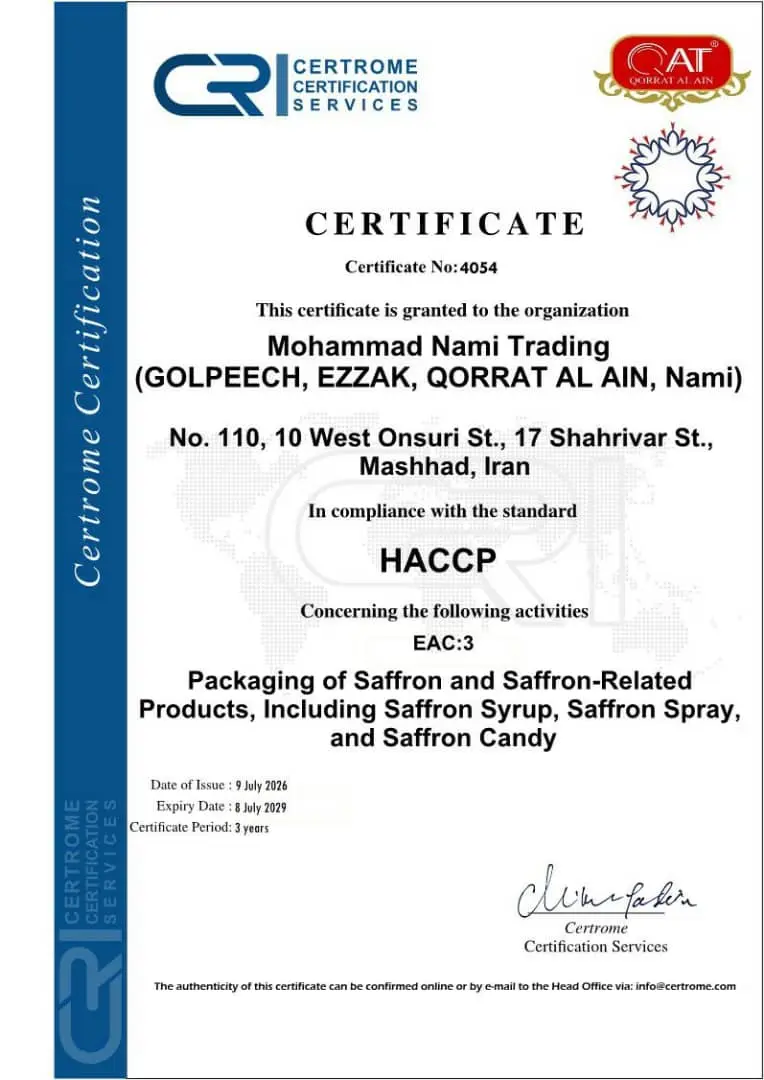
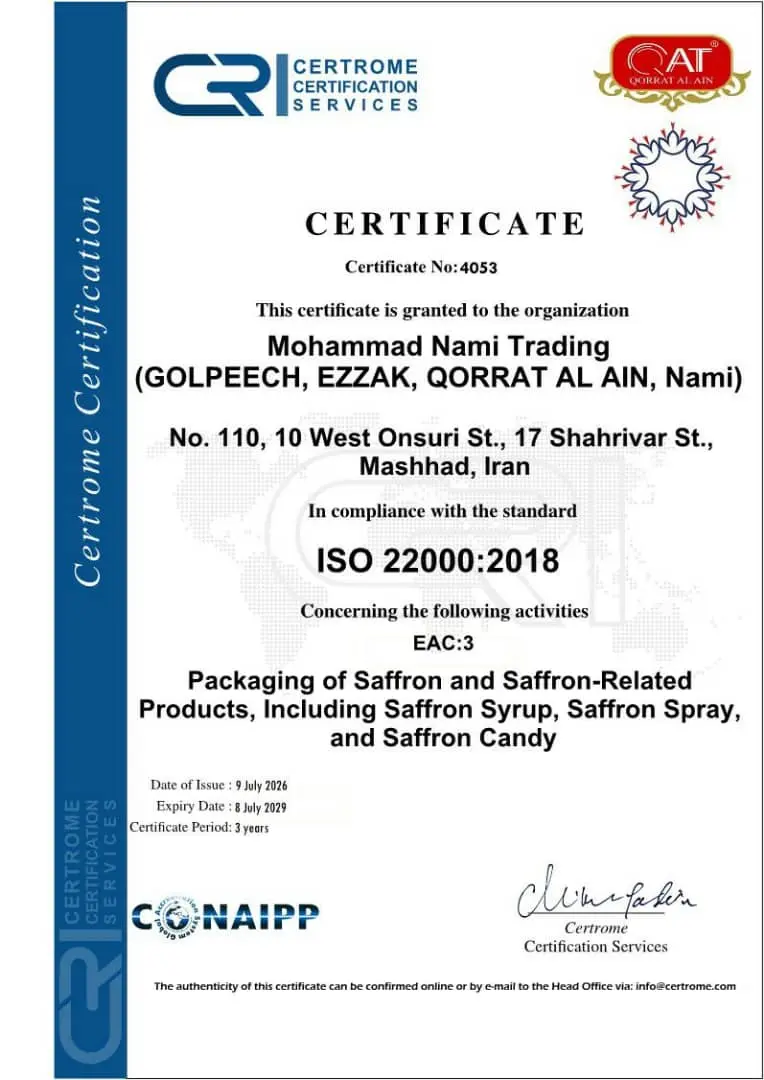
Food safety management based on HACCP and ISO 22000 principles
Bulk, retail, and private label packaging solutions
Professional export documentation and logistics support
Responsive communication throughout the sourcing process
Long-term partnerships focused on reliability and mutual growth
Rather than offering a one-size-fits-all solution, we work closely with each customer to understand their market requirements and recommend products and packaging that align with their business goals.
Whether you are launching a new saffron brand, expanding your wholesale distribution network, or looking for a dependable long-term supplier, Golpeech is committed to delivering consistent quality and professional service from inquiry to final delivery.
Conclusion
Selecting an Iranian saffron supplier is a strategic business decision that extends far beyond comparing prices. A dependable supplier should provide consistent product quality, transparent quality assurance, professional export support, and the flexibility to grow alongside your business.
By understanding the different types of suppliers, asking the right questions, recognizing potential warning signs, and following a structured evaluation process, international buyers can make informed sourcing decisions and reduce long-term risks.
If you are looking for a trusted export partner for premium Iranian saffron, Golpeech is ready to support your business with reliable products, customized solutions, and years of international export experience.
Frequently Asked Questions (FAQ)
How do I choose a reliable Iranian saffron supplier?
Look beyond price. Evaluate the supplier’s export experience, quality control procedures, food safety systems, production capacity, packaging capabilities, and ability to provide consistent support for international buyers.
Should I buy directly from farmers or export companies?
It depends on your business needs. While buying directly from farmers may work for experienced buyers with local sourcing networks, most international importers benefit from working with professional export companies that manage quality control, documentation, packaging, and logistics.
Can Iranian saffron suppliers provide private label services?
Yes. Many professional suppliers offer private label solutions, including customized packaging, branding, multilingual labels, and packaging formats designed for different retail markets.
What documents should an Iranian saffron exporter provide?
Depending on the destination country, exporters typically provide documents such as a commercial invoice, packing list, certificate of origin, and other documents required for customs clearance and food imports.
Is it recommended to request product samples before placing a bulk order?
Yes. A sample order allows buyers to evaluate product quality, packaging, communication, and overall service before making a larger purchasing commitment.
What certifications should I look for when selecting a supplier?
Look for suppliers that implement recognized food safety management systems, such as HACCP and ISO 22000, along with documented quality control and laboratory testing procedures.
What is the typical minimum order quantity (MOQ)?
Minimum order quantities vary depending on the supplier, packaging format, and whether the order is for bulk or private label products. Most suppliers can explain their MOQ during the quotation process.
Why is long-term cooperation with one supplier beneficial?
Working with a trusted supplier helps improve product consistency, simplifies communication, supports better production planning, and creates a more stable and efficient supply chain over time.
Ready to Source Premium Iranian Saffron?
Finding the right supplier is the first step toward building a successful saffron business. If you’re looking for a reliable export partner with extensive industry experience, consistent quality standards, and flexible packaging solutions, Golpeech is here to help.
Our team is ready to discuss your sourcing requirements, answer your questions, and recommend the most suitable saffron products for your market.
Contact us today to:
Request a quotation
Order product samples
Discuss private label opportunities
Explore bulk supply options
Speak with our export team
We look forward to becoming your trusted Iranian saffron supplier.
In today’s world, where global supply chains face constant disruptions, the idea of being self-sufficient Saffron is more valuable than ever. Saffron, one of the most precious and delicate spices in existence, demands exceptional care at every stage—from soil to shelf.
In the saffron industry, quality is not a mere claim; it is a precise figure on an analysis sheet. While the 50-year legacy of the Nami family forms the foundation of trust for the Golpeech brand, the group’s specialized laboratory serves as the vigilant guardian of this quality.
After the delicate dawn harvest, saffron’s transformation truly begins. In this stage—known as processing—the focus shifts from field to facility. The moment the crocus flowers arrive, the race against time resumes, and the stakes are high.